The OA: Review
Netflix, available now Brit Marling, along with frequent co collaborators Mike Cahill and Zal Batmanglij has been cornering the market in character-driven, idea-heavy, not quite any genre fiction for a […]



Netflix, available now Brit Marling, along with frequent co collaborators Mike Cahill and Zal Batmanglij has been cornering the market in character-driven, idea-heavy, not quite any genre fiction for a […]
 Netflix, available now
Brit Marling, along with frequent co collaborators Mike Cahill and Zal Batmanglij has been cornering the market in character-driven, idea-heavy, not quite any genre fiction for a while now. Her collaborations with Cahill, Another Earth and I Origins, use bereavement and science fiction as their magnetic poles, creating remarkable dramatic tension for the stories trapped between them. Her work with Batmanglij, The East and Sound of My Voice, explores ways to subvert the audiences’ perceptions of Marling herself. Looked at one way, The East is a thriller. Looked at another it’s the story of a woman breaking free of the expectations of her gender and class. Sound of My Voice looked at one way is an extraordinarily effective, chilling time travel story. From another angle it’s an exploration of the dynamics of a cult, and the power inherent in that cult being led by a physically unassuming, even fragile, woman.
All four movies are absolutely worth your time. They’re wildly different, often confounding and never less than interesting. Now, Marling and Batmanglij have stepped across to TV. Their first show, The OA, arrived on Netflix just before Christmas. It’s exactly as confounding, and fascinating, as their previous work together.
The OA opens with Prairie Johnson, played by Marling, appearing out of nowhere. We see her through cellphone footage, suddenly present on a busy road bridge. She runs across the bridge, tattered dress flowing around her and we, and the viewer, watch horrified as she climbs the railing and jumps.
 When Prairie wakes up in hospital, we discover two things. She disappeared seven years ago and when she disappeared, she was blind. Now, she can see.
As Prairie readjusts to her new life in her old home town of Crestwood, it becomes clear that something very strange is going on. Her parents do their best to help but she seems curiously driven, first to find someone called Homer and second to escape. As she begins to make her plans, Prairie draws five people to her; local bully and drug dealer Steve; his friend Jesse; Buck, a young trans boy; French, an overachieving honours student; and Betty Broderick Allen, one of Steve’s teachers. Every night, she meets with the five and tells them the story of her life. Her forgotten childhood in Russia, her brushes with death, her captivity and the love of her life, fellow prisoner Homer. Prairie, who wants to be known as The OA for reasons we discover, needs to find and save Homer. And to do that, she needs the Crestwood Five…
The OA is an extraordinary, and extraordinarily difficult to write about, piece of television. I know people who didn’t make it through the first episode, others who got through all eight and loved it and others still who view the series as collapsing absolutely in its final moments.
They’re all correct.
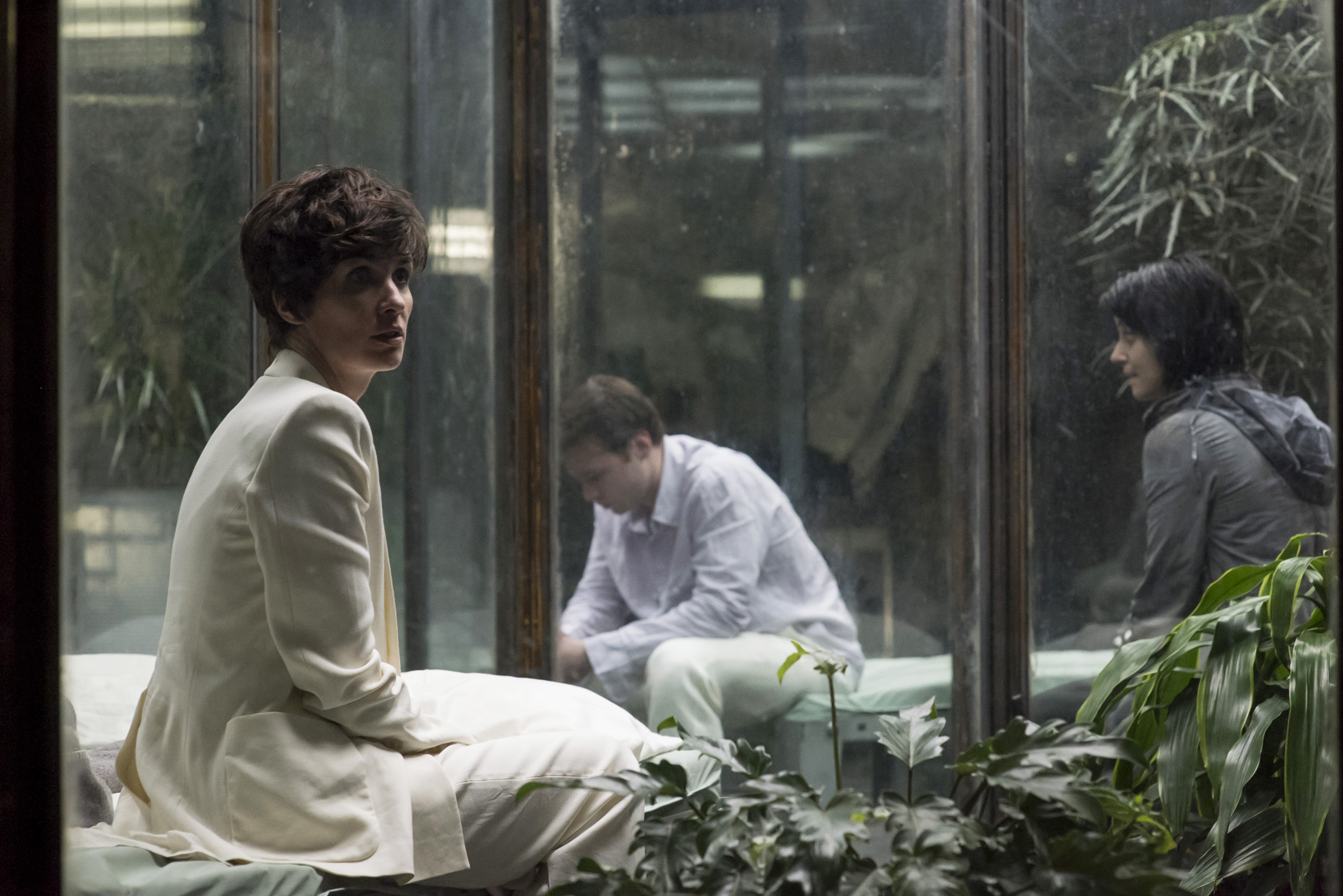 Marling and Batmanglij’s show combines elements of science fiction, horror, romance, thriller and interpretative dance (yes, really) to create something which if it isn’t unique is certainly very difficult to classify. As the show, and the OA’s story, expands it sweeps all these huge elements together in a manner that’s absolutely involving, absolutely realistic and at the same time utterly fantastic. It reminded me of the old joke about how David Mamet writes nothing like and at the same time exactly like people talk. The show presents every element, whether it’s the motion based technology of the Five Movements, the possible goddess Khatun, or Steve (a phenomenal Patrick Gibson) trying to better himself with the same straight-ahead, clear aesthetic. You buy it. Even the odd stuff. Especially the odd stuff. The show, and the OA, tell an amazing story and it’s all but impossible to not follow them down the rabbit hole.
There’s a lot to enjoy down there too. The show is built around an extraordinarily strong pair of ensemble casts, both of which are in turn anchored by Marling herself. Marling, whose work on Channel 4’s over-designed but underrated Babylon is also absolutely worth your time, is one of the most impressive leads of her generation. She’s able to combine a sense of incredible power barely contained with absolutely vulnerability. She’s an actress defined by absolute commitment to the role and fierce emotional honesty and this is one of the strongest performances of her career to date.
The rest of the cast are just as good. Patrick Gibson’s Steve is especially great and his transformation from directionless and furious pseudo jock into a strong, kind young man intent on making amends for his past is one of the show’s strongest elements. Brandon Perea’s French, Ian Alexander’s Buck and Phyllis Smith’s Barbara are also massively impressive, Smith in particular carrying a surprising amount of the show’s emotional weight.
 Prairie’s fellow prisoners are also strongly represented, with Emory Cohen’s Homer a particular standout. Cohen has a quiet authority that far exceeds his years and the chaste, constantly separated romance between Homer and Prairie feels entirely earned as a result. The show’s oddest sequence, equal parts dance routine, miracle and argument is the one point where the entire thing could collapse. Because of Marling and Cohen, it soars.
That space, between catastrophe and beauty, art and artifice is where Batmanglij and Marling’s work all sits but rarely more so than here. The OA asks a lot of its audience and never more than in the final episode. The entirety of the OA’s story is put in doubt, the Five Movements she’s been teaching the Crestwood Five are used in a manner that will throw some viewers straight out of the show and the ending is almost wilfully obtuse.
But it’s still worth it. In fact, the obtuse nature of the show is the exact reason why it’s worth it. The OA is, at its close, less a story and more a set of parts for you to assemble however you see fit. That sounds like it’s a criticism but it’s really not. This is a show brave enough to stick to its convictions and accept that may be too much for some viewers. That almost never happens and seeing it here, seeing Marling and Batmanglij basically given free rein, is as unique as it is inspiring.
Verdict: The strangest piece of TV drama you’ll see this year, but also, perhaps, the best. 9/10
Alasdair Stuart
 Doctor Who News Star Trek News
 Sci-Fi Bulletin: Exploring the Universes of SF, Fantasy, Horror and Spy-fi!