 Spoilers
Sam, Bucky and Zemo head to Latvia – closely followed by Captain America and Battlestar…
Not one, not two, but three sets of antagonists this week. Indeed, we have several birds coming home to roost and in what is the most satisfying episode yet it becomes clearer what the show is concerned with.
I have been nervous that much of the social commentary was little more than set dressing. Let’s highlight the threads the show has put on the screen. The first of these is Sam’s status as a person of colour. Sam appears unaware of how the world sees him; perhaps he believes if he just works hard enough he can be accepted or that his colour will not inform others’ judgements of him. However, the show has shown that is not the case. Yet Sam has never responded as if he recognises this. It has bothered me, but I wanted to see where they would take it.
The second thread is about the haves and the have nots, whether people should have the right to live in whichever community they find, or whether somebody else gets to choose for them. In US terms this is class, although those of us coming from nations with historic aristocracies would perhaps not quite see it in the same way because poverty does not equal working-class.
The third thread is about what makes Captain America. There have been lots of callbacks to Steve Rogers, as well as, underlying everything, a story exploring whether Captain America is the man, the shield, or the symbol. It has been interested in exploring whether Captain America is about achievement, who does the deeds, or the journey itself.
This fourth episode abandons the discussion around Sam as a person of colour and focuses on the second and third threads. Framed in terms of the consequences of the blip this is a unique set of circumstances the MCU is exploring. Further, in a curious discussion with a teacher when Sam uses the word refugee, the teacher is at pains to suggest he is no such thing – that he is displaced. In my mind this entirely misunderstands the nature of being a refugee, particularly an economic refugee, because not everybody who flees, flees war.
Yet there are sensitivities around being a refugee which I imagine Marvel consider sidestepped by re-branding people in need as displaced. Either way there is some interesting work being done here about who gets to belong and who gets access to the basic necessities required for a normal life. Although the show does not run these arguments to ground, the fact they are here at all and informing the motivations of several of the characters on different sides is impressive. Another element I found compelling was the idea that the Global Repatriation Council is not what it appears to be. We have nothing more than hints right now, yet there is something going on here and the complaints of the Flag Smashers are shown to have solid footing.
Will they come back to Sam as a PoC? I do not know, but honestly in some ways I would rather they did not than continue to use his colour as an excuse for drama without interrogating it. Besides which, the central question for Sam is what kind of man he is and whether he will be allowed to be that man. It is entirely individual in nature, shorn of political comment but still compelling.
Now, back to our bad guys. We have the Flag Smashers and they continue to be conflicted. I am not convinced by their turn to terrorism – it does not come with any idea of why they believe violence is necessary. Terror is used to destabilise and frighten populations; the Flag Smashers have populations on their side so why terrorise them? It makes no sense. Yet there are really interesting discussions among the Flag Smashers and others around whether violence is necessary when trying to achieve political ends if you have no political voice.
Then we have Zemo, who is laser focused on ending the threat of yet more superpowered people in the world. There is an interesting take on supremacy and the kind of mindset that always grasps for more power. I am not sure grasping for power is purely about identity and superiority, it can be as much about insecurity and fear as it is anything.
Nevertheless, it is an interesting argument and worth talking through; I am glad it is on the screen. The blip is the overturning of the status quo; it is the only time in the superhero franchise that the status quo has been overturned, the only time the villain actually wins (thanks to the lawful evil Thanos and the chaotic neutral Tony Stark). The Flag Smashers are fighting for that change to be permanent, for the world to be a different way.
Zemo does not care, indeed he takes the state of the world as he finds it; moving through like a tourist, insulated through money, agency and his loss. What he does care about is that the world is not at the mercy of the types of people who can overturn it without any care for those around them. Which is curiously in line with every action of every Avenger ever. The big difference is that he is prepared to personally kill whereas, led by Steve Rogers, the Avengers never were. Is that enough to make one a villain and another hero? Sokovia would suggest not.
There is a pleasing amount of greyness in the show, not grim nor pragmatic but the reality that sometimes there are no good answers.
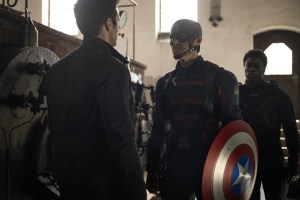
Then we come to our third antagonist, John Walker. Two steps behind, frustrated and feeling inadequate, desperate to be the leader he thinks he should be, Captain America is spiralling. This episode sees the end of that spiral. What the show does well is to hold John Walker not as an evil man but as someone out of their depth and with no moral framework from which to act. Instead, he has his goals and little more, he has trauma but no context, and he has no sense of how to control or understand the power he has been given. When the one handbrake or moral compass he relies upon is removed we see the single most striking shot of this show so far, a shot that will stay with me and I believe deserves to be iconic.
Brilliantly contrasted is Sam who advocates for peace, for choosing ways other than violence on all sides, who defends him self but never initiates conflict. The seeding of Sam as a moral centre has been very gentle and it is only in this episode that we see the core of who he is, his beliefs and how he thinks the world should be come to the front. In seeing this it helps transform his actions throughout the rest of the series so far and it is perhaps the cleverest piece of storytelling in the whole show.
A number of mysteries are yet to be revealed. Who is the Power Broker? Who exactly is running the Global Repatriation Council? What is Sharon Carter doing with access to satellites?
Yet I will finish up with this: there is a short fight in a flat featuring some Wakandans, and it is the most glorious sequence.
Verdict: This show is fun, tapping adroitly into political thrillers and superheroes. It has not always known which direction it wants to go, but when it gets it right it is sublime.
Rating? 9 pointy stabby things out of 10
Stewart Hotston




 Sci-Fi Bulletin: Exploring the Universes of SF, Fantasy, Horror and Spy-fi!