The Boys: Review: Season 4 Episode 4: Wisdom of the Ages
(Major Spoiler territory ahead) Homelander goes home. Episode 4 is dark. Homelander has, in the first three episodes of the season, realised that he’s not happy and there appears to […]



(Major Spoiler territory ahead) Homelander goes home. Episode 4 is dark. Homelander has, in the first three episodes of the season, realised that he’s not happy and there appears to […]
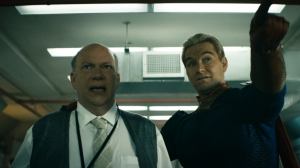 (Major Spoiler territory ahead)
Homelander goes home.
Episode 4 is dark. Homelander has, in the first three episodes of the season, realised that he’s not happy and there appears to be nothing to bring him satisfaction. It’s not that he’s looking for jumping jacks, fireworks and transcendence.
No. Homelander is the kind of unhappy that only having absolutely no inner purpose can provide. I write that deliberately because there are whole swathes of people out there for whom being part of society no longer provides that kind of inner contentment and this episode speaks to almost every aspect of this social ill – alienation.
For Homelander, alienated and alienation is primarily expressed through a discomfort with oneself but is composed of equal parts of an inability to receive what a normal social animal requires from external sources (i.e. the love, acceptance, expectations and boundaries the come with belonging) and the inward looking turn in search of these things that can only be provided through being part of a community.
Homelander is lonely, aging and finding that he has no one with whom to talk, no one to receive acceptance from and, lastly, no one to give those things to.
Sure, he’s absolutely a hateful psychopath and I’m not excusing him. Nor is the show. What the writing does so cleverly is explore what someone who’s entirely alienated does when something disrupts them.
For Homelander this something has two parts. The first is Ryan, his son, whose own morality, although undeveloped, is miles away from his biological father’s (and from Butcher’s too but more on that in later episodes). Ryan also demands something of Homelander that he is entirely unequipped to deliver – a loving relationship with understanding, nurture, equity and reflection.
Homelander is distantly aware of all these things but can’t deliver them because he’s never had these modelled to him in any meaningful way.
Secondly, his mid-life ennui, made worse by the fact he has everything he thought he wanted but can only see the gaping hole in his chest where meaning should be found.
And so we come to the crux of the episode.
Homelander decides to revisit the place where he grew up.
We know it’s going to be a disaster from the moment the screen shows a lift descending to basement level five…
And it is. But not for the reasons most might think. This sequence is tense, horrible and repulsive. It is also all of these things and worse.
Because it’s a vehicle for Homelander to explore his shame, his guilt, his loneliness and the hurt that festers in his adult heart that only years of careful and brutal therapy would help him process (and I’m perhaps ascribing too much power to therapy here given Homelander’s obvious pathology).
Anyway. It’s not the gore of dying people that is disturbing here. It’s the humiliation visited on Homelander as a child. It’s not the manipulation of people into committing their own punishments that makes you wince (well it does but…) it’s the fact that these punishments are deserved because they’re a response to brutal harm.
The defence of we were following orders is NEVER valid no matter the personal cost of disobeying.
The cry of ‘please forgive us’ is not a way to escape consequences – as Homelander repeatedly demonstrates.
This episode is cathartic in a way that Medea would applaud, and again I’m drawn back to the deeply classical Greek theatre and philosophy that’s shadowing this season. We’ve had the tyrant king, we have the kind of tragedy here that Sophocles would recognise and, I dare say, approve of.
It is satire and tragedy in the old manner – with gore and fleshy concerns, with horror and no way to escape, as if the fates themselves have determined these horrors must be played out as a warning to others.
I’ve read about the show being too obvious. I have no truck with that because you may think it’s on the nose but there are still people cheering for Oedipus Rex, there are people cheering on Jason, despite their appalling behaviour towards Medea and their obvious status as antagonists who deserve divine retribution but, instead, receive pardons, celebration and elevation.
Sorry, I meant there are people cheering on Nigel Farage and the repeatedly convicted felon Donald Trump. They still think Homelander is the hero…
This episode is superb, written so tight it can hardly breathe, but in such discipline something terrible and frightening and awful is seen. An awful catharsis both for Homelander and viewer in the resolution of justice (twisted yet) delivered against the sins of the fathers.
This isn’t the poor and exploited breaking out to ceremonially escape before bringing down the enemy. This is the broken mind of a psychopath taking revenge on those who tortured and abused them for years.
No one gets out clean and we know that Homelander gets almost nothing from this event except a realisation that even revenge, in the end, brings no closure, no freedom.
Look, other storylines progress in this episode, some of them even mirroring what’s happening in Homelander’s thread, but they are shadows against the exploration of identity, how the scars of childhood can consume us and how abuse is justified by those involved.
Hughie is dealing with the legacy of his own childhood. So too is Annie. For the former it’s the choices others made for him. For Annie, it’s the legacy of her choices that come back to haunt her. This isn’t to downplay the depth of the questions they’re asking about life and its cost but they are, between them, only the whole of what Homelander is wrestling with alone: What is our purpose? What will we do to find it? What stories do we construct to blind ourselves in the hunt to make what we believe ‘the natural and right’ belief against all others?
Verdict: The Boys continues to shock but this episode shocks with subjects handled extremely carefully if, unsurprisingly, as brutally one might expect.
Rating? 10 human sized ovens out of 10.
Stewart Hotston
 Doctor Who News Star Trek News
 Sci-Fi Bulletin: Exploring the Universes of SF, Fantasy, Horror and Spy-fi!