Star Wars: Review: Obi-Wan Kenobi Original TV Soundtrack
By Natalie Holt, John Williams, and William Ross Disney, out now The score for Star Wars Episode III.V… It probably seems a bit odd to have three credited composers, […]



By Natalie Holt, John Williams, and William Ross Disney, out now The score for Star Wars Episode III.V… It probably seems a bit odd to have three credited composers, […]
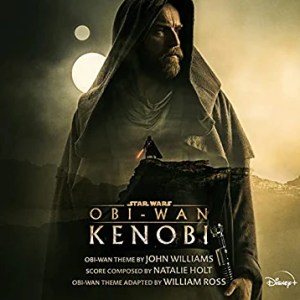 By Natalie Holt, John Williams, and William Ross
Disney, out now
The score for Star Wars Episode III.V…
It probably seems a bit odd to have three credited composers, but there is a reason for it. Obviously John Williams wrote the original movie themes that are incorporated and referenced within the series score. He also wrote a new character theme for Obi-Wan himself, which forms the title theme, and the end credits music.
In the movies, Kenobi, like most Jedi, had been primarily represented by “The Force Theme,” and Williams wanted to write this theme as a proper character theme for Obi-Wan/Ben himself. It’s a lovely piece, beginning slowly, carrying loss and weariness that soon builds to purpose and hope, and actually plays like an almost inverse of the pitches of “The Force Theme” with added tweaks on hunted tension and all with beautiful sweeping strings. The “End Credits” version is quicker-paced and more obviously hopeful and uplifting too.
Natalie Holt wrote the main score, while William Ross is credited for “theme adaptation” in the show’s credits, which means he’s the guy who blended some of the original movie themes into medleys at appropriate points, and he’s credited with composing “I Will Do What I Must,” “Overcoming The Past,” and “Saying Goodbye.” Given the credit for theme adaptor, it’s not surprising that he scores those latter two tracks, while are full of themes from the movies, but “I Will Do What I Must” seems to simply go along with Holt’s music for the series as a whole, being a driving percussive cue, though there is a hint of Sidious/Palpatine’s theme at the beginning.
Holt’s score is excellent throughout, using all of the orchestra to evoke the characters’ fear and loss, and desperation, pain, determination, and hope. Everyone has a set of themes that really work to connect the audience to them and their stories, and which tell a solid story in their own right as an album. Even if you never heard of any of these people or the franchise, you can still follow the story of pursuit, hope, confrontation, and redemption musically. Beautifully done.
If the score – and the show – has a central tenet, it’s that of drive. Characters are driven to do what they do, whether internally driven to prove themselves, or externally driven to rescue or revenge, and this is very cleverly played out in the score too. Rather than frenzied or full-on action oriented, the feeling that really comes over in the percussive beat of the Inquisitorial, Imperial, and Dark Side themes here – whether it be the military snare drum, or the big booming echoes – is that sense of being driven that we get to share in.
A particularly nice touch, in connecting to the series’ place in the franchise is that when we do hear motifs and themes for the Empire they’re chronologically appropriate. “Empire Arrival” is the standout example, in which it at first sounds like the threatening music of storms is about to swell and burst into the Imperial March, but instead – and far more continuity-appropriately – it goes into no the familiar triplet march, but the more martial and percussive sounds head for the Stormtroopers and aboard the Death Star in A New Hope, turned up to eleven and nurtured into full scale military force.
Verdict: At heart, though, it’s about heart, and the dynamics between hearts, and the percussion gives us the beats, but the strings and woodwinds and all those rich deep tones underlying it all share those heartfelt drives with us. And it’s all very Star Wars-ish too, obviously. Easily the best Star Wars score since Rogue One, and a triumph for Natalie Holt. 11/10
David A McIntee
 Doctor Who News Star Trek News
 Sci-Fi Bulletin: Exploring the Universes of SF, Fantasy, Horror and Spy-fi!