Star Trek: Interview: Picard: Kirsten Beyer and Mike Johnson
The new Picard season begins at the start of March, and as an appetite whetter, Simon & Schuster Audio has released No Man’s Land, an audio adventure starring Jeri Ryan […]



The new Picard season begins at the start of March, and as an appetite whetter, Simon & Schuster Audio has released No Man’s Land, an audio adventure starring Jeri Ryan […]
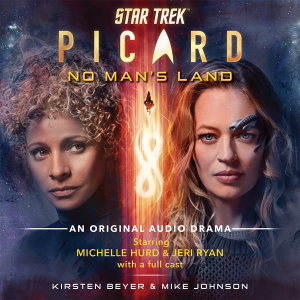 The new Picard season begins at the start of March, and as an appetite whetter, Simon & Schuster Audio has released No Man’s Land, an audio adventure starring Jeri Ryan and Michelle Hurd reprising their roles as Seven of Nine and Raffi (read our review here). It’s written by Picard co-creator Kirsten Beyer and her frequent co-writer on ancillary tales, Mike Johnson, and both chatted with Paul Simpson the week before release…
Thank you for an enjoyable tale. There are so many pitfalls you could have fallen into, but didn’t with this. The main one is describing everything in dialogue. We don’t do that when we’re talking…
Kirsten Beyer: And yet, you have to be aware of the fact that all people have is what they’re hearing so they have to still know what’s going on and where they are, and it’s tough.
It’s a skill, quite definitely. So why this story and why this medium?
Kirsten: The medium was really just determined by Simon and Schuster. They approached me two and a half, maybe three years ago. We were very very early in the Picard process and they were like ‘We’d like to do a Picard audio drama.’ And I said OK.
 A lot of the wait was about getting season 1 done and then getting into season 2 so that we knew which dots we would want to connect. We also always knew it would be fun to do a Seven story. There were a lot of tie-in properties that were interested in Seven stories and we were trying to figure out what the best way to do that would be because the novels are obvious, the comic books are obvious but this felt like it could be a special opportunity to take that forward, assuming Jeri would be excited about doing it along with Michelle.
It took as long as it did to get to us probably because it took so long to figure out where they were going to land in season 2 and then how you needed to thread that needle to tell this story. Always the idea was, we want to talk about the relationship between these two women that was hinted at at the end of season 1. It’s developed further in season 2 but how did they get from here to there? At the end of the day we ended up with a year and a half gap between season 1 and season 2 so it was a challenge to figure all that out.
How did the process work for the two of you?
 Mike Johnson: Kirsten reached out to me. She is very busy writing Star Trek for the television, creating and producing and writing shows, so I was very lucky and grateful that she reached out to me to help her craft this story. We had a great time writing the comics together, and both of us have a lot of experience writing for Star Trek in other media so it felt both natural but also like an exciting new thing to take on the challenge of an audio drama.
From there, I think the process of actually creating the story wasn’t that different to what we do in the comics. Essentially, whatever medium you’re working in, it all comes down to the story. You start from just thinking about what would be the best story to tell.
Then once we landed on that, and the plot and the characters evolved, then it comes down to the unique challenges that Kirsten spoke to you about, writing for just the ears of the audience instead of eyes. That was just a fantastic challenge and a great opportunity.
Kirsten: Yes, it was really tough but I think developing story with Mike is one of my favourite things in the world to do. I don’t know how we fell into this process, but we just sit together for however long it takes and bat the thing around back and forth.
It’s a very organic and fun process to create Star Trek with Mike, largely because he knows so much about it and loves it in the same way I do. I think we share a lot of the same sensibilities about what makes a good Trek story.
 Mike: Yes, thank you and likewise. It’s so much fun.
I think we both appreciate Star Trek in the same way. We definitely bring different points of view to it just based on our own lives and experiences but we have a common sense of what makes Star Trek Star Trek and a real love for that – and also, as we worked on these ancillary projects, a love for ancillary projects as their own thing. They’re things that have built out of Star Trek since the beginning of the franchise. We take them as seriously as we do the shows and I think that, hopefully, shows in the work.
Kirsten: Yes, that’s absolutely true.
It does show because you can always tell; we all grew up with the rip off cash-ins that had been written by someone who had never seen an episode or anything. I think with Trek, we’ve been spoiled particularly in the last couple of decades with the lit-verse and everything that was going on with that, so there is a high expectation of what a tie-in Star Trek story will be.
You talked about the hazards, the trips that there are with writing for the ears only. Had either of you done anything like this before? And if not, what surprised you most when you actually got down to doing the writing that you never thought in a million years was going to be a problem?
Kirsten: Well, the answer to the first question is no, I’d never done anything like this before.
Mike: me neither.
Kirsten: What was surprising when we got into the writing? I’m sure this is true for you Mike when you’re writing the comics, you’re already imagining the images? What you’re going to see?
 Mike: Yes.
Kirsten: And for television, so much of it too is about “What are we seeing?” That’s all anybody needs to know and yet [for audio] you have to find a way to present that, that isn’t just incredibly boring and laborious. I found myself so often just closing my eyes and imagining “What am I hearing?”
I think the only part where I sort of got afraid a little bit was in the dialogue, knowing what I thought the characters would be feeling but not necessarily knowing what the actors were going to bring to that and then wondering if it was going to be clear.
You never want to be on the nose in dialogue. You want people to just be living and having conversations and that reveals whatever is happening between them. I don’t know why it felt [odd]; I think it’s because there were so many times I would say to myself, ‘Oh, all I need is one shot of Seven or one shot of Raffi and I will know exactly what they’re thinking.’ But I wasn’t going to have that, so with that taken away as a tool it was scarier to make sure that what we were hearing was going to translate into emotions for the actors and then for the audience.
Mike: I think we benefited from knowing the characters and the actors and actresses who were working on it, who have such a strong hold on their characters and know their characters so well, so that their voices were really clear in our head.
 So yes, we couldn’t just have a look convey something, we had to rely on the actors’ inflections and how they would read particular lines and they’re… I was going to say the secret weapon but they’re not the secret weapon, they’re the very obvious one! Probably the benefit of working with performers of their calibre is that they can convey through their voice what they might otherwise convey with a look if it’s on camera. They can do that with their voices and that extends not just to our two stars but to the rest of this amazing supporting cast.
It’s a surprise to me, listening to it. I listened to it this weekend for the first time and it was so great to hear the voices of the supporting cast in the context of the story. They just felt like new characters. Even though we had written them, the voices really fleshed out the roles in the world in a way that the visuals do, if you’re watching a movie or TV show. That was really exciting.
Kirsten: And from the beginning that was something we had to think about, for the new characters knowing that this was all people were ever going to have of them. They had no other frame of reference, so how do you make those people very specific? Not just because of the different actors reading them but in the quality of what they’re saying and what they’re doing, you start to understand them as whole people, as much as you understand Seven and Raffi.
I think most people coming to this will be familiar with Seven and Raffi and they’ve already got that in their heads but they won’t have any of these other people in their heads and so, to really be able to flesh those characters out only through sound, was pretty daunting.
As fans, we know what a Romulan looks like but I’ve got a very clear idea in my mind of what that Romulan pseudo emperor looks like. I think that the director [Christina Zarafonitis] very definitely elicited performances that picked up anything that you’ve given them.
Kirsten: Yes, Christina did a great job, she really did. She was a pleasure to work with.
How much liaison did you have with her during the writing of it or was it more that you wrote it and handed it over to her and then dealt with any queries she had at that point?
 Kirsten: It was a very intense process. We worked very closely together down to the nitty gritty of specific lines and specific scenes as we were going through the various drafts.
In the early days they trusted us to create the story and they all liked the story then once we got into the script, things got a little bit more detailed but yes, we worked very closely through the creation of the script. Even once we got into recording, Mike and I were both there for most of the earlier, longer recording sessions just so we could be a reference both for Christina and for the actors, in case anything wasn’t clear on the page or in case anything we had written had ended up being too hard to say.
Which happens, it happens on set all the time too. You just have to be able to very quickly jump to something that conveys the same thing but maybe is just a little bit easier on the ear.
When they recorded it, did they have all the actors together or was it more the animation style of getting actors in separately?
Kirsten: They did everybody separately and that was largely because of Covid. The initial plan was to bring at least some of the major characters together for some of the bigger scenes but that wasn’t possible.
That was a thing that just stopped me in my tracks because I come to this as an actor as well and I thought, ‘How in the world do you play a scene when you have no idea how the other person is responding? What they’re bringing to it?’ But I was made to understand very quickly this is how it works in this format a lot and the actors are actually very good at that. So that was amazing to me.
Mike: One of the most fun things was the recording sessions and watching these complete professionals. It’s like magic when they do their thing and they turn it on, they become the character. We had a great supporting team too who brought the story to life. I was just blown away by the sound effects and the music, how much they add to bringing the story to life, it was so much fun.
All that stuff happens after Kirsten and I have delivered the story and they’ve recorded the actors, so it was a real treat to hear the finished product.
Sometimes audio scriptwriters will give very clear indications what they want from the music, what they want from the sound effects, others are more ‘Give us this mood.’ Which way did you jump with it? Were you suggesting ideas or were you very specific as to what you wanted?
 Kirsten: Well, we were very very specific and the composers that we brought in are composers that I actually know very well. We had a wonderful process between the composers and Christina, myself and Mike, where we would talk.
Before they started to write any themes or record anything, we talked a lot about what we were looking for, down to the kinds of instruments and how full and how small we wanted sounds and that sort of thing.
They of course used the score for the television series as an early guide but we also thought it would be really fun to bring in new kinds of sounds that might be more specific just to this story and broaden the idea of what kinds of sounds and music you can have in Star Trek.
One of the things I was half expecting was effectively temp Jeff Russo tracks, and I was very pleased to hear it wasn’t. It did give it a very specific feel and I think particularly I noticed it with the Raffi and Seven scenes round Raffi’s trailer. Those bits made it clear that yes we were in Star Trek but we were in something different. It didn’t take you completely out of the story.
Kirsten: It was delightful.
It was such a delightful day when we remembered that we had a record player playing that there’s one on the ship. Holy cow, we could have anything!
Mike: Yes. (laughs)
Kirsten: Who knows what albums were there? That’s awesome.
Each iteration of Star Trek has a different feel. What do you think makes a Picard story that wouldn’t work necessarily as a Discovery story or whatever?
 Kirsten: I think that there are a lot of similarities in terms of what people are striving for but I think that the specific identity of Picard has something to do with the past being very present for the characters that we’re seeing. There is an incredible history for Picard and for Seven and for Raffi and for Rios.
These people have lived complicated lives and there are no clean slates, so somehow whatever story we’re telling, whatever is happening in the moment is always about revealing some of that past without directly referencing.
I think that’s what I’m always feeling when I’m working on Picard, that sense of ‘But then this happened but they never talked about it and these two would never have had that conversation but oh my god they’ve had those same experiences.’ And there’s this constant mining of that history and how it reveals itself now and very much determines where these characters are.
Mike: Also taking a cue from the characters and the actors in each show and how much they build and create a particular tone and mood that sets their particular series apart.
 Especially when you’re in the ancillary space creating work that supplements the shows, you’re really taking the cue from the performers so much and the characters that they build, and so the differences in the characters in each show can really drive and ultimately should drive making each series feel unique. And then, each ancillary product that you derive from that feels unique and special because, ultimately – it’s become a cliché but it’s true – it all starts with the characters.
Even when we sit down for No Man’s Land and build out a plot, it comes out of Seven and Raffi and their particular experiences and emotions and then how their individual experiences come together, in the context of their relationship, and that ultimately drives the plot. Then all of the space battles and all the action is the frosting on the cake. But it all starts with the characters.
No Man’s Land is available now. Thanks to Lauren Pires for assistance in arranging this interview.
 Doctor Who News Star Trek News
 Sci-Fi Bulletin: Exploring the Universes of SF, Fantasy, Horror and Spy-fi!