Star Trek Discovery Visual Effects Supervisor Jason Zimmerman has had plenty to deal with during the show’s second season – from an epic space jump in the opener to an […]
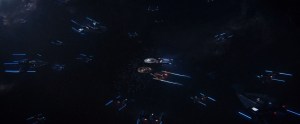
Star Trek Discovery Visual Effects Supervisor Jason Zimmerman has had plenty to deal with during the show’s second season – from an epic space jump in the opener to an all-out battle in the finale. A few hours before the finale aired, he chatted with Paul Simpson about he and his team’s work on the latest iteration of the six decade old franchise. NB There are spoilers within for the whole of Discovery season 2.
I thoroughly enjoyed the finale; it really works well…
I’m glad – it was overwhelming. We watched it on the big screen last week, and it was really nice to see it projected all big with the sound and everything finally done. It’s massive – it’s bigger than a TV show that’s for sure.
The VisFX panel at WonderCon, March 2019: Jason Zimmerman and Olotunde Osunsanmi on the big screen
It feels bigger than a lot of the earlier Star Trek movies…
(laughs) Feels like it when we were doing it, that’s for sure.
How far in advance did you know that there was going to be this big battle between Discovery, Enterprise and Control?
We knew several months in advance, because Alex Kurtzman wanted to make sure that everybody involved had ample time to plan, to strategize – to put us in the best position that we could be to win and really tell the story, to work out how we needed it to look and not really skimp on the amount of time that we had.
Alex let me and everybody else in production know really early on and we started the battle planning. What ships are going to be involved? Who’s going to be there? The choreography started really early. We finished it somewhere around April 5 [less than two weeks before the episode aired].
How much did the battle alter from the original concept or was it constantly altering as it went along?
There’s a little bit of that, but because we had so much time to plan, I think we knew exactly what it was that we wanted to do. Things do change a little bit along the way: once you shoot things in production, they might be a little bit different from the storyboards, but for the most part, we really had a good sense of what to expect.
I worked with [director] Tunde [Osunsanmi] and Alex to lay out the battlefield in advance so we had an idea of how the ships surrounded everybody, and how they were going to be, at least at the start, until the fire started coming.
So we had a good idea, and with an episode that so heavily relies on CG, you have to have a pre-vis for the editors when they start to cut the episode because it’s a large component that plays into all the rest of the shots, and we wanted to be sure to give them something to play off. In some cases, there were adjustments that had to be made, but at least it gave them something to say “That’s it”, or “That’s absolutely not it.” We went through several revisions with Alex and Tunde, changing the animation [in the pre-vis], changing the blocking to make sure that it coincided well with what we had shot practically.
Are there more effects in that episode than in any other than you’ve done so far?
It’s up there – I don’t know if it’s the most, but it’s definitely up there. I want to say it was well over five or six hundred, it was definitely a massive episode.
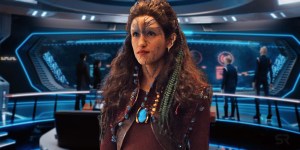
It feels as if there’s hardly a scene without some sort of effects, even if it’s just background screens on Discovery or Enterprise – until the shots at Starfleet Command, and even there, there’s quite a few shots.
There’s the obvious shots, the big CG things, the shuttlebay extensions, but even with the character Po, for instance, we were adding blinks to her throughout – she’s through the episode and 213. Taking into consideration the various levels of shots that we did, it seems like it was every other shot. We definitely had our hands full.
What was the biggest challenge – just sheer time?
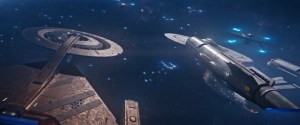
Yes. The scope of it was so big, and we’re working on a pretty good timeline, all things considered, but even with that it was a very, very demanding episode of television and we had to get all our ducks in a row. As I said, we were well prepared, we knew what was coming in advance so we had the time, but the sheer scope… It’s so big, choreographing space battles that basically last the majority of the episode, tracking where everybody is in every shot because there are very specific plot points based on who’s flying where, who’s shooting who. All things you have to track and have a constant awareness of. I think it was a large undertaking in terms of the choreography to achieve what we had to do.
It felt like a 3-D battle – people were moving on all three axes…
That’s the thing with space – in effect a battle can happen in every direction, so we wanted to make sure to utilise that. It also helps make it a more dynamic battle than the two-dimensional world that we’re accustomed to seeing in battles on Earth.
Was the first part of the finale a lighter episode for you? It seemed character-based and therefore not quite as effects-demanding.
It wasn’t as big. There’s always a lot for us in each episode. I’d say it was on the lighter side, all things considered, and had the typical things that we’re used to, with the different establishers and things like that. It didn’t carry the scope that 14 brought!
Going to the other end of the season, you mentioned in the panel we did at WonderCon that you knew about the space jump in episode 1 a year before it happened… How much did you get told initially?
We knew right off the bat. It was funny: we were delivering episode 15 of season 1 and Alex came to me and said, “I’m writing and directing and working on the premiere to season 2, and there’s going to be this space jump.” He knew what it was going to be already, he had the rough layout in his head, so he verbally told me and said, “When do we start?” I said, “Let’s go to pre-vis.”
So we immediately started pre-vising it while they were polishing up the script, and also storyboarding it, so we had three different versions running concurrently to make sure we could get this thing fleshed out as quickly as possible. As the script came together, we went back and married all three of those things – the pre-vis, the storyboards and the script – together into one cohesive thing so that we could present it to production so everybody could see what we were planning and start shooting, and how we’d be able to shoot it and discuss how things could be done.
How much did it change during production?
For the most part, what we started with in pre-vis did stick, but I think what happened is like any time when you start with “This is what it’s going to look like with no laws of physics” or how big the stage is or “Can we get the dolly in there, can the crane do that?” We started with [the pre-vis] and once we got up [to Toronto] to production everybody looked at it and went, “That shot? The way we can shoot that is: rather than them come to camera, we can have the camera go to them.”
It was working with Glen Keenan our DP, and the rest of our team, to take this and say “How do we put it into a real world context?” There’s a little bit of adjustment made, of course, but I think we maintained Alex’s vision throughout and didn’t need to compromise too much. Everybody on the show, the crew up there, are so good at what they do, there’s very seldom, if at all, a time when we say we won’t be able to accomplish this. It’s a question of everyone sitting down and saying, “How do we do this?”
Has there been a moment this season when you’ve read a script and thought, “Holy… how are we going to do this?” or is that situation normal for Discovery?
I don’t know that I have those moments any more just because I know between everybody involved, if we all sit down and talk about it, we’ll figure it out. I don’t think there’s ever been a time when everybody’s gone, “Well that’s not possible.” You have to take into consideration the different resources you have at your disposal but the team in Toronto and my team here in LA are really good at problem solving and figuring things out. I don’t say that to make it sound like we’ve got everything figured out – of course there are things that are challenges, and we don’t know how it’s going to work out, but by and large we all look at it, and if it’s really complex and crazy we laugh at first and then get to work, and set our minds to figure it out.
Did changing the picture ratio for this season cause any major issues for you?
Not really no. Once we knew the new specs we were off and running. Anamorphic is so cinematic it was really fun to work with.
Were the flashbacks in the finale changed in any way?
Other than adding the filter, they were directly from the episode in which they were used. That definitely helped – I’m not sure how many more shots we could have fielded on that episode.
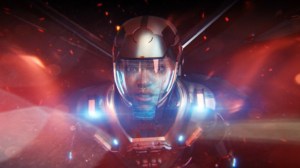
The final shot that we see of Discovery that we see disappearing into season 3 feels very much like the wormhole effect from Star Trek: The Motion Picture. Was that a conscious look back?
I think with all these, we look back at all the previous Trek shows because they lay the groundwork for the Star Trek universe. The idea for that came, actually, I believe from Alex in concert with Tunde talking about it; if I’m not mistaken, when I heard about it, it was when I walked onto set during the finale. Tunde came up and said “We’re going to put streaks on everybody, that’s what Alex says.” Alex came up with the idea and fortunately it was something we were able to make it work.
Were there any differences in the effects for the Red Angel for when it was Michael and when it was her mother?
The Red Angel is the Red Angel in the sense that the technology that drives the suit and everything about the time travel of it all is going to be consistent, and it has to be. That was something that we looked at too: we made sure that whoever used it, used it the same way.
There shouldn’t be anything discernible that I can think of other than anything that would be specific to the episode, such as when it’s her mom and she’s struggling being captured in 10, that might be a different look than when Burnham is powering up at the end of 14 to go into the wormhole.
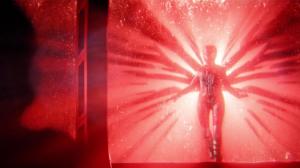
The Angel appearing to Saru – was that Sonequa, or was it CG?
That was purely CG, actually. We had talked about shooting that practically and I think based on schedule we ended up doing it in CG partially due to time constraints and what we needed to do in Production and when we needed to deliver.
What’s been the element that’s made you have to think hardest, in terms of how you’re going to do it?
Just expectations. Going into season 2 and learning what we learned on season 1, and Alex coming in and directing the first episode. There were expectations to step up our game. I’m a visual effects person, and I think most if not all visual effects people feel this way: from season to season you’re obligated to one up yourself and do better than the season before.
I think that was part of it – the world was expanding so there was definitely more to work with, more scope-y things, like the planets that we went to, the planning out for Kaminar… Expectations were probably the biggest thing we went and said this year we’ve got to be bigger and better than last year. How do we do that? What ways do we continue to do the franchise of Star Trek justice in season 2?
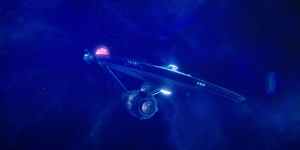
And there’s a heavy presence of Enterprise, a ship that’s had multiple iterations. Were there things you knew your version of Enterprise to be able to do that led to slight alterations in how it looked or it was filmed?
Not anything like that, as far as that was concerned – obviously with the Enterprise bridge, we added that which we didn’t have last year. Having the viewscreen, what would that look like, that was a new wrinkle in the Enterprise that we represent in our show. By and large once we established it last year and how it looked, we had an idea of what its capabilities were, and we were able to work within that already.
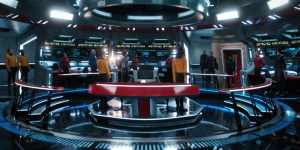
Were there elements you could bring across between Discovery and Enterprise, or did you have to treat them as two separate ships?
We treat each ship individually just because the design is so different. Enterprise being Enterprise, that is such an iconic ship you really have to spend your time and make sure every effect that you do on that ship does what it’s meant to do, based on canon, on what people are expecting. There was nothing we really ported over; we tried as hard as we could to make sure that everything had a unique look for the Enterprise vs. the Discovery.
We went back to Earth for Starfleet Command – was that San Francisco look built on the real world as it is now?
We started from actual footage; I personally always think to start from something practical in a shot helps to make it look a little bit better. We started from footage and then again did our research based on previous iterations and created what you see then.
All of the designs, I have to give a shout out to our production design team, the art department, because they do a lot of filmscapes, concept art that start us off and plays in this direction. It happened last year and happened this year – they were very helpful with all that.
And creatures from Neville Page’s designs that all add to the mix…
Speaking of Neville, he actually designed one of the fighters that was in 14: an Enterprise Federation fighter was a Neville design. We worked with him very closely – obviously he created the design, got the approvals.
The great thing about Neville is he doesn’t just give you something that looks cool, he has thought out how it moves, how it operates, what the science is behind all those things. It’s very helpful, because it sets you off in a direction with all the rules. It’s not just a cool design, there’s purpose and functionality built into it as well.
The reality of the situation is we’ve never seen a space battle, we’ve only seen it in entertainment, so the rule is you really have no rules. You can have whatever rules you want, but it helps when you can establish ground rules, different things that you can and cannot do. Part of that obviously is the canon of Star Trek and how those ships move, but any time when you’re doing that that you can say, “These are the parameters we’re working with”, it really helps us to not go off the deep end and do something that doesn’t work within the confines of what we’re trying to accomplish.
Thanks to Arpi Ketendjian, Bonnie Kim and Rachel Voter in their assistance in setting up and preparing for this interview, and to Lorna Osunsanmi for the picture from WonderCon
Star Trek Discovery is available on CBS All Access in the US, Space in Canada, and Netflix in the rest of the world.



 Star Trek Discovery Visual Effects Supervisor Jason Zimmerman has had plenty to deal with during the show’s second season – from an epic space jump in the opener to an all-out battle in the finale. A few hours before the finale aired, he chatted with Paul Simpson about he and his team’s work on the latest iteration of the six decade old franchise. NB There are spoilers within for the whole of Discovery season 2.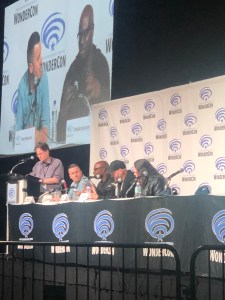
 It feels as if there’s hardly a scene without some sort of effects, even if it’s just background screens on Discovery or Enterprise – until the shots at Starfleet Command, and even there, there’s quite a few shots.
 Yes. The scope of it was so big, and we’re working on a pretty good timeline, all things considered, but even with that it was a very, very demanding episode of television and we had to get all our ducks in a row. As I said, we were well prepared, we knew what was coming in advance so we had the time, but the sheer scope… It’s so big, choreographing space battles that basically last the majority of the episode, tracking where everybody is in every shot because there are very specific plot points based on who’s flying where, who’s shooting who. All things you have to track and have a constant awareness of. I think it was a large undertaking in terms of the choreography to achieve what we had to do.
 Was the first part of the finale a lighter episode for you? It seemed character-based and therefore not quite as effects-demanding.
 We knew right off the bat. It was funny: we were delivering episode 15 of season 1 and Alex came to me and said, “I’m writing and directing and working on the premiere to season 2, and there’s going to be this space jump.” He knew what it was going to be already, he had the rough layout in his head, so he verbally told me and said, “When do we start?” I said, “Let’s go to pre-vis.”
 How much did it change during production?
 Has there been a moment this season when you’ve read a script and thought, “Holy… how are we going to do this?” or is that situation normal for Discovery?
 The final shot that we see of Discovery that we see disappearing into season 3 feels very much like the wormhole effect from Star Trek: The Motion Picture. Was that a conscious look back?
 The Angel appearing to Saru – was that Sonequa, or was it CG?
 And there’s a heavy presence of Enterprise, a ship that’s had multiple iterations. Were there things you knew your version of Enterprise to be able to do that led to slight alterations in how it looked or it was filmed?
 Were there elements you could bring across between Discovery and Enterprise, or did you have to treat them as two separate ships?
 We went back to Earth for Starfleet Command – was that San Francisco look built on the real world as it is now?
 The great thing about Neville is he doesn’t just give you something that looks cool, he has thought out how it moves, how it operates, what the science is behind all those things. It’s very helpful, because it sets you off in a direction with all the rules. It’s not just a cool design, there’s purpose and functionality built into it as well.
 Sci-Fi Bulletin: Exploring the Universes of SF, Fantasy, Horror and Spy-fi!