 The first season of Discovery, the latest small screen iteration of Star Trek is now available to own on Bluray and DVD, and visual effects supervisor Jason Zimmerman took a few minutes away from his work on the new season to chat with Paul Simpson about stepping into the 23rd century…
I’ve enjoyed your work before Discovery – I’m one of the few people who watched and enjoyed Terra Nova!
(laughs) It was definitely an acquired taste, but it was fun to play with dinosaurs. It was one of the things I got into effects to try to do.
 What got you into effects work – did you look at the screen as a kid and say, “I want to do that”?
To be honest with you, it was dinosaurs: I was watching Jurassic Park when I was a teenager and I said, “Man I want to do that”. I started looking at the different programs for it, and I went to school for it. Right out of school, I jumped into an internship and became a VFX artist for about 15 years before jumping into being a supervisor.
Why did you switch to management?
As you grow as an artist and start to learn more, it’s kind of a natural career progression if you want it to be so. Especially being a compositor, you have the chance to put everything together and assemble everything and see how it develops, so you’re sort of semi-responsible for the endgame of that. As I started working at the different vendors I started getting more responsibility along with the experience of doing what I was doing. I realised that it was pretty fun to do this more and more so naturally gravitated toward being a supervisor.
I think it was the natural progression of the career after learning what I had. I slowly became manager of different artists and different teams, and then had the opportunity for a show called Sleepy Hollow about six-eight years ago. At that stage I jumped over to the studio side of things to start handling it from that perspective.
 How did you get caught up with Discovery?
Alex Kurtzman and his production company, Secret Hideout, did Sleepy Hollow and brought me on board for that, and I’ve been working almost exclusively with them ever since. They’ve tended to bring me along on all those different projects – I’ve been very very fortunate in that regard – and they said Star Trek was coming up. Obviously as a visual effects person, Star Trek is one of the bigger, if not the biggest, shows on television and features, so of course I wanted to do it and fortunately things worked out. It’s been a crazy ride but a dream come true as far as a visual effects guy can ask for.
Were you a Trek fan before, or did you come into as someone knowing of it, as opposed to being knee deep in it?
I was definitely a Trek fan but I probably was not as involved in it as some fans – the fanbase know so much about the show: the iterations of the TV show and the features Growing up I had watched plenty on TV. I had friends who were full Trekkies who took me along to different conventions. I was exposed to the world both as a fan and also as a friend of fans. I knew enough about it but not to the extent that I do now. You start working on the show and you learn so much about the world that you didn’t think of before.
 Is it sometimes an advantage to not be so mired in the past that you can look at it more objectively?
I think you can make an argument for both – looking at it with fresh eyes coming into it probably does help sometimes, and in my case helps me to look at the big picture before I got into the particulars of it, but I also understand the other side of it.
For me growing up as a visual effects compositor, some of the guys I worked off right off the bat had worked on the first iterations of the TV Enterprise – they were rock stars at the time. I looked up to those artists and those guys. But there’s something to be said that if you geek out over it, you can also bring something to the show. Some of the people who work on this on visual effects are big Trek fans and because of that they put such passion and time and effort into what they do.
I was already partially a fan, but I would definitely say that since I’ve gotten onboard, I have grown to love it so much more just because of the passion of the people around me. Not just visual effects but all the departments on the show all the way to Alex, who’s a superfan. I think it’s a combination.
 The first time I interviewed Alex was just before Fringe began – and his and Bob [Orci]’s passion for the genre was palpable. And [story editor] Kirsten Beyer’s passion for Trek…
She’s so great. She’s amazing. She’s such a good research resource for us on the show – if there’s ever a question she’s probably the first person I go to. “I want to run this by you, what do you think? Is this the right way to go, does it line up with canon?”
Back to your point about Alex and Fringe, I worked on that as a compositor well in advance of ever meeting Alex. I probably worked on most of his shows at one VFX house or another. I worked on the pilot of Fringe and a couple of other episodes, so I’ve always been around the Alex world so it was really cool to take this ride with him along the way.
 Looking at Season 1 as a whole, what was the biggest challenge in your role as supervisor – not necessarily of the show but for you as supervisor?
I think it goes back to the legacy of the show and the fans. It’s a tremendous responsibility; this isn’t a world that we’re creating from scratch, it’s a world that we’re adding to and that we’re participating in. The challenge is to do the best that you can to continue the legacy. All the supervisors and the visual effects artists and the work that they’ve done have been a benchmark for visual effects for so long. I think the challenge is to do your best not to take away from that but build upon that, and stand on their shoulders and continue the legacy of the show.
And keep the fans happy. The one thing about Star Trek fans is that they’re incredibly visually knowledgeable and they will let you know if you’re not doing a good job. Whenever you’re working on something as a visual effects artist or supervisor, there’s a sense of pride that I think you take for each and every shot that you do, whether it’s a monitor comp or a full CG ship. But when you realise the weight of the Star Trek name and the fans behind it, and you want to make them happy and make something that they will enjoy, that’s a tremendous challenge but it’s also (laughs) something that can keep you up at night if you’re not careful.
The sheer nature of the fact it’s a business means that sometimes you have to stop and move on.
Exactly. When people say, “How do you like it, are you happy with it?” I’ll say you’re never done, you just run out of time. Supervisors and artists on most shows will say the same – there’s always something else you can do. You can watch a shot 300 times and on number 301 you think, “I know what can make this better”. It’s a process that is always evolving and the creative part of it is really fun but there’s always something more to be done.
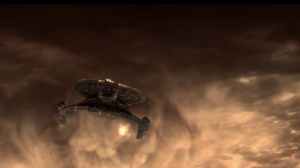 With the creation of the main starships, did you look at the footage of the earlier ships – how involved were you with those?
Those were designed by the production design team well in advance of us getting a hold of it, and these are guys who have worked on previous iterations of the show. We had the benefit of having a very knowledgeable art department and production design team that set us out on the right foot.
But there is a great deal of research that goes into looking at the details, understanding the history and the legacy and why things are the way they are. Sometimes as an artist you think it would be cool to add something and it might be great – but not in keeping with what the design of the ship is meant to be, or what canon is. You really have to honour what the design team has done but also do your research so that once you take over and bring it to life that you’re continuing to build off what they’ve done but keep it true to what it’s supposed to be.
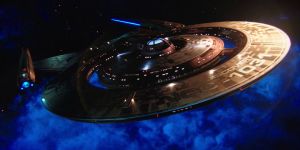 How much did the USS Discovery itself change as the show went on?
My impression is that it was pretty well thought out from the beginning; I don’t think there was a time where we thought, “I don’t know how we’re going to do this,” or “How does this happen?” Again, credit to the art department and production design, they really have everything figured out.
I think it was pretty well established what it was going to be – there wasn’t a time where we had to reverse engineer. It’s an ongoing collaboration with everybody. We do the visual effects but there’s a whole slew of people going through it before us, and the best thing you can do is lean on them, so you understand what it is because they’ve probably thought about it before we have. A lot of it boils down to constantly communicating with production and the team to make sure we’re not overstepping or going in the wrong direction. Together we had it figured out.
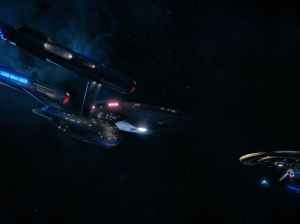 The one that everybody is probably most interested is the appearance of Enterprise in ep 15 – I watched those figures changing to “1701” and just went “Yes!” it was a perfect end.
It’s funny because when we were working on that for episode 15 and I read it in the script I thought, “Cool. Enterprise”, and I was looking at it objectively as supervisor… but the first time we saw the shot after we had textured and rendered it, and we had that little bit of music that was the Star Trek call-back, I went, “Holy crap, we just did the Starship Enterprise!” It didn’t really hit until I saw it but when I did it was this tremendous “Wow! We’re part of it.” What a cool feeling and experience to say you got to work on that and was part of it.
Did the art department come up with the latest iteration? It’s not quite the ship from The Cage, or the original series, or the 2009 revamp.
Again credit to the design team and the original designers. They worked for a very long time to create the latest iteration. We were responsible for bringing it to life but it was something that was in the oven for quite some time before us.
 In terms of the non-iconic shots, how much is there in the show that people don’t realise are effects?
There’s a lot, and that’s sort of an indication where visual effects is going in production in television and movies. There is so much opportunity. There are times as simple as painting a smudge off the wall in the background, it can be adjusting a light – there are a fair amount of “visual effects” that are invisible. Maybe it’s extending a wall slightly because they shot off the set. Those things don’t happen a lot but they do happen and on a television show you’re here to service the team and give production whatever they ask for. Sometimes that’s a giant amazing 30 second full CG shot, and sometimes it’s painting a mark out of a floor. There’s a decent amount of that as well as full CG and heavy visual effects.
I remember when I was working on the books about the making of Farscape back 20 years ago that they said there were more vis fx shots in their pilot in 1999 than in the entirety of ID4 three years earlier. Are there times when you look at it and go, “Are we really able to create this?” Or has that wow factor slightly gone?
 I don’t think that the wow factor ever goes away, particularly because on this show, especially last season where you’re setting up the world, there’s so much opportunity, and there’s variety in the show. Every time something comes up, it’s “Man, how are we going to do that?” There’s always that excitement of “What is this challenge, how are we going to accomplish this?” then getting the best approach in place for shooting it and then in post. I don’t think it ever gets old, but as visual effects have evolved, and comparing your point about Farscape, I want to say on season 1 we were somewhere around 4,800 shots by the end of it, the same as a summer blockbuster.
We were really proud of it – not just the bulk of the shots but each individual shot of it. We take a lot of pride in it. We will sit there and stare at monitor comps as much as the full CG shots because we want it all to carry the quality and the workmanship that the show deserves.
It’s the old thing about people seeing the tiny black spot on an otherwise blank white piece of paper – they only notice the one thing you don’t want them to see!
Exactly.
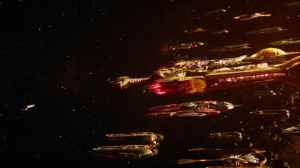 In terms of shots that you’ve created for the series was there anything that you were able to do that you’d always wanted to do that you’d not had the opportunity to do up to now?
In general, space is something that I’d done very limited amount of stuff on. I worked on shots here or there throughout my career, but having an entire space battle and sequences like that on an epic scale was a really fun thing.
The thing on this iteration of Trek is that we have an opportunity to do so many different things – we’re done creature work, space battles, significant set extension work on episode 15. We got to do so many different things that it’s hard to point to one thing.
When we were submitting to different award shows, we had such a hard time – not necessarily because we thought everything was incredible, I don’t want to sound so egotistical, but at the same time there’s so much about this. The mirror universe was incredible to work on, to be able to do the ship graveyard on that. We’d start to watch an episode and say “maybe episode 10 is the one” and then get to 13, and go, “No, this is the one”, then get to 15, “No man, this is…”
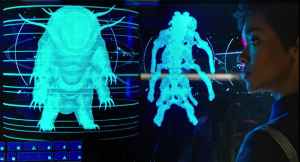 What was cool was the ability to do high level visual effects on every episode. All these different things, whether it was creature work or the interaction with the tardigrade, there was so much on each episode to have fun with and stretch our legs creatively and make it look photoreal.
It’s hard to pick one thing, but in general being able to be part of the Star Trek universe last year and this year has been a dream come true, and seeing all that stuff – seeing Enterprise come to life, seeing all of these iconic things happen – it’s been a lot of fun.
Thanks to Danielle Kemble and Nicole Yavasile for their help in setting up this interview.
 Star Trek: Discovery season one is available on DVD and Blu-Ray




 Sci-Fi Bulletin: Exploring the Universes of SF, Fantasy, Horror and Spy-fi!