Peacemaker: Review: Series 1 Episode 6: Murn After Reading
The butterflies make a move… There was a big revelation last week – and on it hinged the future of the team. We start there and, at last, find out […]



The butterflies make a move… There was a big revelation last week – and on it hinged the future of the team. We start there and, at last, find out […]
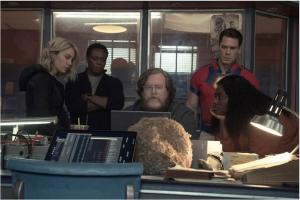 The butterflies make a move…
There was a big revelation last week – and on it hinged the future of the team. We start there and, at last, find out what’s really going on.
By this point it’s not so much of a reveal as an underlining of what we already knew. While all of this is happening the rest of the world continues to do its thing. It’s a sign of fantastic world building when each and every character has their own agenda that proceeds apace without reference to the main character. Peacemaker has at least four sides in its story and each of them have their own motivations and goals.
This episode brings all four of those sides crashing into view, each of them acting, each of them preparing for something momentous as we careen towards the season’s close.
We see what the butterflies are doing. We see what White Dragon is getting up to and we learn that even with all this at stake our heroes (such as they are) have no real clue about what they’re up against.
Peacemaker does a great job of reminding us that real people don’t have perfect knowledge, don’t have an overview of the world which allows them to put a grand plan together. It also reminds us that when you’re looking one way you can’t, by definition, see what’s going on elsewhere.
In any other series, Peacemaker’s dad might be a major threat – here, in this context, although he’s not to be underestimated, he is really nothing more than a sad, angry old man with a serious lack of imagination. This representation of racism as a broken, inward looking and pathetic ideology is, for me, excellent. It works because it not only doesn’t glamourise something reprehensible but it contrasts this sickness with the everyday ignorance of ordinary people.
There is a scene where the team discuss whether the term Oriental is racist and if it’s ok to use it to describe someone and that occurs in the same episode in which we have full on white hood wearing scumbags planning mass murder. Neither are directly connected but the two scenes inform one another. The structure reveals that middle ground where we can discuss problematic views and the line beyond which there is no discussion to be had, beyond which we need to shun, reject and fight those who will never change.
These moments aside there is an extended sequence revolving around an interrogation that had me snorting with laughter. I won’t say too much about it except that when you have two rules and one of them is ‘don’t be a moron’, then complaining about how hard it is to follow them is not a good sign.
If I have one reservation it is the ongoing police plot – we have a pair of detectives who are determined to do what’s right and their story comes to an end. It’s a strange ending and, to be honest, I’ve found their presence throughout messy and ill defined. The reasons for that become clear in this episode and, sadly, it’s mainly because they were only really there to provide a (literal) vehicle for the main antagonist as we head into the close of the season. Part of me is sad because I liked these two officers but another part of me is a little frustrated because seeing how it ends; their story wasn’t ever really going anywhere and that much was clear from the beginning. It’s a thread we didn’t really need, which could have been presented more tidily with far less time on screen and would have been more satisfying for that brevity.
Lastly we come back to Peacemaker’s found family. Although the team shows every sign of coming apart again in this episode – especially as seeds sown earlier start to blossom, as one team member cycles away from Peacemaker, others come close and, somehow, he remains loyal.
The greatest moment in the show is caught almost as an aside – that Peacemaker has come to the realisation he doesn’t want to be what he thought he wanted to be, that in all the mess of his life he’s seen the central problem and wants to change it, to change himself.
I love this because it’s been a very slow journey for him – entirely consistent with who he is – but it again shows this sense that people can change. Peacemaker finds himself living a life he doesn’t want. He’s living it partly because other people made choices for him, partly because he reacted to those choices but also because once you start down a road it is really hard to change direction.
Gunn has artfully lead Peacemaker to the point where he actually wants to be Chris Smith, not Peacemaker any more. I don’t know how he squares this with what’s coming, with the enemies who are headed his way, but it’s the nugget of emotional truth in among the lurid colours of the rest of the show that lifts this into something more than a bonkers superhero story.
Rating? 8 out of 10.
Stewart Hotston
 Doctor Who News Star Trek News
 Sci-Fi Bulletin: Exploring the Universes of SF, Fantasy, Horror and Spy-fi!