Lovecraft Country: Interview: Kalina Ivanov (Production Designer)
With HBO’s Lovecraft Country now available on digital download, it’s time to assess the series as a whole, and in the first of two interviews with key personnel, the series’ […]



With HBO’s Lovecraft Country now available on digital download, it’s time to assess the series as a whole, and in the first of two interviews with key personnel, the series’ […]
 With HBO’s Lovecraft Country now available on digital download, it’s time to assess the series as a whole, and in the first of two interviews with key personnel, the series’ production designer Kalina Ivanov answered questions from Stewart Hotston, Nick Joy and Paul Simpson…
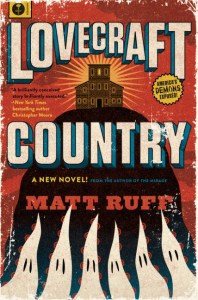 How aware were you before production of a) Lovecraft and his stories and b) the original book on which this is based?
This may come as a surprise but I’ve never read H.P. Lovecraft’s books. However, in 2017 I read the novel Lovecraft Country by Matt Ruff, and instantly became a huge fan. Once the trades announced the project, I pestered my agent to arrange a meeting and was determined to design this exciting story. During my interview I made a passionate pitch to Misha Green of how much this project meant to me both as a woman and as an artist. I related to the deep humanity of the flawed protagonists, and to the raw political climate of the 1950s, which caused so much suffering to Black people. There is a line in the script, “Some stories stab you at the heart”, that fueled my passion, so I was elated when Misha invited me into her creative orbit.
What were your primary inspirations for the series – and how much did you have to alter them to fit the requirements of the show?
 Misha Green and the writers specifically set the first season in 1955, the year Emmett Till was brutally murdered. As a designer I always strive for emotional and historical authenticity, so bringing the 1950s to life was the foundation of the overall look. I felt that it was important to root all the characters in the reality of Jim Crow America. I developed specific color palettes for each character that mirrored their complex inner lives.
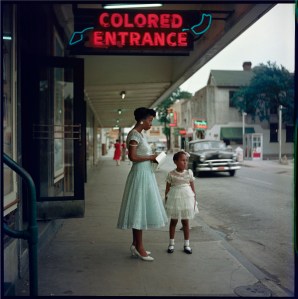 My departure point was the tremendous amount of research done on Chicago and America in the 1950s. There is so much photography preserved from the period, and perhaps most important was the work of Gordon Parks. Once that foundation was in place, I was ready to let my imagination fly to each direction the scripts called for. I also wanted to examine the period through a modern lens, bringing complexity and richness to the past, making it relatable to contemporary audiences. The environments needed to brim with life, so that the viewers feel seamlessly transported into each world.
When Hippolyta is in the parallel universe it felt like we were seeing 1960s and 70s pulp brought to life – what were the touch points for this sequence? And what inspired the retro tech for this?
 Episode 7, “I AM,” was perhaps the most challenging script anyone had ever handed me. I should mention that all the scripts were ready before we started the prep work, so Hippolyta’s journey was well mapped out in advance. Developing the many worlds she travels to was an entirely different matter, that took months of drawing and imagining. Misha gave me a carte-blanche to dream and dazzle.
The central theme of a woman made to feel ‘small’ who finds her true self, spoke to me as an artist, woman, mother and political refugee. I grew up in a drab communist country, and as a teenager often day-dreamed about living in a world of color and joy. So I channeled that young Bulgarian dreamer to embody Hippolyta’s creative, curious and intelligent mind. The goal was for the audience to put themselves in the character’s shoes and time-travel to strange and magical places. I wanted the colors to grow more shimmering with each place Hippolyta visited.
 I also wanted to play with the concept of a sphere to best describe Hippolyta’s astronomical mind. Planets are round, and that shape became my primary template for designing “I AM”. In addition I spoke at length with the writers about Afrofuturism, and Sun Ra’s Space Is The Place, which had a huge influence on all of us.
Going back to the central idea of circular design, it’s first revealed in the Kansas observatory set. Misha and I settled on 1930s Deco architecture for the interior of the abandoned building. I designed the floor to look like a sky with stars to bring the universe inside and to foreshadow the time-travel sequence. We built our own telescope, and then aged everything to look like it had been left in the elements for thirty years.
The next circular set was The White Room on Planet 504, where Hippolyta meets the eight-foot tall Beyond C’est. I originally looked at African braids as inspiration for the room and the planet. My preliminary sketches experimented with the whimsy of braid styles in an effort to capture Hippolyta’s mind. From there we developed the room into a glowing, elegant place with star-like lights embedded into the twisted columns. It’s supposed be a prison cell 200 years in the future, so an observant eye would notice that the floating building on Planet 504 looks like a warped sphere with prison bars.
 Another circular set is the Kingdom of Dahomey’s Fighting Pit, where Hippolyta trains to be a supreme warrior. I also incorporated circles into the design of the rocket ship which lands on Planet Nelus, along with its aliens’ rotund bodies. And if you look closely at the branches of the planet’s trees, they have circular craters embedded in them.
When I was designing the planets, I looked at 1950s science fiction book covers and films. I was also thinking about my favorite childhood book, The Little Prince. At the same time I kept a modern sensibility to the shapes, colors and architecture, since I wanted the sets to feel both nostalgic and fresh at the same time. It was challenging, but so much fun!
Although the sets felt ‘authentic’, there were many occasions when you could look at a scene and know a certain character was involved. When multiple characters were involved how did you decide which aesthetic would win out?
When I design a set I always ask the question: what character made the color and decor choices, and how much money did they have?
 Was it a conscious choice not to have people smoking?
The decision to not have people smoking was made entirely by Misha.
Was there any particular source of inspiration you drew on for the Lovecraftian creatures like the Shoggoth and the nine-tailed fox?
While I was involved in crafting the final look, Misha Green and the VFX team were mostly responsible for the creatures.
Can you tell us about the design of the Winthrop house – did you have all the episode requirements before shooting began?
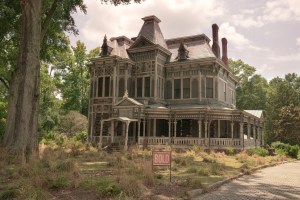 Misha Green and the writing team produced all the episodes before I came on board with HBO’s approval. The daunting part was that I had to design 600 pages at once – that’s four normal-length films. Finding the Winthrop house was a big challenge, and the one we finally settled on was in perfect condition with immaculate wallpaper inside. I knew that we could transform it into an abandoned house by aging it, adding dead vines and grasses, boarding up the windows, etc. However, it was a historical house, and we were not allowed to nail anything to it to create a dilapidated look.
I remember sitting outside the location and wracking my brain over how to show that the structure is falling apart, when an idea came to me. If I couldn’t break any of the veranda columns, what about adding an awning in front that is detached from the house? I went back to my office and drew the idea. I also added a fallen gate in the foreground. Those two architectural additions made all the difference.
 The next step was transforming the ground floor of the location into Hiram Epstein’s former home. We covered the existing wallpaper with our own, and aged it. We changed all the furniture and added the elevator; this was done so that the camera could film seamlessly from the street to the ground floor. Then I designed the second and third stories, plus the basement and subterranean hidden chamber as stage sets. We used the staircase as the connecting tissue between the floors, and it worked flawlessly. Each floor had a distinct personality, since they represented Hiram’s backstory and family life. The idea was that his wife picked the wallpaper and decorated the rooms, and after she died he was left alone to do his gruesome experiments in the sub-basement. The ground floor had the most elaborate wallpaper, since that was where Hiram and his wife accepted guests and entertained visitors. The second story was their personal quarters, and the third story was the former servants’ quarters. I love telling the back story of the characters through architecture, color and set decor.
What was the biggest challenge you faced during the shoot?
 The biggest challenge in designing a television series is having enough time to produce the sets on schedule. Anticipating this, I started the concept process very early in order to execute the vision. I had two things going for me: a great art department, and Misha Green who gave me carte blanche to dream. My hat goes off to everyone in the art, set decor, construction, paint and prop departments. In addition I had a great partnership with the VFX department, which was spearheaded by Kevin Blank. The collaborative process was great fun, and rather smooth for such a big and elaborate show.
Which set do you think works best on screen – and are there particular elements of any of them that people should go back and look at that they might have overlooked before?
There are more than 162 sets in the series, and each episode takes place in a different time or universe. That’s like having 162 children from all over the world, and being forced to pick a favorite.
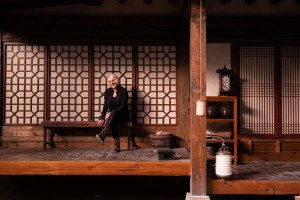 Let me answer this in a different way – the set that was most unusual to design was the hanok (episode 6), as I’ve never been to Korea. This meant that I had to research and understand a culture I was unfamiliar with. I strive for authenticity, and I was incredibly lucky to find a set designer of Korean descent. She was very talented and resourceful, and she found articles in Korean that described the architectural principles behind the hanoks. Once I was able to understand why the homes were designed in such a specific way (i.e., the kitchen is below the living quarters to emanate heat, etc), I was ready to create the spaces. I’m very proud of that set for its accuracy and beauty.
Another set that I loved was in episode 4, History Of Violence. For the Boston Museum I pitched Misha Green the idea of a large statue of Titus as the portal to the hidden chambers (the original script called for a trap door in the floor). For me, Titus was like Columbus, an evil man glorified as a hero. I wanted the statue to dominate the room, and specifically designed the crocodiles with their bare teeth flanking it to reflect the shoggoths’ mouths.
 Once our protagonists enter the statue, they climb 20 feet down into Titus’ chamber. I designed the chamber as if it had been carved out of stone, as a bridge between the beautiful man-made architecture of the museum and the organic earth tunnels. Much of my inspiration for the tunnels came from the Sudwala caves in South Africa, which are over 240 million years old and have a very warm palette. Creating the tunnels and figuring out how to submerge them into a large water tank was a great technical challenge, and the entire art department rose to the occasion. We submerged a sample of the painted walls in water for a month to make sure it wouldn’t peel and create debris. The water in the tank needed to be crystal clear so that the camera could shoot from both above and below.
For the ‘puzzle’ door, I turned to Lorenzo Ghiberti’s “Gates of Paradise” as an inspiration. That was the departure point for our version of a Garden of Eden riddle. We also made the sculpted panels practical to push so that the actors could interact with them. I believe in physical scenery, so it feels authentic not only to the performers but also to the crew; in this way the sets become an immersive experience for all. It worked very well on Lovecraft Country, and as a result we built a massive amount of sets for each episode.
Lovecraft Country is available to own now digitally.
Thanks to Jason Woodley for assistance in arranging this interview.
 Doctor Who News Star Trek News
 Sci-Fi Bulletin: Exploring the Universes of SF, Fantasy, Horror and Spy-fi!