Lovecraft Country: Interview: Costume designer Dayna Pink
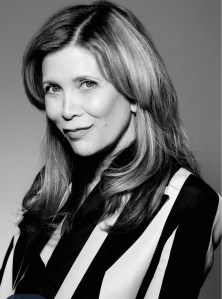
Dayna Pink is best known for her work as costume designer on multiple feature films, including the Baywatch and Bumblebee movies. Her work for showrunner Misha Green on the recent […]



Dayna Pink is best known for her work as costume designer on multiple feature films, including the Baywatch and Bumblebee movies. Her work for showrunner Misha Green on the recent […]
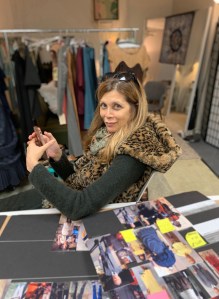 Dayna Pink is best known for her work as costume designer on multiple feature films, including the Baywatch and Bumblebee movies. Her work for showrunner Misha Green on the recent HBO series Lovecraft Country has drawn plaudits worldwide and as the show becomes available for digital download, she chatted with Paul Simpson about her time in the 1950s…
Thank you very much for the time and thank you for a fantastic series.
I wish I could take credit for it but… (laughs)
With something like this, if one piece of the puzzle doesn’t quite fit in, everybody jars their foot on it. So, I think if you or anybody had not been on their A game it might not have been what it is.
Were you aware of the book before you were involved with the project?
Of course I knew of it and I knew of Lovecraft, but I hadn’t read it before; the script was the first thing I read before the book.
Did you go back to the book at all or did you very much work from what Misha’s vision of it is? It is very much the book plus some, really.
I didn’t work from the book, I worked from Misha’s script
Was it one of those projects that you went after or did they come to you?
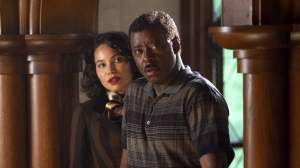 I knew the guy who was directing the pilot, Yann Demange. He brought me in for a meeting and I read the script.
I had never done television before, my background is in film, so I read the script and was so enamoured by it that I went in with an idea of how I would do it. My concept was: ground yourself in the period and then play from there, just like [Misha] did with the music, just like she did with other things.
I’m sure there’s a lot of costume designers that would have done it differently than I did it. You could have certainly stuck to that period and had it very traditional 1950s – have the shapes and all the fabrics and everything – but to me, there was more there than that. It wasn’t just the opportunity to stick to a moment, it was an opportunity to start from a moment, so that’s what I pitched.
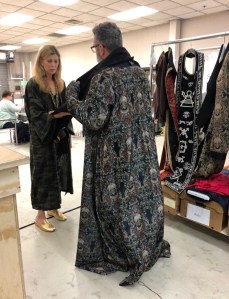 And that’s really what the whole series is, isn’t it? The minute that you add the Lovecraft element in we’re not tied to the real 1955. Is that a period that you knew that well stylistically anyway? Had you worked on anything that used 50s ideas before or is this a complete new world to you?
No one’s asked me that before. I had done little 50s things but not a 50s film or anything of this size before but I felt really attached to not only the aesthetic of it but what she was saying. There were so many interesting elements to this script, just the pilot alone.
I pitched the idea of grounding it in the period and making it bounce off there and then using modern fabrics. I stuck to the silhouette of the 50s, so the shapes are 50s – some are 40s: Christina’s 40s, she’s more noir.
I was so in love with the pilot, I didn’t plan on doing the show but then I couldn’t not do the show. Once we gave birth to the characters, and we did all the extras and created this world, I was just never going to not be involved in the whole thing. I just fell in love with the people and the whole story.
It’s one of those moments isn’t it, when you think you just can’t let somebody else have as much fun as you’re having doing it.
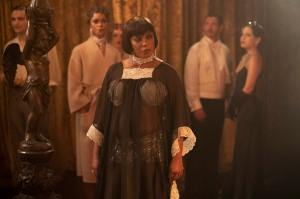 Completely! I was creating these things and it was like, what if? It was the what if? of it all and it’s just a rare opportunity for us to get the what if? Everything is a what if? in its own way but this, the magnitude of what we could create… We went to the future, we went back to Paris, we created warriors and all these amazing thing that were just whatever we wanted them to be, which was a really cool opportunity.
Personally, do you like this sort of what if? fiction – is it something you choose to watch?
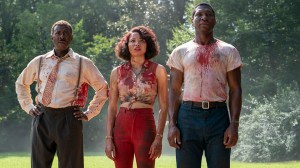 Not usually, but I never was making a horror show. People talk about it being a horror show but I never made a horror show. I never approached it like a horror show or thought of it like a horror show. The only thing was they’re going to get bloody so we need a lot of multiples [extra copies of the costumes when one got dirty]. So, there’s a horror element there but otherwise, it was so much more, it was so many things that I didn’t approach it like one genre. I just approached it like a storyteller I guess.
Did you have moments where you looked at something and just went, ‘That’s just not working, I thought it was going to but it doesn’t’?
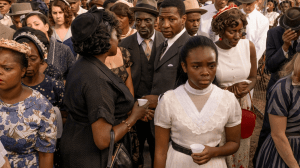 It’s so interesting because the things I was worried about never made it. There were things: I care about every sock. We dressed 4,000 extras from head to toe, we put every shoe. Everyone wore the proper bra, the proper underpiece. Of course there are things that I was worried about, when I would go to set and see that shirt’s not staying tucked or whatever.
Whatever Misha’s magic is, almost every single thing that I lost sleep over never made it. It really was like the perfect storm of all of our visions put together. I don’t know if it was on purpose or by accident but literally the things that I was worried about, you never saw.
You know when sometimes you’re watching something and you notice something and it takes you out of the moment? That didn’t really happen for me. I’m pretty proud of my team and what everybody accomplished and I didn’t have that moment.
What was the biggest challenge for you overall of the production? Obviously every day has its specific, every costume had its specific “oh my god how are we going to do this?” moment. But just looking at the whole project, the whole 9 or 10 months, what was the biggest challenge you faced?
Well, [the] television [schedule] is the biggest challenge I faced because on a film, you’re prepping it and shooting it together but on television you’re prepping an episode, shooting an episode, prepping an episode, shooting an episode. There’s never that moment to stop.
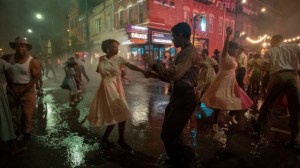 I did Bad Boys 3 before I did this and [if they’re shooting] a chase scene for two weeks, you’re prepping. You have moments you can catch up with yourself but on this, there’s no moments. You are on a hamster a wheel the whole time because you’re shooting and prepping simultaneously. Just when you think “Great, 1×04, we did it, fantastic”… then someone’s tapping you on the shoulder: “OK, we have fittings for 1×05.” It’s just constant.
We had a lot of extras and we went to a lot of periods, so we were never just going back to a closet and pulling things. ‘Let her wear the same’? No, it was not that at all. Everything was new, everything was moving forward; their arcs, their characters all changed so we never got to sleep in!
Obviously for the 50s elements of it, there are books and newsreels that you can go and look at as something to kick off from but what about the fantasy costumes like the superhero outfit and that gorgeous costume right at the very top of the show. If you’ll pardon the pun, were they just from whole cloth from your mind or were you influenced by particular things?
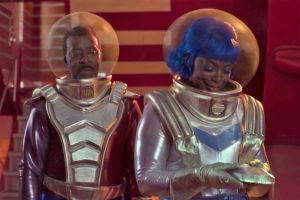 We did research all those things, taking little elements and inspiration from other things in history and we definitely had things in mind. It was very cartoony; the spacesuits were very cartoony and based on that idea.
Our whole office was covered in photos and boards and inspiration and they would change as the episodes changed. So, it all is based on inspiration from other places but it’s like making a soup, I guess: you take ingredients from all over and mix it together and make it your own.
It’s like a writer friend of mine used to say, all you need is a good idea, it doesn’t have to be your good idea! How much input or feedback was there from the actors on their costumes once they started getting into it? The female leads had some gorgeous outfits.
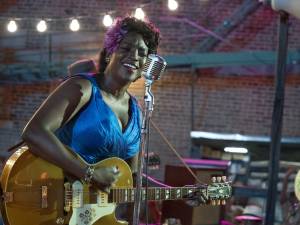 Oh thank you, thank you. I think my job is to be a storyteller and to be a collaborator at the same time, so Misha’s input and all the actors’ input, you take everything into consideration and then at the end of the day I’m coming up with all those things combined.
So, definitely Leti became Leti and we knew who she was; I could look at her and say “What would Leti wear today?” Because she has a style, Christina as well and Ruby… Making Ruby so sexy was really wonderful for us. So yes, I take into consideration and I work with the actors and try to help them find those characters, and then from there we get to come up with whatever we come up with and surprise and delight them hopefully.
What outfit surprised you most that worked so well on screen? Was there one that you just thought ‘I knew it was good but that’s good!’?
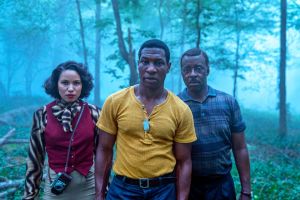 Yes, there is and you’re going to be shocked at what it is but it’s so simple: Atticus’s mustard Henley in the second episode. It was a gold Henley next to Leti’s red vest –just watching how they crossed those colours and how golden that looked and how beautiful he looked in that Henley, I mean, he’s beautiful in everything and I knew when I put it on him that he was going to look great in it but I didn’t know how wonderful it was going to work in the woods, the way they shot it and the way it came out. That gold Henley to me was gold, it was everything.
Did you go on location with them or were members of your team out there doing that?
I established every look so every time they’re wearing something new, I’m there on set with them. Then once the cameras start rolling there’s people there that watch and make sure that it all stays the way it’s supposed to.
Looking back on it, what was the element that you really didn’t expect?
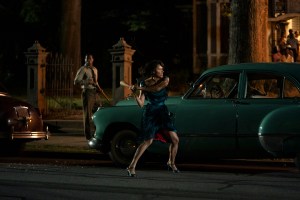 Well, I think you get attached in another way in television because it is such a long process and you’re there for ten months. Because we’re not fitting it all at one time, you’re growing as the characters are growing. So you’re really getting to know them, and since you’re not already committed to something – we’re not shooting the last scene first – as it’s going along, you’re changing your view or perspective on what something’s going to be.
If I’d prepped the whole show at the beginning and then shot it, I don’t know if Leti would have been as deconstructed as she was because she was so glamorous at the beginning. As the episodes were going and everything was happening to her and she was in it, she really was [asking], “Where would I even get that?” We ended up putting her in Atticus’s clothes, putting her in clothes from Dee’s closet and I don’t know if we would have de-glamorised her as much had I prepped it all at the same time. I think what happens in television is you get the opportunity to grow and evolve and change what you’re thinking along with the characters instead of committing to something at the beginning. Does that make sense?
 It makes perfect sense. What have you brought away from working on Lovecraft Country that you wouldn’t have expected to bring away? It’s the flip side of that last question.
I’m really proud of being part of it; not that I wouldn’t have expected to be proud but I really am proud of the show in a different way than I’ve been proud of other work before. Because of what it is and what it says for itself, I got to combine my art with my heart and that was really cool.
I don’t know if it’s unexpected but it really happened in an amazing way and with all the events of this year as well, I really felt the kismet of being involved in that show at that time.
Being able to still do my art was a huge gift and I will forever be grateful to Yann for bringing me in and to Misha for letting me tell the story.
Lovecraft Country is available to download and own now.
Thanks to Jason Miller and Jack Everley for their assistance in arranging this interview.
 Doctor Who News Star Trek News
 Sci-Fi Bulletin: Exploring the Universes of SF, Fantasy, Horror and Spy-fi!