Lovecraft Country: Feature: Commentary on episode 5
Stewart Hotston’s examination of the themes in Strange Case… I found this episode excruciating. It’s a word I may well use again in what follows. It’s also an episode that […]



Stewart Hotston’s examination of the themes in Strange Case… I found this episode excruciating. It’s a word I may well use again in what follows. It’s also an episode that […]
 Stewart Hotston’s examination of the themes in Strange Case…
I found this episode excruciating. It’s a word I may well use again in what follows. It’s also an episode that I think will send some people away for good – not knowing what to make of it and I suspect they will almost universally be white and male.
I suspect those complaints will be about it being too pulpy or too overwrought or that they can’t see the motivations for the characters making the decisions they’re making.
And I’ll tell you right now why they feel disconnected from the show: it’s about privilege up and down and through its marrow. The complaints want the show to be ‘serious’ about the BIPOC experience as if that was the only way to have merit for them. They want it to present these issues in ways those who’ve never experienced the wrong end of the endless meat and gristle of structural disadvantage can understand. They want to feel righteous for watching and entertained as well.
And fine. Goodbye to them. I’m a little sad to see them go. However, I’m also exceptionally glad a show like this can be made – where the experience of BIPOC is examined from within its own context without sitting down and educating ‘the white man’. Because if it did that it would lose the entire point of its existence – which is that of a show representing BIPOC in a specific time and place and referring only to their experience from in their own context.
If it was a book (yes, I know), it would be standing on a street corner refusing to italicize its pidgin English and use of slang.
That’s not to say the show doesn’t have its problems. I am not sure what to make of its presentation of LGBT+ characters. It’s not a part of the context I’m well prepared to comment on but what I am watching is showing a specific character in a difficult light. I don’t know how making his sexuality part of that is working. For me the two elements – his sexuality and his apparent moral failings – appear to be too tied up for comfort but I’m sure other, better qualified, people can comment more effectively than me.
That’s a whole long way of bringing us to the actual episode.
This episode is titled ‘Strange Case’ but it could just as easily have been called ‘The Case of White Privilege’ or ‘The Case of Getting What You Wished For.’
There are multiple threads this week, each given a decent amount of time to breathe. We see more of Montrose, more of the consequences of an unspeakably grim act he undertook last week and how it continues to tear him to pieces. Yet he holds on, because in the end the idea that we do something and then simply stop is not what actually happens. In reality we live in the aftermath and we see that hollowing out, that living with the filth of what our decisions make us on full display in Montrose’s thread. In some ways he is the least reliable POV we experience and I think that’s deliberate. If there’s no gore in his life this episode, it doesn’t make watching him collapse emotionally any less harrowing.
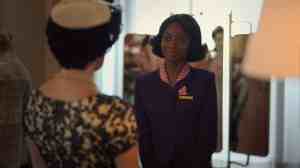
Yet it’s Ruby Baptiste, played by Wunmi Mosaku, who steals the episode, and perhaps the entire show so far. She is offered a chance to do whatever she wants, is offered a freedom she didn’t even know was possible. She takes it like the drug it is to those who’ve lived with disadvantage every single moment of their lives.
The shows asks her, and us, whether power corrupts those with good intentions.
I think it goes so far as to ask if White People are corrupted simply by virtue of the fact the society they’ve created provides them with power deliberately not available to others.
If you woke up and discovered that the world viewed you entirely differently than when you went to bed what would you do with that power? If you could turn up and be rewarded then what? What if all your hard work suddenly counted, not simply as grinding you up the ladder to protect for inevitable calamities but as providing an unassailable right to security?
It also asks whether you can, when power lands in your lap, remember who you are or are you doomed to lose yourself. In shorthand – do you pull the ladder up behind you?
Every step of her journey gives her all the privilege of being white and then puts her right in the spot of seeing herself from the outside. At first Ruby does the things she always wanted to do but which had previously been denied. Small, tiny accomplishments. Then she realises what being disadvantaged has done to her – how it shrank her ambitions and horizon down to almost nothing. It’s then she starts to think, then she realises both her true power and what using it does to other people.
There are two extraordinary scenes (neither for people of a squeamish disposition) which lay out in all the gory details what it means to have power and in both we see Ruby waking up – and it’s not necessarily a journey to being a ‘good’ person. I found it hard to watch because each decision she was faced with felt like blade to the face. The allusions to Dorian Grey are brilliant.
I also want to talk a little about Tic and Leti. We learn a lot about them this week – not action but character. Once again they do so much remarkable work with their bodies I am left breathless. They discuss role models and the place of violence in communities and families. And it’s here the show ends – with two revelations about family and identity that take us somewhere unknown and leave me salivating for next week. I’m not going to say anything about them except one hints at a past which has been gently teased to us but now moves centre stage. And the other? The other changes the threat for everyone.
 Doctor Who News Star Trek News
 Sci-Fi Bulletin: Exploring the Universes of SF, Fantasy, Horror and Spy-fi!