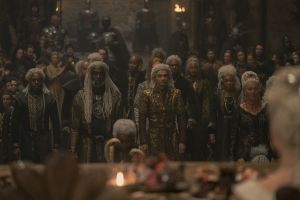
 Daemon returns to the vale to see his wife. Viserys reaches an accord with the Valeryons over the marriage of Rhaenyra. Alicent continues to probe for the truth about the princess.
No getting around it, elements of this week’s episode of House of the Dragon are really quite distasteful, and finding out that all creative minds responsible were heterosexual leaves somewhat of a nasty taste in the mouth. As if it weren’t bad enough that the show continues Game of Thrones’ obsession with sexism for the sake of ‘authenticity’ (guys, it’s a made-up world) now we have to slip in some good old-fashioned homophobia as well. Bravo, guys, bravo indeed.
Still, now I’ve got that off my chest, how is the episode as a whole? Interesting, if only for the fact that it emphasises a more palatable truth which the show shares with its forbear – nobody here is nice. Some may be admirable in their bravery, their tenacity or their simple cunning, but not a single one of these characters is actually a fundamentally decent person.
Viserys and Rhaenyra, having reached mutual agreement that she must be married if only for the form of the thing, broker agreement with the Valeryons for her to marry their son. One small hitch you might think is that their son happens to be gay – something his father thinks he’ll ‘grow out of’. Turns out that isn’t really an issue at all given that Rhaenyra isn’t really all that interested in having a husband so much as a token to secure her throne and shut everyone up.
Daemon proves that for all the complexity he has been shown to exhibit he’s also a completely amoral bastard when it suits. Returning to the Vale to see his wife (about whom he never seems to stop complaining so far) their reunion is… not a happy one. While it’s clear Daemon isn’t completely heartless and does have the ability to care for some people, his wife clearly isn’t one of them, as if that were ever in doubt.
Alicent meanwhile is still trying to get to the bottom of exactly what did happen the night Rhaenyra and her Uncle were spotted by her father’s spies. In doing so she ends up questioning Ser Criston, and in what could be – in another, more light-hearted show – a hilarious mixup, discovers more truth than she was expecting. Ser Criston, already distraught at the thought of Rhaenyra’s impending nuptials and apparently very concerned with the vows he swore as a Kingsguard now he’s not got his pants off, is desperate to confess, though doesn’t get the reaction he expected.
And so to the feasting and merriment of the wedding itself, and that’s where things get suddenly and inexplicably uglier. Bad enough that the writers have decided Westeros must be homophobic because ‘that’s what it was like in medieval times’, but the way things unfold here is about as trope-laden as it could be in the worst possible way, and it just gets worse. Poor form indeed, but we do end up with an oddly fitting contrast to the last famous wedding related to this franchise overall.
So it’s really a mix. At its best, it’s the most compelling, entertaining cut and thrust of political machination and the naked self-interest of every single character. At its worst, it’s backwards-facing, hackneyed stuff using thin excuses to trot out problematic nonsense. Ironically, the more it carves out its own identity as a show, the more it echoes its predecessor.
Verdict: Fantastically entertaining political intrigue and dastardly deeds somewhat undercut by some really poor choices by the writers. 6/10
Greg D. Smith




 Sci-Fi Bulletin: Exploring the Universes of SF, Fantasy, Horror and Spy-fi!