Game of Thrones: Feature: Season 7 Recap
After a gruelling two year wait, the final season of the phenomenon that is Game of Thrones is almost upon us. Strange and desperate alliances have been struck as the […]



After a gruelling two year wait, the final season of the phenomenon that is Game of Thrones is almost upon us. Strange and desperate alliances have been struck as the […]
 After a gruelling two year wait, the final season of the phenomenon that is Game of Thrones is almost upon us. Strange and desperate alliances have been struck as the world of men braces itself to meet the onslaught of the Night King and his undead army – bolstered now by a zombie dragon – and suddenly it’s less a question of who will sit on the Iron Throne so much as whether there will be an Iron Throne on which to sit. Greg D Smith provides a quick recap of the last season for those desperate to get their Westeros on.
If there’s one thing on which most Game of Thrones fans can agree, it’s that the series is at its best when it’s providing epic moments, and Season 7 certainly did not disappoint on that score. We finally saw Daenerys unleash the full fury of her dragons on an army (and the spectacular mess that it made); we finally saw Littlefinger get his long-overdue comeuppance; and we finally saw the army of the dead collapse a section of the Wall and begin its long, deadly march towards the lands of men. Season 7 felt like a culmination of its own in so many ways, giving us reunions, new alliances and a whole lot of action while also notably scaling back on the levels of gore and nudity for which the show has always been famed.
But with all that said, as epic as those bigger moments were, it was in the smaller, more intimate moments that the show really lingers. The impressive meeting of Daenerys and Jon Snow, with its back and forth, was no less enjoyable for playing out almost exactly as we might have guessed. The stubbornness of each played adorably off the other, with wiser counsel being offered from the sidelines by the impressively educated Tyrion and the equally impressively worldly Ser Davos. It was never really in doubt that these two rulers would form an alliance together, but the fun was in the journey, and what a journey it proved to be.
 Cersei continued to prove why she’s managed to stay at the centre of power in Westeros for as long as she has by remaining every bit as devious as ever. Alliances of convenience, and some unorthodox military tactics saw her claim several victories, not least the annihilation of Highgarden and the subsequent annexation of that House’s lands and gold, ensuring the Iron Bank would be paid their due.
Lady Ollena and Jaime’s last scene together was another of those quiet moments – we didn’t need to see the battle which we knew would be one-sided, but the conversation those two shared was electrifying. Olenna’s confession, that she had been the one to murder Joffrey, didn’t provoke Jaime to further violence, once again raising the question as to exactly how fond Jaime ever was of his least appealing son, and Ollena clearly relished the chance to confess her deed.
 Back at Winterfell, Sansa also proved, in her brother’s absence, that she was as capable of leadership as needed. The running subplot of Littlefinger setting her and the newly-returned Arya at odds with one another was tense, spinning out over several episodes only to be resolved at the end with the Lord Baelish finally reaping the reward of his years of deception and manipulation by having his throat cut. This, and the scene in which Arya sparred with Brienne, were two of the most memorable scenes in the entire season, proving that you didn’t need big battles or massed violence/nudity for true impact.
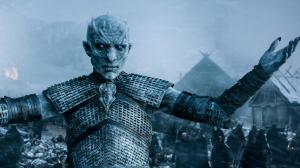
And the ongoing march of the dead reached a stunning conclusion, as Viserion was killed by the Night King and then reanimated to serve as a zombie dragon, whose fire was now powerful enough to demolish a section of the Wall and admit the army of the dead into the lands of the living. As final shots go, that destruction and the silent march of the dead into Westeros has to be among the best that the show has managed.
 And so now we wait to see what these final episodes bring us. The dead march, the living form complicated, complex alliances to which not all of them are fully committed. Will Cersei’s mercenary pragmatism survive contact with the Night King’s threat? Will Jon and Dany’s relationship prove an added complication in the fight to come? Will Arya even have time to tick the other names off her list before the war against the dead starts claiming everyone? And who will, finally, sit on the Iron Throne and rule the Seven Kingdoms? One thing remains certain – this has to be, globally, the most anticipated television event in modern history, transcending considerations of genre like nothing before it. However the story ends, Game of Thrones feels like it has made an indelible mark on television as a whole, and the medium feels all the better for it.
 Doctor Who News Star Trek News
 Sci-Fi Bulletin: Exploring the Universes of SF, Fantasy, Horror and Spy-fi!