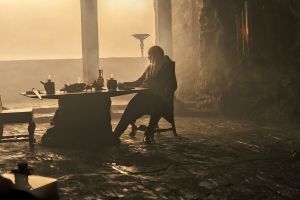
 Six months on from the death of his queen, Viserys finds himself under increasing pressure to choose a new wife. That pressure is not helped by the continued belligerence of his brother, nor the threats to the shipping lanes from the Crab Feeder.
Right out of the gate, this episode has Game of Thrones imprinted on it, with its predecessor show’s original theme tune playing over an opening credit sequence which also forcibly echoes it, and yet, that really isn’t a bad thing.
In the opening episode, I worried whether House of the Dragon could be its own thing, yet here it contrives to be exactly that, while evoking the same feeling and cleverness that Game of Thrones showed in its earlier seasons. It isn’t that this show will ever not feel related to its predecessor, but more that it can tell stories which occupy the same space (albeit in a different time) and introduce us to all sorts of new characters, intrigue and adventure.
Six months have passed since Aemma’s passing, and all is not well in Kings Landing. The throne is perceived as weaker, and that means trouble. In the islands through which the realm’s most important shipping lanes run, the Crab Feeder and his followers wreck ships and torture their sailors. Lord Corlys, practically about to burst from the pressure of his own ambition, demands restitution, but Viserys is reluctant to act and provoke a war.
Daemon has taken over Dragonstone, ancestral seat of the Targaryen line, and is effectively in open rebellion, taunting his brother with news and an act which Viserys can ill afford to ignore, but the king is reluctant to spill blood for Dameon’s foolishness, and even when roused to action, is overruled by a Hand who clearly holds ambitions of his own.
The question of succession is on everyone’s mind. Named as heir, Rhaenyra finds herself belittled by all around her. The Council treats her barely better than a servant girl, her father won’t allow her to act and others take every opportunity to remind her that as a woman, her claim is only steady until her father re-marries and produces a male heir. Rhaenyra though, is not her father, and chooses her actions carefully and wisely, for maximum impact. Here perhaps is a worthy successor indeed to the Iron Throne, as politically astute as she is fearless.
Viserys finds himself increasingly backed into a corner on the subject of remarriage. He has little interest, bereft without his wife, yet all his closest advisers are pushing him towards a decision which seems inevitable (and in all honesty slightly sick-making). A king who seems so easily herded can surely only make one choice, unless others are manipulating him more cleverly from the sidelines.
It is all rather deftly done, invoking the same feelings of cloak and dagger politicking, backstabbing and epic conflict brewing that Game of Thrones did before it, but feeling subtly different in important ways. Matt Smith continues to have obvious fun as Daemon, who remains an enigmatic character indeed, obviously impulsive and vicious but not without heart and humour as well. Paddy Considine plays Viserys well, a man who you can see rose to and has maintained his position through guile as well as strength. He may appear to be a weak man, driven wherever the winds blow him, but he’s clearly astute, happy to let others underestimate him and reap the rewards of their mistakes. Rhys Ifans though, may be the standout so far as Otto, the King’s Hand. The position always gives interesting characters and Otto is no exception, a man not quite on the levers of power but always happy to give them a nudge in a direction beneficial to him when nobody’s looking.
Truth be told though, there are no uninteresting characters here. It’s a very strong second episode.
Verdict: Firmly grasps its own identity while echoing its predecessor in all the right ways. 9/10
Greg D. Smith




 Sci-Fi Bulletin: Exploring the Universes of SF, Fantasy, Horror and Spy-fi!