For All Mankind: Interview: Ronald D Moore (Season 3)
As part of the launch of For All Mankind’s third season, Greg D. Smith chatted with the show’s executive producer, Ronald D. Moore, about the characters that populate the series… […]



As part of the launch of For All Mankind’s third season, Greg D. Smith chatted with the show’s executive producer, Ronald D. Moore, about the characters that populate the series… […]
 As part of the launch of For All Mankind’s third season, Greg D. Smith chatted with the show’s executive producer, Ronald D. Moore, about the characters that populate the series…
Krys Marshall [who plays Danielle Poole] told me she loves the collaborative nature of the show, as an actor, and how she’s able to give input on her character. How much of the actors that you cast ends up bleeding into the characters as you write them, or do you have a set path for the character to which you mould the actor?
I think there’s always a melding of the two. In television you come up with these characters, and then you cast somebody; once you’ve cast them and you start watching them in dailies, you start hearing their voice and seeing their strengths and weaknesses. You start saying, ‘Oh I can give this person more comedy’ or ‘this one really likes action’ You start writing to them; you hear the way they deliver dialogue and the character changes. The character starts to become a little more about how they’re portraying the character, and who that particular actor is, so it’s definitely a melding of the two.
Do you have a favourite character to write for?
I really don’t. I’m usually asked that on almost any show and the truth is I seldom have a favourite character. There’s usually favourite scenes, and there’s favourite episodes. There’s things that are fun to do with all of them. And part of the thing about being a writer for an ensemble like that is you find, ‘Oh I can’t wait to write this for that character’, because they’re all kind of specific ‘Oh a great Margot scene, that’s gonna be fun’ which is different than ‘Oh a great Ed Baldwin scene’. There’s these individual joys that you find in the individual characters.
Both episode 7 in season 1, Hi Bob and episode 8 in season 2 And Here’s to You, that you wrote involve some deeply personal tragedy for characters and quite seismic events in the arcs of the show. Were you drawn to writing that particular kind of episode or was that just how it worked out in the writing process?
 A lot of it just has to do with the batting order of the writers and which one needs to be done at what time. But I was drawn to those episodes also on a personal level.
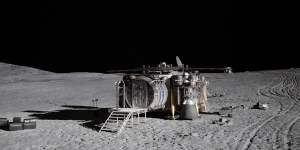
I liked the challenge of Hi Bob: I love the concept of it and I really liked the idea of writing for these characters trapped on the moon with just one episode of Bob Newhart. I just loved that conceptually.
Then in the second season, And Here’s To You was very intense and I relished the challenge of it. But I think both of them came up because of where we were in the production schedule.
I did notice that in the little alternate history titbits that you like to squeeze into the show in the montages, there’s a bit of a running Beatles theme. Is there a Beatles fan on the writing staff?
Everyone’s a Beatles fan! I really led the charge on that. Going into the second season I was adamant that John Lennon was going to live. In fact I had ideas that he was going to be a bigger presence in the background of the tests than ultimately he was. Although we maintained a lot of the things that I wanted to do with him as a peace activist, and then having a concert for peace and all that, originally we talked about having a Beatles reunion as a peace concert at the climax of season 2 but it was too many things. There was so much going on in that finale that it was like, well you can’t do this as well. But then we thought, Yeah, of course they would get back together, they would have done it, it would have been great, it would have been fantastic and they would’ve sold out everywhere, so why not?
 We’ve done the moon, we’ve now on Mars, how far realistically do you think you can take the concept?
I think you can take it pretty far. I mean space is big, as Rick Berman used to always lecture me on Star Trek, when I would do things that were too small. I think space exploration is a very broad term for what we can do with the show.
It’s not always about going to the next celestial objects; sometimes it’s about expanding where you are. At the beginning of the project we talked about at least a seven season arc, so I feel confident that there’s at least seven seasons of story in our future, potentially more.
With the new character Dev, the thrusting entrepreneur getting involved in the space race, was there any temptation to draw inspiration directly from certain contemporary people doing similar things at the moment, or did you shy away from that?
We specifically talked about not doing that, because we didn’t want it to be just a parody or a caricature of a particular person in our modern reality. However, it’s hard to ignore those entrepreneurs and what they’re doing, so we wanted to have our version of that in an alternate setting and play it into the show because it felt important to talk about the entry of private enterprise into the space race, particularly an entrepreneur who would have those kind of resources. How does that change the dynamic of space travel in our reality? But we really didn’t want to make it ‘Oh here’s our version of Elon Musk’ or ‘Here’s our version of Jeff Bezos’ because we just weren’t interested in that.
 For a show that started from what seemed like a fairly simple conceit of ‘What if the Russians made it to the moon first?’, is it difficult to develop from that? Do you find it a challenge to keep building from that given that once you’ve started from that point, all of history diverges?
The fun and the challenge was always that. The show conceptually was about ‘What if there was an alternate version of history where space travel became much, much bigger, and NASA did all its big ambitious goals that it abandoned in the early Seventies after the Apollo mission?’ So right from the beginning we were talking about building a different world and a different history, and [going] towards a goal, towards a positive future, towards a way of showing that space travel could enrich the entire world and that we could live in a better society as a result of that. It’s a very idealistic idea. It’s certainly rooted in my history of Star Trek and ideas like that, so from the get-go that was always what we set out to do, and then it was a question of ‘Well how would that have happened?’ And that took us to ‘Well what if the Russians got to the moon first?’
What’s fascinating to me about the show is, you thread in certain historical events such as the downing of the flight in season 2 which then takes one of your characters out. How do you choose what to keep and what to change – what informs that process?
 It’s just long discussions and arguments in the writers room – you start with the history of the decade that we’re looking at. What are the big things that happened that the audience knows happened? How do we change some of those things and what are the things that we choose to maintain to give the audience a sense of continuity?
There’s no real rule about what we choose to do and what we don’t. Usually you’re starting from a place of ‘First we have to talk about the space race. Where is NASA? Where are we technologically?’ And then, ‘OK, what have we already built?’ ‘Where’s the Soviet Union in the previous decade?’ ‘Where’s the United States?’ ‘What’s the geopolitical situation?’ ‘What’s going on in the culture, and is there any way we can say the culture is being influenced by the show?’
Some things are just fun, some things you just want to reference because it’s fun to do a Rocky clip or something like that, but if you can do a cultural reference that has meaning like with Gordo and Tracy, that’s really fun, so you’re just sort of always looking for those nuggets. We certainly start with a lot more ideas and a lot more concepts on the big board and then we just keep winnowing it down and down and finding the ones that will actually work for us.
Are there any sacred cows? Anything you would avoid going near in terms of using real events of diverging in some way?
 I’d have to think about that. There’s nothing that leaps to mind that we haven’t at least discussed. There were things that we’ve decided ‘No let’s not do that’ because maybe we felt it was in poor taste or maybe we thought we were just stepping on something that didn’t feel right for the show. But there’s nothing that’s just set off from the get-go as like, ‘OK we’re not going to do that.’
New episodes of For All Mankind are released every Friday on Apple TV+
 Doctor Who News Star Trek News
 Sci-Fi Bulletin: Exploring the Universes of SF, Fantasy, Horror and Spy-fi!