Fallout: Review: Season 1
War. War never changes. Imagine a sequel to Oppenheimer where the timeline goes a little bit wonky. One where the dream of nuclear families running households full of atomic-powered gadgets […]



War. War never changes. Imagine a sequel to Oppenheimer where the timeline goes a little bit wonky. One where the dream of nuclear families running households full of atomic-powered gadgets […]
 War. War never changes.
Imagine a sequel to Oppenheimer where the timeline goes a little bit wonky. One where the dream of nuclear families running households full of atomic-powered gadgets becomes a reality. Where vacuum tubes never go out of fashion, TV stays resolutely in black and white, computer monitors are always green on black and the scare of Reds Under the Beds never goes away. Where Nuka-Cola, America’s beverage of choice, contains 110% of your RDA of sugar. Where American culture freezes in the early 1950s and life is still soundtracked by the likes of The Inkspots and Ella Fitzgerald, plus a Crosby or two, forevermore.
And then on 23rd of October 2077 an ongoing Sino-American war comes to a close as the USA and then the rest of the world is hit by a barrage of nukes and in the space of two hours life on Earth is changed forever. Except for the lucky few…
By “lucky” I mean “rich” because America’s largest corporations saw it coming, and over one hundred vaults were built below ground for those who could afford it to continue to live the American Dream until such time as their descendants could rebuild. And by “lucky” I also mean “unlucky” because those same corporations might not really have your best interests at heart.
Cue a long running series of computer games, starting in 1997, with the most recent entry (the divisive Fallout 76) landing in 2018.
Executive produced by Westworld alumni Jonathan Noland and Lisa Joy, along with game publisher Bethesda’s Todd Howard and others, the series begins at the back end of the established Fallout timeline in 2296. Everything that’s happened in the games has already happened, so there’s the freedom to tell new stories without worrying about having it fit with established lore from after the events, so even someone very familiar with the games won’t have a clue where this is going. A wise move I think.
I’ll clarify this now – quite rightly you do not need to have played any of the games or have any knowledge of them whatsoever in order to follow and enjoy this (confirmed by fellow Sci-Fi Bulletin scribe Nick Joy). Anything you need to know is communicated, either by context or one of the flashbacks to life before the bombs hit. If you are a fan then of course there’ll be little moments of fan service to please you, in fact there are many; I’ll come back to those.
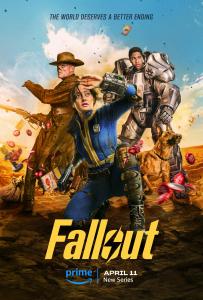
For this iteration we follow the interconnected stories of three protagonists. Our main hero is Lucy, played by Ella Parnell (Army of the Dead/Belgravia) who lives in Vault 33 with her father and brother as well as an hilariously small breeding pool of fellow descendants. With no suitable partner (her cousin is besotted with her but as she points out that’s fine for kissing but not so much for baby-making) a match from the connected but separate Vault 32 is on his way. This does not end well. Luckily we’ve already established, in a neat nod to how your game characters are created, that Lucy is particularly skilled at gymnastics, fencing, hand-to-hand-fighting, riflery, repairing and American History and also not too shabby at science. This particular set of skills (I couldn’t resist the reference as Liam Neeson voices your dad in Fallout 3) will unsurprisingly come in handy very soon. It’s a lovely performance from Parnell. The character’s bright and breezy, thumbs up, can-do, Holy Moley persona could have become grating in lesser hands but the doe-eyed Parnell (surely lined up for a Bette Davis biopic at some point) completely sells it. Seeing her try to maintain her positivity in the face of the horrors of the Wasteland is great fun but also not a little heartbreaking as she’s forced to toughen up.
Above ground we soon meet Maximus, played by Aaron Moten (Next/The Transfiguration), a trainee in the Brotherhood of Steel. The Brotherhood is a sort of technocracy modelled on Arthurian legend – Knights encased in (presumably very smelly) Power Armour are assisted by their trusty Squires, whose job is to essentially schlep a huge holdall full of weapons and survival gear. Another fun nod to the games inventory management, where the real-life mechanics of carrying around a shedload of materiel is somewhat ignored. Newly picked to be Squire to Knight Titus, a violent turn of events presents Maximus with an opportunity he really can’t not take advantage of, one that may help him get revenge on those responsible for the death of his family. Moten is excellent as this quiet, rather stoical, young man whose entire existence is tied up with what is essentially a cult intent on reshaping what’s left of society to their image.
Lastly there’s The Ghoul, played by Tarantino favourite Walton Goggins (Django Unchained/The Hateful Eight). Pre-war he was Western star Cooper Howard, whose public image and skills with a gun and a rope provide him with his post-war persona as a bounty hunter. His backstory is intriguing, with flashbacks gradually revealing his connection to the Vaults. Just how this gentle family man became an amoral gun for hire is probably the show’s best thread and Goggins convinces as both iterations.
Of the supporting cast the most notable is probably Kyle MacLachlan (Twin Peaks/Dune) as Lucy’s father, Hank. MacLachlan is first class as always, one of those actors I always delight in seeing and will happily watch in almost anything. Her brother, Norm, is Moises Arias (Hannah Montana), a major character who is key to solving the mystery of Vault 32. He’s aided and very much abetted by his heartbroken cousin, Chet (Dave Register). They make a lovely comic duo, the hulking Chet towering over his diminutive sleuthing partner.
As mentioned earlier there’s no end of fan service here, but I don’t mean little nods and winks in a “see what we did, how cool was that?” sense. Pretty much everything you see that has appeared in a game is just about exactly how it appeared in that game. The prefabricated walls and windows of the vault are spot on, down to the nuts and bolts. The ubiquitous blue and yellow vault suits all dwellers wear are as accurate as possible, tweaked a little mostly for real-life wear (they’re a little more forgiving of beer bellies and umm… packed lunches if you get my drift). The guns are instantly recognisable. The signage below and above ground respectively nails the future-retro and actual retro look of the originals. Magazine covers, bobbleheads, drugs of all types and even pre-war food (such as the delicious and trademark-swerving tinned meat Cram) are wonderfully recreated. At one point someone logs into a computer using the exact same hacking word puzzle as players have to. There are some reworks to make sense of it, for example the Power Armour has a facia that can be opened up, rather than having characters lug around their helmet when they need some fresh air. While that might annoy some fans it makes perfect sense for a TV version, you can’t have them just mysteriously disappear until needed again like in the games
Does any of that actually matter? Maybe not, but it is good for getting free pre-release publicity from fans based on the trailer etc; you want them onboard for their enthusiasm to trickle down to the non-gamers who will hopefully make up the lion’s share of the audience. It’s a wise thing to do – conversely, see the trailer for the long-delayed Borderlands for an example of how to completely turn off a fanbase (do not get me started, I’d be here all night and I’m still recovering from binge watching this all night). It also reiterates the fact that this isn’t strictly an adaptation of pre-existing material, it’s an addition to it. The average viewer of course won’t have any idea of the lengths they have gone to to recreate the world of Fallout. Where this really scores, and it’s far more important than the visuals, is the tone.
Fallout is weird. The premise is serious but also satirical and sometimes plain silly. The combat is terribly violent but also cartoonish. The main characters tend to be solid but the supporting ones are usually somewhere between eccentric and mad-as-a-box-of-frogs. The soundtrack is your ancestors’ easily licensed record collection. The outside world is harsh and unforgiving but still piles of fun to be in for the player. It is supposed to be fun and funny. That is transposed flawlessly to this series – it never forgets that while pressing the X button to fire a gun might be a big part of the gameplay, that’s not what makes a game memorable and arguably not fun to watch. The love for a game comes from the experience of being in that world, of learning about it, of solving mysteries, finding oneself involved in a well-constructed side-quest, coming to care about some of the characters and just getting invested enough to put many, many hours into it. I know I have spent more than a couple of thousand hours of my life playing Fallout 4 – and that’s not even the best one.
Take the music. There’s any number of very visceral scenes where combat more closely resembles Itchy & Scratchy than Tom & Jerry. No body part is safe from becoming detached from its owner. But it’s hard to be revolted when Johnny Cash is there to take the edge off, or Ella Fitzgerald is cooing in your ear. As with the visuals, most of the songs used here are ones previously used in the games – there they play on radios or on your trusty Pip-Poy, a sort of Apple watch but huge and clunky. If you’ve never played the games then the songs provide an unusual counterpoint and might introduce you to some old-timey music you may not be familiar with. If you have played them then many of them feel like old friends, so many times have we heard them. The sequence where a character gets into power armour for the first time accompanied by Betty Hutton’s It’s a Man is just glorious. There’s also examples of the mostly forgotten genre of what we might call Uranium Rock, exemplified by Warren Smith’s song of that name. Songs that directly addressed the post-war fervour for the Atomic dream/nightmare, it’s very weird stuff if you want to go down that rabbit hole.
I’ll admit it is hard to be entirely objective. I did find myself, from time to time, wondering if this was actually really good or was I just so happy to see a Super-Duper Mart or a copy of Tesla magazine so accurately recreated that I’d put my critical faculties to one side. I don’t think that’s the case though; it’s a series that takes a well-trod genre and presents it in a thoroughly entertaining way. In ways it’s not dissimilar to that exemplary first season of Westworld, albeit a lot funnier, in that it takes its inherent weirdness and preposterousness as read and convinces the viewer to do the same. From the source material we inherit a whiff of Mad Max and Harlan Ellison’s A Boy and His Dog (but thankfully not its disturbing misogyny) although sadly not the cheeky appearance of a certain Police Box. There’s also the undeniable presence of not just Westerns in general but specifically Sam Peckinpah’s modern-day Western Bring Me the Head of Alfredo Garcia – I’ll let you guess why.
It’s notable that Bethesda, despite long wanting to bring the franchise to the screen, have turned down no end of proposals over the years, so it’s not merely a cash-grab on their part. This one happened because Jonathan Nolan, a fan of the games, went to them with a strong idea of how to make it work, and it really does. There’s no official word on a second season but I don’t think it’s beyond doubt. The series does tell a complete story but also sets up the premise of a follow up, including a reveal which will mean nothing to the not-we but will have any fan of the best game in the series punching the air.
Verdict: A rare example of a game-to-screen adaptation which absolutely nails it and brings its world vividly to life while also telling its own tale. For a non-fan maybe an 8 or a 9 but for me there’s no question: 10/10
Andy Smith
 Doctor Who News Star Trek News
 Sci-Fi Bulletin: Exploring the Universes of SF, Fantasy, Horror and Spy-fi!