Arcane: Review: Series 1 Act 3
Unrest and violence grows… It all comes crashing down in this last Act of the season. We get backstory across the roster of characters and nearly all of it is […]



Unrest and violence grows… It all comes crashing down in this last Act of the season. We get backstory across the roster of characters and nearly all of it is […]
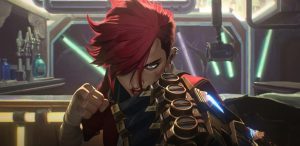 Unrest and violence grows…
It all comes crashing down in this last Act of the season. We get backstory across the roster of characters and nearly all of it is additive, challenging and works to provide rationales for the gaps we had coming in to episode seven.
Unlike Act 2, Act 3 picks up immediately after the end of the preceding episodes but the end of the previous Act left the characters with a big quandary – after having worked hard to get back together, Vi and Powder discovered neither of them were what they had in their imaginations. That meeting was one of confusion as much as damage and conflict.
Powder remains a character who is searching for something it seems she can’t find – and I was rooting for her to get it, to secure that ledge on which she could find firmer footing.
Vi also continues to search for an idea the world is rapidly dismantling with each step she takes. The two sisters are foci around which everything revolves, sparks which light fires that were ready to blaze.
The show does an excellent job of challenging the viewer to reflect on whether the outcome was inevitable – was this tragedy the result of an unfortunate confluence of events or, given the trajectories of each character in the series, were they inevitable? We’re back at the heart of Act two – just how much choice do we have?
The show gives with one hand and takes away with the other – suggesting that we get to make many choices but, all told, most of them make no difference whatsoever.
Yet it also suggests those choices that can, do make a difference. They truly count. Whether it’s choosing to make our own decisions against the flow of those around us, of choosing to trust another when the evidence would suggest not to or in choosing to remember those who came before and hold to their dreams for a different world. We see choices from each and every character that challenge those around them, that insist we can make a difference.
All the while those decisions intersect with others and the outcomes are never plain.
You could see the ending of the series as slightly cynical – as manipulative even. I didn’t. For me the story ends exactly as it should – with the legacy of all those characters explosively interacting with the chance to create a tragedy.
Tragedy is best defined as that which we hoped for arriving too late, and boy does this show deliver on that. The price, the timing, the communication of hope all judder into life at just the wrong time, clashing with politics and chance to create a disaster we can only watch as it slowly unfurls across the screen.
In truth the ending left me speechless. I could see it coming but that didn’t subtract from the weight of how good things, good intentions, hope itself, can be crushed before they take root.
If you like, we come back to how people aim for the kind of world they want. Those who are really committed work at these things for years and decades, never giving up but also losing sight of where they came from and the fault lines they carry within them as part of that journey.
The problem with working like this is the longer we do the narrower our capacity, our vision, for what we’re aiming at. There’s a fragility which comes with such focus and it’s on full display in the last act as each of the characters feel the world they’re aiming for slipping through their fingers.
A kind of panic ensues in which more and more extreme decisions slide by as acceptable because the goal feels so close, so immanent but also so likely to slip away once again.
Sacrifice becomes the order of the day – not reflective or considered, but necessary because any kind of price becomes reasonable when we stand before that dream which has haunted us for so much of our lives.
No one walks away from Arcane with what they wanted. Nearly everyone is full of loss. This is Greek tragedy as modern animation. Our characters may fight the fates but from the very first frames of episode 1 there was a sense we would see it all again and, behold, there it is arcing across the sky bringing ruin in its wake.
Arcane is fantastic. It looks fantastic, it sounds fantastic and it delivers a brilliant story without fear. Just as importantly does great representation almost incidentally, with a wonderfully diverse cast.
Right at the end I could feel those boundaries of the possible pressing in – reminding me that certain of the characters were playable in the game which gave them life and therefore defining just what stories could be told.
Yet the illusion of this being freewheeling, original and without narrative riverbanks holds just long enough to stick the landing. Roll on season 2.
Rating? 9 decisions too late out of 10
Stewart Hotston
 Doctor Who News Star Trek News
 Sci-Fi Bulletin: Exploring the Universes of SF, Fantasy, Horror and Spy-fi!