Agatha All Along: Review: Season 1
Spoilers Agatha is going on a journey… a long journey… Agatha finished with a two episode drop (8&9 for those following). Having done this I thought it was most productive […]



Spoilers Agatha is going on a journey… a long journey… Agatha finished with a two episode drop (8&9 for those following). Having done this I thought it was most productive […]
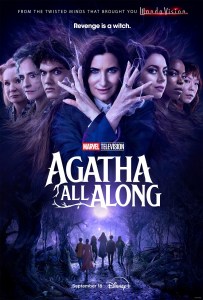 Spoilers
Agatha is going on a journey… a long journey…
Agatha finished with a two episode drop (8&9 for those following). Having done this I thought it was most productive to look at the season as a whole. Indeed, dropping the last two episodes together speaks to me of two things – uncertainty about the show itself from the studio but, hopefully, mixed in with a sense that this was a series entirely written to be seen in short order with, probably, a sense of going back and reviewing what came before in light of what comes at the end.
Why? Because the end of Agatha recasts the entire season as something else. It explains the thematic focus of each episode and even upturns many of the deliberate leads the show offered through the early parts of its story.
Sure, some of those leads were more obvious than others – that is actually a sign of good writing. A good adventure show like this shouldn’t blindside its viewers but rather leave them with a decent amount of ‘I knew this would happen’ together with a good dollop of ‘I didn’t see that coming’. For me the show largely achieved that balance.
The choices about who Teen was made sense in retrospect, were essential to the structure of the show. As I like to tell readers who argue about whether ‘the curtains were blue for a reason’ in a story – the answer is always yes even if the author can’t articulate it. Why? Because good craft demands no wasted words. If a detail is there it’s because it was needed and Teen’s identity was a perfect example of this – on the surface it could be read as arbitrary but by the end of the season it’s clear that it was by meticulous design.
If there were tropes and they were cheesy they were also there for a reason. All of which are reasons to love what Agatha accomplished. Sure, it is messy and untidy with threads that don’t go anywhere (like Teen’s boyfriend) but it worked according to its own standards.
This approach was ambitious but I think it also had problems.
Unreliable narrators need to deliver a story that before their fakery is exposed nevertheless compels the audience. The nature of the pastiches from episode to episode make sense within the world but were they compelling for viewers? I don’t know. Mostly for me, I think.
Yet a show, a story of any kind, should live on its first read through because ninety percent of people will only ever engage with it once. It’s not enough to say ‘ah but at the end it all turned around and you should watch it again’, because who has time for that?
Which leaves me in a quandary. Agatha’s ending was really interesting (the first ending, not the second which I thought was…a little too trite because of what had come before. When death isn’t weighty then self-sacrifice is also not weighty. Sigh.)
So straight As for ambition. But a B- for execution I think. Being clear though, I’d rather that way around every day of the week. Who wants the bland even if it’s done well? Give me camp, tropey adult women doing their stuff all day even if that stuff isn’t going to work for everyone.
Verdict: I’d love to see more of this kind of ambition from Disney – whether the miserable mob allows for it is anyone’s guess but given the fate of The Acolyte we can be forgiven for being pessimistic.
Rating? 8 psychopomps out of 10.
Stewart Hotston
 Doctor Who News Star Trek News
 Sci-Fi Bulletin: Exploring the Universes of SF, Fantasy, Horror and Spy-fi!