 This week, Big Finish release their continuation of ITV’s cult children’s SF series, Timeslip, reuniting series stars Cheryl Burfield and Spencer Banks as an older Liz and Simon discovering that their adventures through the time barrier aren’t over. The revival features two stories: The Age of the Death Lottery by Andrew Smith, and The War That Never Was by Marc Platt. Shortly before recording began, Sci-Fi Bulletin’s Paul Simpson and Radio Times’ Morgan Jeffery sat down with Platt and script editor John Dorney to discuss the new version…
Let’s start with the obvious question, what do you remember about the series?
Marc Platt: I’m sure I’d seen some of it. I didn’t see it all. I was at boarding school – I was a day boy but we used to do our prep at school so I didn’t get home till about 8 o’clock at night, so when it was on, during term time, I couldn’t see it. But I do remember some episodes because they obviously ran during the holidays as well. So I do remember it quite well actually.
 What sticks in your memory?
MP: I just remember Cheryl and Spencer being there. I probably didn’t see enough of it to relate to the fact that there were all these different locations but with the same actors, turning up in different roles. That’s one of the things I really like about it, now I’ve sat through it on YouTube.
It’s just part of that simple history of things that ITV used to come up with. They used to do wonderful programmes, imaginative children’s drama. So you always knew that it was going to be inventive and imaginative and therefore a good watch.
John Dorney: I’m too young for the original transmission. My main memory of Timeslip growing up was how during my teenage years I was a massive Doctor Who fan but there was a huge gap when Doctor Who was taken away so I started following other programmes within the telefantasy genre. I would buy magazines like DreamWatch and TV Zone and read up on these synopsis of other series and shows that were before my time.
And one of those, I do distinctly remember, was Timeslip which always sounded quite intriguing. I don’t know – did it come out on VHS at all?
Yes. In black and white
 JD: This is the thing: I never bought the VHS, so it meant that the first time I actually saw the series was last year but it had always had this slightly weird enigmatic quality about it where it seemed fascinating and interesting, and very involved and clever. So, when it was mentioned as a prospect [for Big Finish] I got automatically quite excited about it. I thought it would be a really fun thing to be involved in and it gave me an excuse to buy the DVDs finally and start watching it through..
When you look back on it, did it surprise you? It is meant to be a children’s series but some of the themes are quite complex.
 MP: It’s not written down [to the audience], it’s actually quite adult. It’s character led as well – I think that’s what I really like about it – so you do see characters developing. You have Denis Quilley who’s absolutely wonderful. He almost changes shape: he plays himself at various different ages, it’s an extraordinary performance. A wonderful actor.
It’s just so intriguing and has this potential because they keep jumping to alternative versions of the same place. It’s journeys in time not space.
JD: There’s a tone to it that sets it apart. If you look at something like The Tomorrow People, it feels a bit more for kids than Timeslip ever did. Timeslip at times requires quite a bit of actual energy I think, from the viewer. Which is particularly interesting from a children’s programme but then I think TV was different then, so they could afford to take their time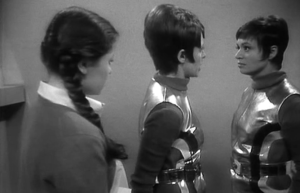
MP: It doesn’t have to spoon feed viewers
JD: People talk a lot about how the pace of television has sped up as viewers get more literate but I always find myself a little bit wary of talking about TV used to be slow and now it’s quite fast because those are automatically loaded in one way. If you say TV used to be quite measured, now it’s rushed you’re essentially saying the same thing but you’re hitting it a slightly different way. Slow isn’t bad
MP: Slow gives you stuff to think about
JD: It gives you detail, it gives you a certain richness and scale and I think Timeslip is the definition of measured. It is a really rich and complex piece.
You could probably tell each of the stories in a one hour episode.
JD: Yes – but would it be better? As I’ve said, the definitive edition of most novels is not the Reader’s Digest edition!
Nor is it Stephen King’s 1600 page version…
JD: Absolutely
In terms of the tone of these new episodes, is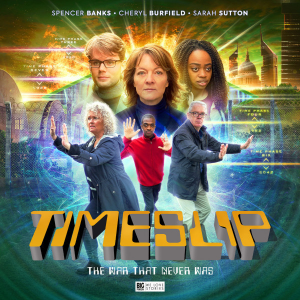 it a similar tone to the original? Are they more adult because the audience might be ones who grew up with the original show?
MP: Maybe it’s more adult because I suppose we don’t have young teenagers anymore
JD: No
MP: We’ve got Cheryl and Spencer who are reprising their same roles but grown up and we have two new young characters who get involved as well. I suppose you see it through their eyes.
JD: But even then I still think it has a very obvious similarity in a way; it doesn’t seem that much different. Because even by the standards of the 70s, Liz and Simon feel quite middle aged even in the original TV series.
They feel like more 60s characters
JD: They are. The charm of that age now feels more like the teenage now – they grow up more quickly. I think the tone is very similar in the stories that we’re telling, they are very much of an ilk. There’s a degree to which you don’t write things in a vacuum, so it’s going to be influenced by modern storytelling techniques..
Are your characters going to have seen Doctor Who, Battlestar Galactica and programmes like that? Are they aware of the concepts?
MP: I would have thought so yes. The two youngsters both come from the 1980s.
JD: Yeah, it doesn’t really come up. It can turn into a bit of a crutch. Everything becomes a bit of a “it’s like that thing in that film” which can be fun.
MP: The budget is bigger.
 JD: Oh yes there’s a whole Selhurst Park sequence in one of them so… massive crowds in a way that the original TV series couldn’t manage, but it’s still very much the same tone and style. Marc and Andrew we feel very much connected to that tone.
MP: Yeah, I was lucky in fact because Andrew starts it. He does the first six episodes setting it all up and I had a few things that I asked him to put in which would lead into mine. And then sat back while he did it all so well. Poor bloke had to do all the heavy lifting but he’s done it beautifully.
The first story’s set in the future, the second’s in the past.
JD: But I think that was very clearly part of our game plan, to give that variety to the series. I loved Marc’s idea of an alternative past. It doesn’t happen anywhere near often enough but that’s a really interesting idea to play with. It gives us a lot of questions to ask about – are they still around and what’s going on and how does this all work?
MP: There was a slight problem, in the original they had loads of ideas. Ideas would pop up every week and then they wouldn’t quite follow through with them. So you got these strange things going on about people being able to see into the future and things like that. But you’d forget about it two weeks later.
 Even the novelisation was full of things like that, you go well, where’s that gone?
MP Yes, quite. You can circumvent those things a bit but we do tidy them up a bit. It was fun writing it.
The original series had Peter Farley the ITV Science Correspondent doing introductions.
JD: The ‘are you sitting comfortably’ sort of thing? Yeah I’m sure we did talk about that at some point.
The original series as well had one of those moment that sticks in your mind – the idea about rapid aging. Was there a real desire to keep those scary bits?
JD: There are some scary bits.
MP: Definitely some in the second story.
JD And obviously the concept of the Death Lottery was quite horrifying.
MP: Andrew’s come up with this. He’s able to pin that down a bit, but I found it very scary the way our government could go.
JD: Andrew’s always got a quite methodical approach.
MP: Quite the opposite from me.
What do you each bring from your own background and interests?
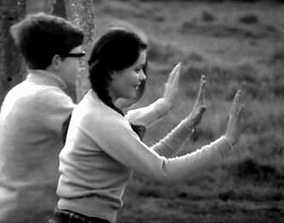 JD: It’s having a different angle on it. There’s a degree which I’ve always felt – and maybe there are a few exceptions – that if a script arrived from anyone and they’d covered the front page, I would be able to tell you who it was by, give or take. There are a few that are quite obvious. As I was saying earlier, Andrew and Marc have their own specific sensibilities that matches the 1960s storytelling style – they both wrote for TV in the 80s, it’s still connected to that period, that slightly studio based style. They’ve both got a huge interest in the nuts and bolts of it, I think. Andrew’s quite grounded – you can see the policeman in Andrew’s scripts.
MP: He’s just brilliant on procedures.
JD: It’s quite methodical. It’s an impeccable piece of engineering. You’ve got the future police state [in Andrew’s story], and Marc’s is the past, with an impeccable level of research and detail.
MP: It’s 1953 because I was born in 1953. I vaguely remember the Fifties – a bit grey and brown.
JD: It probably helps that I’m coming from a more modern perspective, having seen the original. I think to tend to bring a slightly weird colour. Let’s have something that’s ridiculous – nudge things into a slightly different area.
I think it’s quite a good idea to have a script editor with a different approach because then you can bash out the ideas.
MP: Feeding ideas always helps.
In part 2 of this interview coming after the episodes are released, John and Marc discuss some of the specifics of the revamped episodes.
Timeslip launches on May 6 at 2200 BST on Big Finish’s YouTube channel, and is available to purchase now.




 Sci-Fi Bulletin: Exploring the Universes of SF, Fantasy, Horror and Spy-fi!