Tightrope: Interview: Spencer Banks
Spencer Banks followed up his role in cult favourite Timeslip with an espionage thriller that’s recently had a reissue by Network: Tightrope, created by Victor Pemberton. Banks plays schoolboy Martin […]



Spencer Banks followed up his role in cult favourite Timeslip with an espionage thriller that’s recently had a reissue by Network: Tightrope, created by Victor Pemberton. Banks plays schoolboy Martin […]
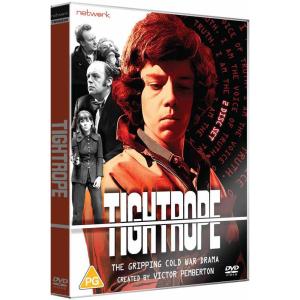 Spencer Banks followed up his role in cult favourite Timeslip with an espionage thriller that’s recently had a reissue by Network: Tightrope, created by Victor Pemberton. Banks plays schoolboy Martin who’s inveigled into the spy world by John Savident’s Forrester. Banks chatted with Paul Simpson about the making of the show…
So how did you get involved with Tightrope? Presumably this is well after Timeslip was finished.
I was approached by John Cooper, the producer, it would have been February/March of 1971 and he very graciously mentioned that they were looking at a project and they would hope that I might be able to get involved in it. So, I had a heads up around March time and I think we went into production September/October 1971
It was created by Victor Pemberton, who worked on Timeslip and I think he’d been given the brief to develop some sort of thriller serial. I understood from him that he’d actually canvassed schools and various outfits to see what the most popular genre was at the time and espionage spy thriller seemed to come top of the list. So that’s how he sat down and started to create the idea for Tightrope.
What did you get upfront? Did you get a description of Martin and the plotline or were the scripts actually written before you went in?
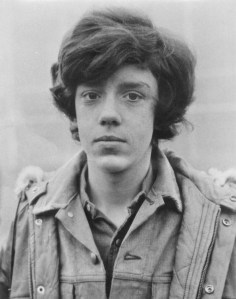 I didn’t actually see the scripts until probably a few days before we went into production. I’d been incredibly lucky and busy up to that point and if memory serves, a packet of scripts were waiting for me at the place I was staying at in Barnet, a good two or three days before the read through.
I’d had a very broad outline through my agent of what it would be but I had no idea of the complexity of it. I was absolutely tickled to death, I don’t mind saying. I could barely put the scripts down. I was quickly trying to get episode 1 and 2 under my belt before the read through. Nothing more embarrassing than turning up at the read through and you’ve only just glimpsed through it.
I was really impressed from the go get. I think, as with Timeslip, it’s a pity we didn’t have the production values then that we have now, but you could say that about anything. But also as with Timeslip, I think the fact it was character led as much as it was story led, was an important part of its success. I think it was reasonably well received when it was first transmitted.
Do you remember what you thought of Martin when you read him?
I was really quite intrigued by it. I was particularly impressed by the fact that he was a regular teenager, in the sixth form; life and school was always before him. Perhaps he was not that aware of world events, in terms of the draconian element of government and the withholding of information and perhaps the whitewashing of various things. Some of that element has got some relevance today except that in the 70s I suppose, it was a lot more clear cut: it was ‘them’ and ‘us’ and the ‘them’s’ were clearly defined as Eastern Europe. It would be a very different picture if drawn today, perhaps.
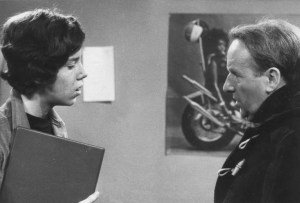 One of the huge strengths from Victor Pemberton was the somewhat fractious relationship between Martin and George Waring as his single dad. I thought that was a nice element to it, it wasn’t all action and running around. And the realisation that as a sixth former that the teachers around you are not all as they seem.
Talking of the teachers, it was a great thrill to work with David Monro whose reputation had obviously gone before him with Orlando, which I favourably remembered. He was embarking upon his directorial and production career in the background, at that time. He hadn’t got as involved in the documentary work but he had recently completed a film short called Conquistador. It ran in cinemas. It told the story of the introduction of the Conquistador horse to the Native American Indians. It was a typical short of its time, twenty odd minutes, very little dialogue but as a small independent project, I was really impressed with it. He was a great guy, we got on famously. As we all did, as a production.
The Man from U.N.C.L.E. was always set up that the idea was that Napoleon or Illya would have to get a member of the public caught up in their scheme of the week and that’s how you got your guest stars in. It just suddenly struck me watching this, that actually John Savident is almost playing Napoleon Solo but slower and more annoying…
(laughs) I’ve never considered that. That’s a nice concept.
Martin has his life and MI5 or whatever department they are supposedly working for, are coming and interfering with his life rather than the other way round.
Yes, it was that very element of it that impressed me or grabbed me the most, I think.
In terms of the practicalities – and I do appreciate it’s a little bit of time ago – for you what were the challenges with it?
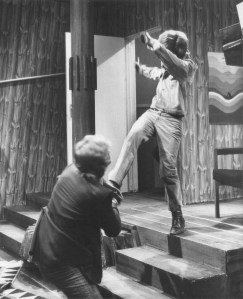 I suppose one of the challenges was the physicality of the role. There were one or two set pieces where there were fight sequences and they brought in a stunt coordinator Roy Scammell, his name was. Roy and I already had a history, and we would go on to have further history because he was my stunt double in a Walt Disney picture, Diamonds on Wheels, I made not that long after Tightrope. John Savident was also in that. He was one of the rally stewards at a checkpoint.
Another challenge I think, really looking back in particular was to keep an element of reality about it and John Savident in particular was very helpful in that respect.
It was very easy to fall into a, perhaps rather standard way, of reading particular things or playing things whereas in fact, [it would be better] if you can give it a more natural element. I’ll give you a classic example: the scene where George Roubicek the Canadian Army Intelligence Officer, gets caught by the bomb that’s been placed in the phone and I discover him. We worked on it, all of us including the director, but it was John who actually gave me quite an interesting key to it. Before he became an actor, John was a police officer and he described to me the first time he had to deal with a murder scene. Your initial reaction isn’t just to walk in and deal with it, you actually do have quite a physical reaction. That was immensely helpful.
On a slight more light hearted note, one of the particular days we were filming external sequences – there were small elements that were shot on film to match with the studio. The confrontation on the bridge with Forrester, the opening sequence where I’m run off the bike and leaving the school, it was bitterly, bitterly cold. I don’t think I’d ever experienced cold like it, particularly on the bridge. I remember us getting back to Elstree for the lunch break and we were frozen, I could feel nothing from my knees down!
So, did you have the scripts for the whole series when you started?
 Not at the very beginning, no. I’m pretty certain I probably had read the first four or six episodes, but I can’t remember a period where we were drumming our fingers waiting for the scripts to arrive.
On Timeslip for example, the original concept was just the first six episodes. They were a standalone serial in themselves and then, my understanding was that discussions about ITV retaining the franchise for that slot were progressing during the audition period. So, at a stroke it went from six to twelve and then from twelve to twenty six. I think there was an element of the creation carrying on once production had started there. I wasn’t as aware of that with Tightrope. I’m fairly certain Victor had a fully rounded concept of the arc from start to finish.
There are bits and pieces that you’d have played very differently in episode 1, if you’d known what was coming up.
Yes, exactly.
Victor’s Doctor Who work and his radio plays always had a quirky visual somewhere involved in them and that does seem to be very much the case in Tightrope.
I was particularly impressed with the big showdown in the Hall of Mirrors in the fairground at the end.
Were you surprised that any of the characters turned out to be who they were? There is an awful lot of misdirection.
 Oh yes, the owner of the pub: that was a surprise, the way that character developed, and the major payoff was a huge surprise as well. It did reach a point, possibly about halfway through, when you began to think ‘Is there anyone on that school staff who isn’t either vaguely involved or they’re not going to turn out to be who I thought they were.’ But again the everyday, the ordinariness – I loved the postmistress running the local shop. Hazel Bainbridge was an absolute delight, an absolute delight… as an actress as well as in the production. I thought it was lovely stuff.
I don’t know if you spotted the very very cheeky reference in the Post Office? When John Savident’s waiting for the shop to empty, so he can talk to her, there’s a revolving book gondola that he’s browsing. They placed a copy of [the Pan edition of] Timeslip right in the centre of the shot as he was slowly turning the rotator rack, which we all had a bit of a chuckle at.
There was the potential for more of this, did you ever expect there to be?
It could have gone either way, if memory serves.
I suspect that the danger would have been that if Tightrope had gone to a second series, how do you credibly involve Martin in something else…
 Inevitably he’d have been that much older. He’d reached the point he was sitting his A levels so you’ve maybe got him going on to possibly university. I suppose the only slight danger with that scenario would have been that you’d have been moving away from the classic demographic for the slot at five, five-thirty. Whereas they’ll identify with school, perhaps the audience wouldn’t immediately identify with university life.
I think one of the strengths of this is that you’ve got the juxtaposition of what we think is an ordinary school against the very shades of grey espionage world.
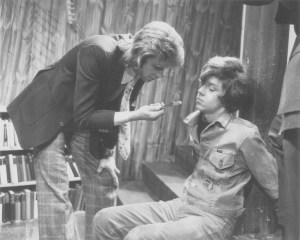
Yes, I quite agree. I think it brings us back to that point of, here was a character who’s living out his school life in the village and life as usual and it’s suddenly interrupted. When you look at some of the content – the explosion, the bomb in the telephone, the pen that fired CS gas, when Forrester tranquilises Martin – I think you’d struggle to get any of that through now.
It is very much of its time.
Yes.
But equally you could update this story with surprisingly little difference.
That’s very true, yes. Particularly the advent of social media and mobile technology.
Tightrope is available now from Network
 Doctor Who News Star Trek News
 Sci-Fi Bulletin: Exploring the Universes of SF, Fantasy, Horror and Spy-fi!