 BFI, November 5, 2019
Panel run by Samira Ahmed
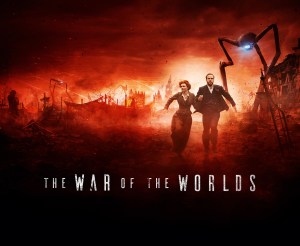
It’s fair to say that it’s pretty impossible to think of The War of the Worlds without immediately conjuring up images of Jeff Wayne’s seminal concept album, and it therefore didn’t surprise me that, after we’d seen the first episode, host Samira Ahmed opened with a question about the influence of that album on this new BBC adaptation. Both writer Peter Harness and director Craig Viveiros acknowledged that the album had played a huge part in their early lives (as it has for many of their generation) and as Ahmed observed, there were certain visuals, like the picture from the album of the distressed woman running away from the tripod, which seemed to be referenced here.
But this adaptation is also very much its own thing. Make no mistake that when there is talk of the ‘faithfulness’ of the new show, it refers to the setting and time period, this being, as everyone was at pains to point out, the first televisual adaptation set in England at the turn of the twentieth century. Harness at one point responded to a question about whether he’d shifted it forward a few years from the novel to say he himself has always believed Wells wrote it to be set a few years ahead of when he wrote
In many other important ways, it differs from the source material significantly. Eleanor Tomlinson’s Amy – the name for the traditional ‘Journalist’ character’s love in this version – is no longer the cypher character who gets bundled off to escape the invasion a few pages in and doesn’t reappear until the end. Here, Amy is a strong-willed, intelligent central character, followed by the plot more than anyone else. Tomlinson said it was incredibly exciting to have such a role, playing against the stereotype of the era and free of the restraints of any perceived quality of the character precisely because she was so blank in the novel.
Harness made the point when talking about how his characters are adapted here that where the book left so little to go on, a direct adaptation would have left thinly sketched characters and a lack of the real drama that the medium requires, hence the significant alterations to George and Amy’s characters and situation, to say nothing of the increased role of George’s brother (Rupert Graves) and Ogilvy the astronomer, played by Robert Carlyle as more of an eccentric loner similarly frowned upon by polite society as George and Amy, and a jack-of-all-trades amateur rather than the dedicated expert on the stars the source material might imply.
It’s in the way in which the Martians themselves are executed where some real artistic licence comes into play. The cylinder itself when it lands is not at all what one might expect, based on initial concepts by Harness on the page and developed by Viveiros for the screen. The projectile itself is slightly organic in appearance on the outside, but more mechanical and eerie underneath. The tripods too, have a more organic, living appearance than one might expect, a decision which Viveiros credited originally to looking at a tree in his garden. There’s a sense to them of growth and regeneration – a sinister implication of their durability and resistance to the destructive capabilities which are possessed by their human adversaries.
Harness and Viveiros clearly have a very fixed perception of certain aspects of what Wells was driving at with his novel which informed their decisions. Harness referenced the way in which Wells was essentially commenting on the society in which he lived – what it must feel like to be one of the many races around the globe visited by the British Empire with its destructive weapons and alien culture and wiped out, and wanted to translate that across into this adaptation as much as he could. Viveiros mentioned the way in which Wells seemed to view faith and religion in the novel, and how this translated visually into certain scenes, particularly the first proper view of a Tripod rearing up over a church tower.
Harness also mentioned that he wanted to shock and surprise with the adaptation – that people who knew the book and thought they knew what to expect should still find things they were taken off guard by. In particular there is one element indicated by the first episode which riffs on an element of the novel which Harness felt (rightly or wrongly) was not really addressed properly and which he sought to do here. That one decision seems from what I saw to have coloured a lot of how this adaptation was approached, and the shape of the story it will tell within the basic confines of the source material.
It’s clear that the production left its mark on all three. Tomlinson responded to a light-hearted question from the audience about whether working on the show had made her a ‘believer’ to say that yes she believes in alien life but not that they are giant machines coming to murder us all. She also commented that the shoot was exhausting and reassured us that several reaction shots in the show are genuine terror thanks to the sterling work of Viveiros and the crew in making scary enough noises and surprises for the cast on set. Harness said he was done with adaptations (he previously adapted Jonathan Strange and Mr Norrell for BBC One) but would be tempted to work more within the sci-fi/fantasy genre as it was exciting and offered many storytelling opportunities. Viveiros said that there’s one other H G Wells book he’d like to bring to the screen but he refused to be drawn on what it was, stating simply it was something he wasn’t aware of ever having been adapted before. Clearly this production has been a journey for both cast and creative, and it’ll be interesting to see how it’s received by the public when it screens in a couple of weeks’ time.
The War of the Worlds begins on BBC One on November 17th at 9 p.m.
Our set report and full episode 1 review will follow next week




 Sci-Fi Bulletin: Exploring the Universes of SF, Fantasy, Horror and Spy-fi!