The Undeclared War: Review: Series 1 Episode 1
A student on work experience helps Simon Pegg and the whole of GCHQ fight a cyber war (I kid you not, that’s the story). UK readers of Sci-Fi Bulletin may […]



A student on work experience helps Simon Pegg and the whole of GCHQ fight a cyber war (I kid you not, that’s the story). UK readers of Sci-Fi Bulletin may […]
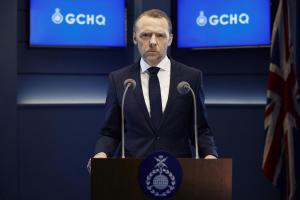 A student on work experience helps Simon Pegg and the whole of GCHQ fight a cyber war (I kid you not, that’s the story).
UK readers of Sci-Fi Bulletin may well remember the BBC comedy, Little Britain, and David Walliams’s unhelpful receptionist, Carol Beer. Carol/Walliams would sit behind a computer, gawping at whoever desperately needed her help. She would then input the data, with Walliams barely pretending to type, just randomly hitting keys, his hands like flippers, and stare at the screen, only to announce in a flat estuary monotone, regardless of the situation: ‘Computer says no.’
Unable to take a moment of the dreadful Undeclared War seriously, I spent much of the first episode longing for David Walliams to add a little passion and authenticity to proceedings.
There’s a thing that actors do when they are required to look like they are brilliant tech nerds. They stare at the computer screen (which always lights their faces beautifully), and touch-type strings of code at break neck speed. The thing is, not many people can touch-type these days… and you can tell the actors can’t either, because their fingers randomly tap away on the top three rows of the keyboard never hitting the space bar or backspacing to correct an error. French and Saunders used to parody this in their sketches too.
I feel quite sorry for the cast of The Undeclared War. Aside from our unlikely school leaver, Saara (ably portrayed by Hannah Khalique-Brown) they are all battling with reams of computer jargon, which they have to look as if they understand. To make matters worse there are further reams of ‘casual’ dialogue to explain what a ‘drip’, a ‘flag’, a ‘pling’ and ‘plong’ are. Of course, not all of those examples are real computer terminology. And that’s the point. It doesn’t matter. We don’t care.
What a drama has to have is characters, story, human interaction, protagonists, antagonists, internal contradictions, that sort of thing. People staring at lines of code having to explain vaguely what they mean is, just, well… people staring at lines of code having to explain vaguely what they mean.
My better half was squinting at the screen. She said: ‘Why has Simon Pegg got his hair like that?’ I replied: ‘I think that’s his character.’ To be fair, he had to do something to imply that he was a living breathing human being. I love Simon Pegg, he’s a hero of mine, but… oh dear.
Cut to: An excruciating scene supposedly set at a COBRA meeting with Adrian Lester playing television’s least convincing Prime Minister ever. Lester is one of our finest actors, born to be PM if anyone is, but even he can’t do anything with dialogue as wooden as this. I won’t tell you what happens, I can’t relive it, even in the cause of criticism.
If you think I’m going overboard on the vitriol here, you may well be right, but I was really, really, really looking forward to this. Writer Peter Kosminsky is one of the best in the business. The Government Inspector (about the death of David Kelly), Warriors (about helpless peacekeepers in Bosnia), the BBC adaptation of Wolf Hall – these are just three of his landmark productions. He’s a serious writer with a burning political conscience and a reputation for dramatizing real events in a vivid, gripping and human way, but with The Undeclared War he has finally met his match. He is completely out of his depth and I sincerely hope this is the last time he goes anywhere near a tech thriller. For sure, we can tell he’s done his research, but the key to dramatizing research is that the audience shouldn’t even notice it.
The thing is, if there were to be a cyber-attack on this scale, then the heart of GCHQ is the least interesting place to be, when it’s the consequences of that attack which we are craving to see played out, but here they are all happening off-screen. The series appears to be fundamentally misconceived.
Verdict: I’m not sure whether I’ll watch any more. I suppose I’m vaguely interested to see whether it can redeem itself in any way whatsoever, but on the basis of this series opener, this reviewer says ‘no’. 4/10
Martin Jameson
 Doctor Who News Star Trek News
 Sci-Fi Bulletin: Exploring the Universes of SF, Fantasy, Horror and Spy-fi!