The Irregulars: Review: Series 1
All episodes available on Netflix now Victorian London – a gang of teenagers are called on for help by the resident of 221B Baker Street: John Watson The Baker Street […]



All episodes available on Netflix now Victorian London – a gang of teenagers are called on for help by the resident of 221B Baker Street: John Watson The Baker Street […]
 All episodes available on Netflix now
Victorian London – a gang of teenagers are called on for help by the resident of 221B Baker Street: John Watson
The Baker Street Irregulars are a group of homeless people referenced in Arthur Conan Doyle’s Sherlock Holmes stories. They’re ostensibly his own intelligence network of informers and spies who keep an eye on the comings and goings of richer, more acceptable, folk in London.
They appear in many of the incarnations of Holmes’ stories we’ve seen over the years whether in Elementary, the BBC Sherlock series, or a huge number of films.
This show, created by Tom Bidwell, posits something different – it tells the stories of these ‘irregulars’ from their point of view. It focuses on a group of four of them plus some ‘extras’ and it twists the tale to be explicitly supernatural in feel.
Warning though; to enjoy this you’re going to need to make some adjustments to your expectations. The show was cast ‘colour blind’ and the diversity on screen from a Black Watson to a diverse cast in the Irregulars themselves is straight out of the same sentiment as the recent 2019 adaptation of David Copperfield by Armando Iannucci. It is fresh, startling at times and thoroughly enjoyable to see a London populated by people from all backgrounds.
We meet most of the well-known named characters from the books and other iterations over the years and they’ve all been stretched into a new shape by Bidwell. My personal favourite is a deeply unsettling portrayal of Mrs Hudson – a smart, angry woman you would not want to meet down a dark alley.
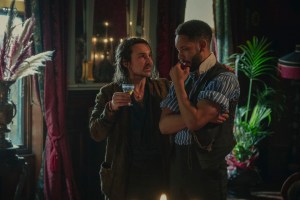 Watson is brooding, melancholy and decidedly grumpy for what turns out to be very good reason while Sherlock…well I won’t spoil it. None of the characters are what you might expect if you are looking for a recasting of Sherlock’s mysteries just from a different POV, you will be disappointed.
Add to this a very modern take on how people talk and the best thing to do is accept the cast has modern concerns mixed in with those of Victorian London and you’re best set for rolling with the presentation.
For me the changes worked. The script for the first episode was a little chonky at times, but overall it did a great job of setting up the stakes and delivering a set of clearly distinguishable characters who made me laugh and provided some thrilling moments. Once we’re past that initial intro to the gang and the stakes then it settles down and I have to say the script for the rest of the series is pretty tight with a nice rhythm which not only sets out the different characters clearly but doesn’t waste the time it has on irrelevant material.
The predominantly young cast do a great job. I’d highlight Thaddea Graham and Jojo Macari as standouts and I look forward to seeing what else they do. The direction by Johnny Allan, Joss Agnew and Weronika Tofilska sets out a clear vision for where we’re going; the show carries the gothic horror of Shelley, Stephenson and Byron by way of the social concerns of Rian Johnson and feels authentic to these wider sources throughout.
In particular it deals with themes which are far from the normal fare for this kind of YA adjacent show. Bidwell brings us a structure which is essentially monster of the week, but each episode grows a sense of some bigger threat looming behind the scenes. Crucially it answers some element of this deeper mystery each episode rather than leaving us hanging for a single large reveal at the end. This movement to a wider world means that by Episode 6 Bidwell leaves the monster of the week format behind to dwell in the larger world it’s built.
What’s smart is that this show focuses on the relationships of each of its characters including the antagonists – taking time to explain how they got to where they are, providing us sympathies for each and every person on the screen (with the possible exception of one particularly irredeemable Workhouse Master). There is no wasted time for any of the main characters, which for me is a sign of a well written story.
With an ensemble cast it could be easy for one of the characters to be underdeveloped or used as a plot device or there solely to provide exposition at the right time. It never feels like that with The Irregulars and I loved how each of the characters is grown through their experiences. These are young people with every reason to act out and hate the world. Instead we’ve given a group of people struggling with maturity, with hard choices and who proceed through it all with no sense of entitlement.
The world sets out a series of rules around how it works and it sticks to them. Not for this show to expand a character’s abilities when it’s written itself into a corner. There’s no Deus ex Machina here saving the characters or giving the antagonists additional moxie.
This is often a bugbear of mine, so by the time the last episode finished I was looking at the overall arc and world building and smiling broadly with pleasure – the story set out its rules, stuck to them and the result was an unexpected ending with real heartache rather than being neatly wrapped up.
It’s also worth noting that there’s a trend among these kinds of shows to put a sympathetic antagonist on screen who argues for some alternative political position (such as climate action, equality, racial justice or the futility of nationalism) only for their argument to be fatally undermined by some unforgivable violence or evil motivation which enables the heroes to act to save the problematic status quo.
The Irregulars shows the injustices of the world it’s in with no gloss, no sense anything is necessarily worth saving. It then asks its characters to decide and their decisions are, in the end, personal, accidental, immediate and heart-breaking.
It’s worth talking a little about the sets and the costumes – which are glorious. London in this show feels alive, there are plenty of people and even if the sets are reused there’s never a sense of constraint. Add to that a fantastic set of outfits ranging from the poorest people through to princes of the land and the effort put into the show creates a palette which brings out each of the characters in brilliant relief. This is the horror themed counterpart to Bridgerton.
The Irregulars is unexpectedly gory, often unnerving and on one or two occasions actually frightening enough that my teenagers were looking away from the screen. The monsters are terrifying not simply because they’re monstrous but because they’re often righteous and single-minded too. This is not a show that deals with the bad guys using guns or violence as a first resort; the characters are often overmatched and overpowered – needing to make difficult and terrible choices to find a way through. It’s a show which deals with consequences – of being lonely, of doing violence, of losing love and being abandoned.
What’s more, for a show set during the height of Victorian Britain the show doesn’t shy away from the challenges of class and inequality. It’s not particularly preachy about this but the difficulties of obligation, of being from different social strata and the very real terror of being poor are all present in the show as core themes. What the show does really well is explore the fact that no one comes out of strict social structures with their souls intact and it provoked a long discussion here about what it means to be in the royal family and why being an outsider to such a club might be so difficult.
The Irregulars ties all its threads together using love. The love in this show isn’t of the twee and happy kind but it’s the love which moves mountains kind, the unrequited kind and central to this is the impact of losing those who love you and whom you love.
The last act (episodes 7 and 8) in particular pack an emotional punch because even when the big threat is resolved the aftermath is full of a deeply sweet sorrow, not the more usual triumphant happiness as the heroes celebrate their awesomeness.
The series is eight episodes long, and with each running to nearly an hour it feels like we get real insight into each of the characters and watch them tackle the crisis underlying the surface details as the story gets told. However, it’s so much more than that and for this unexpected emotional depth I cannot recommend it highly enough.
After a very slightly wobbly first episode which lays out everything it wants you to see the series steps up and tells an assured story about love, loss and surviving when no happy endings are possible. It is a solid piece of world building and, as I say, the characters are distinct and at no point did I wonder why the ensemble cast had as many members as it did.
Does this show need to be tied to the coat tails of Sherlock Holmes? I can see the commercial reasons for it – the name alone must offer an easier way to get a show commissioned than going in ‘naked’ so to speak. Admittedly both Watson and Sherlock provide anchors to the show’s overall concerns and emotional beats, but I think they could have been any suitably written adults.
Having said that, I liked the involvement of Holmes and Watson even if it wasn’t entirely necessary to make this story work. Their presence lends a sense of familiarity which the show would have to have built otherwise and I can’t tell you if the extra work it would have required could have been done successfully within its established confines.
Verdict: With a second season hopefully on the way I’m looking forward to more of a show which adopts a hopeful melancholy as its thing.
Series Rating? 8 Victorian scallywags out of 10.
Stewart Hotston
Click here for our other coverage, including interviews with cast and creator.
 Doctor Who News Star Trek News
 Sci-Fi Bulletin: Exploring the Universes of SF, Fantasy, Horror and Spy-fi!