The Irregulars: Interview: Tom Bidwell
Tom Bidwell’s very different take on the world of Sherlock Holmes, The Irregulars, has been a hit on Netflix – and in this spoiler-filled interview, he looks back at the […]



Tom Bidwell’s very different take on the world of Sherlock Holmes, The Irregulars, has been a hit on Netflix – and in this spoiler-filled interview, he looks back at the […]
 Tom Bidwell’s very different take on the world of Sherlock Holmes, The Irregulars, has been a hit on Netflix – and in this spoiler-filled interview, he looks back at the creation of the series with Paul Simpson
One thing that really came to mind as I was watching the series was why did you make it Holmes and Watson, bearing in mind how much of the canon is altered in terms of the characters through the story? To the Irregulars themselves, they’re two adults who are screwing them over.
 That’s a really good question. Basically, the way I conceived the idea for the series was that I’m a big Sherlock Holmes fan and came across the Irregulars in the books. That was the first time I thought, ‘OK, there’s something in this as a series’. But as I read more of Conan Doyle’s other works – which mainly are horror stories, short stories, ghost stories – and read more about his own life as a spiritualist, as someone who was interested in phenomenology, who believed in mediumship, fairies amongst various other things, I started to almost be as interested in Conan Doyle and bringing him into the world of Sherlock as telling the Sherlock story in its own right.
So that’s how the series started to come about: I wanted to make an amalgam of Conan Doyle and his greatest creations. OK it can’t be Sherlock, because Sherlock isn’t Arthur Conan Doyle, so what does Sherlock look like when you start to throw all these things at it?
By the end, as you say, it is completely different and we hint in the timeline of the show that he was similar to how he started out [in the books], because Sherlock mentions the first cases that you get in the canon, but then the world of the supernatural moves into his life and when we join the story, he just isn’t at all what you would expect or have seen of Sherlock Holmes.
 And I wanted Watson to be sinister because it’s really fun (laughs).
Somebody said to me, ‘I can’t see how you could possibly do a second season’. I can instantly think of three or four routes straight away and I’m sure you can.
Yes, it’s quite tantalising. Once you’ve set it up you think ‘My God, think of what we could do with this character or in this direction’.
I know you’ve been working on this for a long time. How much of what I’ve just watched differed from what you originally had in mind for the show?
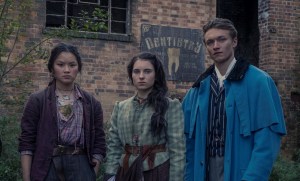 Quite a lot. When we set out on the show, we knew it was going to be a lot of things – a romance, mystery, crime, horror, adventure and young adult story as well – and we thought, ‘Oh that will come together very easily’ (laughs). But as we were going through we inevitably had to change a lot of what we thought the show was going to be when we first conceived it.
I think we ended up with something that really felt like what we originally wanted, and that’s often different from what we maybe expected visually or tonally. I think it’s really close to what we wanted in terms of how it makes you feel – we wanted to make a really entertaining adventure story and that was really what we, our collective editorial team set out to do.
One of the things that feels very strong through it is the theme of unrequited love, right through to that last dinner between Watson and Bea. Was that one of the strong themes that you wanted to bring through all the time or was that something that came out as the characters became more rounded?
 There was an element of loneliness about the characters, I think. They’ve built their houses on relationships that haven’t worked out for them; certainly with Sherlock/Watson and with Bea who’s the leader of the gang.
I think that idea of needing other people is important to the show because it lends stakes to the relationships. At the end when Bea’s just sitting there, you just want Watson to hug her, you just want her to have someone there for her.
I do feel like that’s a really astute thing you’ve noticed there about it being about having someone there and unrequited connections. It’s a found family isn’t it? They’ve found each other so they must have had a lot of that in their lives.
You touch on a number of other elements from the period, such as Frankenstein in one of my favourite episodes, and you’ve also got a real character with a real illness in Leo. Did you ever feel that that was a weird juxtaposition?
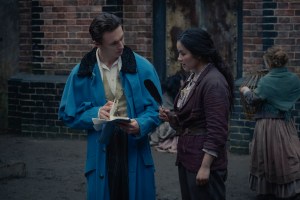 I think there’s an element of that where we wanted a element of pulp.
Imagine if he was in this world, imagine if she was in this world – once you’ve got those elements, you’re trying to dig some real emotion and real story out of it and make it a bit more grounded.
I think that was the challenge of the show. It was taking all these elements that one way or another are quite pulpy and try and tell entertaining stories, ground it and then ask the audience to go quite deeply, emotionally, with the characters. Of all the challenges on the show – and there were a lot of them – that was probably the hardest thing to do, yes.
The Linen Man is an intriguing character, is he drawn from – if you’ll pardon the pun – whole cloth or was he inspired by a character from literature?
 We were taking a lot about Twin Peaks when we started breaking story on the show and we loved that in Twin Peaks sometimes a scene starts and you just don’t know where you are and you don’t know what’s going on and you don’t know who this character is. We loved the idea that we can be a show that keeps people on their toes.
We were aware that London is very drab and can feel very closed off and very brown, black and grey, so we wanted to have a character who was coming in from somewhere else.
The Linen Man I think, l again I think it’s inspired by the fact that Arthur Conan Doyle’s literature, including the Sherlock Holmes stories, reach out to America quite a lot and touches on the Pinkertons and people like that. I was very interested in that world. I didn’t want to take anyone to America physically but I wanted an element of that in because it felt like a mix of Arthur Conan Doyle’s work.
In the first novel, A Study in Scarlet, there’s a whole interlude set in America.
That’s right, Salt Lake City.
 Was there ever any idea of bringing Professor Challenger in? Because you could see him there.
Yes, absolutely. We don’t want to be too Easter Eggy – I feel like you can really fall into a hole with that – but we do have a list of people, we want to bring into the story and make sure that there’s a reason that they’re there. Lestrade we had in our show and the actor that plays him absolutely nailed it. To use an iconic character like that in a different way and grounded in the story, that’s very exciting for me as a storyteller for sure.
 During production, what was the hardest thing? Obviously you had Covid, which I know from talking to the cast, you had that huge gap and they had to pick up the pieces six months later.
I just had a baby before we started; that was a big challenge. Covid was obviously huge and we paused filming.
In terms of challenges born out of the nature of the show I think it’s an episode a week, so you’re focusing on serial and you’re focusing on episodic storytelling as well and I feel like, in the editorial phase, that was a difficult balance to strike.
When we came to production, action set pieces are a challenge technically and I learned a lot about writing action and about using it wisely.
Are you one of those writers who basically directs the action on the script page or is it “These are the beats that need to be hit” and you then pass it over to the director to deal with?
 Yes, director and the stunt coordinator. I feel that’s the best way of doing it because ultimately you don’t want to be very descriptive and say ‘It has to be these things’ then when it comes back and you say ‘This is terrible’, they say it’s your fault because they couldn’t do it.
I told the stunt coordinator, ‘You’ve coordinated a thousand fights, you tell me how this fight is going to look great on screen.’ We really let the people who know lead us. It’s the same in every department in production, you’re working with the top of the industry in terms of design and the effects and costume and makeup. I’m not going to go in there and say, ‘I really feel like you should do it this way’. I will always let those guys lead because they’re the people who make the show what it is in the end.
Had you completed all eight scripts before you started shooting?
In various forms and of various quality.
How much, if at all, did the performances of the actors in the early parts of the shoot affect any of the writing later?
 Not consciously I would say. I think as soon as those first rushes come in on the first day, all those times you imagined the scenes in your mind, they’re gone because these new people are now in your head as those characters.
There was inevitably a little bit of finesse you have to do, but not consciously. I never sat down and thought, ‘Oh well, this performance is steering this way or that way’. I think it’s just an unconscious adjustment you have to make.
But they’re amazing and surpassed anything that I hoped for. They’re a very, very talented group of young people, we were lucky to have a cast like that. That is the thrill of those first rushes coming in. You go, ‘Oh man, this is great stuff’. Because you never know until you see it.
If there’s one scene or one moment from the show that you’ll look back on in ten years time and say ‘That’s what season 1 of The Irregulars meant for me’?
 That’s a really good question. In episode 5 we bring the great detective in and he’s talking to Bea. She’s saying to him, ‘Why do you do the things you do? Why did you make those choices?’ We’ve gone from the pulpy level under the show. We’re always trying to build and earn these emotional high points.
I watched the episode for the first time and Weronika, who is so talented, did it so skilfully that you feel like you’ve earned it. The performances are fantastic.
You sometimes feel high points of the drama. A show can be great but you sometimes feel like you’re on the crest of that high point and I remember watching that for the first time and thinking, ‘Yes, we did it, we nailed it. We earned, we got one of those crests’. That is just a moment I’m really proud of.
 Doctor Who News Star Trek News
 Sci-Fi Bulletin: Exploring the Universes of SF, Fantasy, Horror and Spy-fi!