 In Tom Bidwell’s The Irregulars, Thaddea Graham plays the leader, Bea; Darci Shaw is her sister, Jessie; and Harrison Osterfield portrays Prince Leopold (known as Leo to the rest who don’t know his true identity). A couple of weeks before the series arrived on Netflix, Sci-Fi Bulletin’s Paul Simpson joined in the round tables…
There’s not a lot written about the Irregulars in any of the books or culturally so I wonder if you were given any particular pointers as to where to draw from for your characters? It feels like there’s a bit of the musical Oliver in there perhaps and maybe The Goonies adventure element…
 Thaddea: I think, for me anyway, Tom has written such a beautifully rich world and these relationships are so strong and so prevalent. That makes me sound like I did no work at all (laughs); I did do work. I think because it’s so beautifully written, it’s so easy just to buy into that. Although it’s worlds away from my reality in 2021, the relationships are all very real and the human elements are so easy to relate to and that sisterly bond, that feeling of choosing your family and protecting people. I think Tom has just given us an absolute gift with the scripts really. What about you guys?
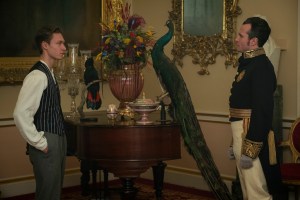
Harrison: Yes, totally agree. The fact that he’s able to create this world from four or five lines of the Irregulars in the original books is an amazing feat and I think, as Thaddea said, we treated the scripts as our bible and go-to and gaining all this information.
For me, I was quite lucky as well because even though Tom’s drawing from the characters from other Sherlock adaptations, Prince Leopold was actually a factual person, which is quite fun to look into and to see where he’s drawn the inspiration for the character from and seeing what the royal family said about him back in the day in the 19th century. I was quite lucky with that.
 Darci: I remember in the rehearsals we had Tom in the room and we got to ask him loads of questions about the characters. That was really amazing because he’s been trying to pitch this show for ten years, so he’s been sitting with these characters for so long, he knows them so well. We got to literally sit there and ask him everything about them, about their relationships and about their strengths and weaknesses, everything. It was really fascinating to sit down with someone and really get to know these characters like they were people.
What was the most surprising thing that you learned from that conversion with him? Obviously, you’re not urchins from the East End or a haemophiliac prince, so there’s a large amount of acting involved with the characters anyway but what did you learn about them from that discussion with Tom that informed where you went with them?
 Darci: I asked specifically a lot about Jessie and her mum and that relationship, and also about the relationship with Bea because that’s a really strong bond throughout the whole show. It’s a very important bond, so it was important that came off properly on screen. I asked a lot of questions about them, the fact they went to the workhouse when they were younger and how they got out of that. You have to fill in the gaps because we find them as teenagers but you wonder where did they start out? Where did they begin their story? So we really delved back and thought, “Well, if they were in a workhouse did they stay together? Were they split up?” We have to invent these backstories as well with Tom which was really fun.
Thaddea: I think it was helpful as well because obviously Billy, Bea and Jessie have lived since they were little together and they all have the same shared experience. So when they say ‘the workhouse’ I know exactly what they’re thinking about. We meet up with Spike and he joins the gang a little bit later on – he wasn’t in the workhouse with them – so I think it was really for us as actors to all be on exactly the same page so we knew what these characters had lived together. I found that really helpful, like Darci said just that relationship between Jea and Bessie… I mean Bea and Jessie. (laughs)
Well, they’re interchangeable obviously.
Darci: It’s only halfway through the day as well (laughs).
Thaddea: I’m never going to live that down.
Harrison: Tom gave us that conversation but then he was only a text away if you ever had any questions. He was very collaborative.
From Leo’s perspective, obviously he’s been kept at the palace for most of his life, 17 years. and I wondered what drew him to the Irregulars and why he wanted to stick around. I think he’s obviously looking for friendship, looking for love and I think he enjoys being valued as someone who’s incredibly intelligent and bringing something to the team, and being a normal teenager and being a part of those friendships.
 Darci, you have a number of scary scenes; how did you deal with them and did you find it difficult to switch off after filming?
Darci: No, we have such a safe environment on set and everyone was so attentive to me and making sure I was OK.
It was fine: we were in these tunnels that they built and I had a lot of fun playing with it. I won’t lie, the adrenaline and stuff like that was hard to keep up at times because it was so high energy. I was running and screaming and crying and so I was in a lot of energy all the time so in terms of switching off of a night, I felt as soon as my head hit the pillow I was out for the count.
It was a good experience and definitely different from what I’d done before.
Love and relationships are a huge theme throughout the show but Thaddea and Harrison, you two get the romantic centre of that. Was that a slight detachment from all the darkness Darci was having to go through?
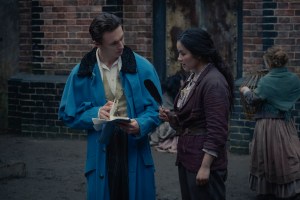 Harrison: Yes, I think so. It’s an interesting one because there are these dark supernatural elements going on and at the same time you’re trying to chat up the girl of your dreams. So it can be a bit difficult and a bit balanced but the relationship they have is very strong and from the off they notice that there are some qualities that they like in each other. It’s really just exploring that and being a teenager in love, being young and in love, and just seeing what happens and where it goes. Obviously there’s a lot of other circumstances in which they figure out quite quickly that love isn’t easy and it takes a lot of work to get to. It’s been fun to do.
Thaddea: Yes, I really love that there’s that depth to the relationship, it’s not just “oh my God you’re really fit”. There’s a lot there that they help each other with emotionally and I think that connection is so strong and other things come from that, but I love that it is these two people connecting on a very emotional level. They see each other and they see things in each other that the other person thinks is a weakness and the other person’s is like ‘ Oh no no no, you see that and I hear that you see that but I see it like this’ and they really help each other. I think it’s really lovely.
What do you think you brought of yourselves to the character that would have been different had say for instance, Darci, you and Thaddea had changed roles? How would those characters change?
 Darci: That’s a really interesting question. It was funny because originally I did read for Bea, when I first went into the room. Then on the train home I got a phone call asking me to look at the role of Jessie over the weekend and tape. So I’m not sure…
I think it just fell into place and I can’t imagine it being any other way really. I feel like Thaddea brings such fire to Bea and I think she’s done it so brilliantly, I can’t imagine anyone else playing her.
For me, for Jessie I loved playing with all of the different sides, her cheeky side teasing Bea about shenanigans, I had a lot of fun with that. Obviously all the nightmares and stuff was a really interesting side to Jessie as well so I had a lot of fun.
 Thaddea: Yes you’re right, it’s really strange to think about that.
I got cast, and then Harrison and I did a chemistry test and we saw a couple of other people come in for the part of Leo. All of them brought a really different quality and it was really strange, as soon as Harrison walked in I feel like he just got the essence of him so it’s really strange to think of anyone else playing those people now. It feels like perfection really, a match made in heaven. The entire cast I think is brilliantly cast.
Harrison: Yes. I’d love to see the audition room for all those Leos, just a bunch of socially awkward nervous people, I think it would be quite funny.
For me and the character, a big thing for Leo is finding his feet outside of the palace and finding his feet in friendship. I was quite a shy kid growing up and I wanted to bring a sense of that, of being in a shell and then finding your feet and growing as a person. The growth and journey of Leo is something I’ve really enjoyed.
Filming was halted due to the pandemic and you started again a few months later. How difficult was it going back to production whilst there were restrictions going on and Liverpool was in a bad way with coronavirus?
 Thaddea: I think we were all a little bit apprehensive. We were one of the first shows to get back up and running and everyone had been so careful. The idea of going back to a set with lots of people was daunting but I think the advantage we had was that we all knew each other so well – we’d spent almost seven months together before we stopped work and paused – so going back with what feels like a family made it less scary.
I think it’s the fear of the unknown. Sitting there thinking ‘Oh God we’ve got to go back and film during Covid’ was scary until you got there and realised just how careful they were being. The protocols they’d brought in were really safe. We were all in isolation, we were being tested all the time, the crew had different wristbands so people were in bubbles. It felt like one of the safest places we could be was on set because everyone was being so careful.
Harrison: Definitely, to have that security that it was going to be a safe place and just to see how it worked with all the protocols that Thaddea mentioned was really reassuring. The medical team were testing us a numerous amount of times and it just felt like a safe place to work, and also having that bit of a break during Covid and the lockdown, because it’s a big show and the last two episodes are really this big epic finale, we wanted to do it justice. Having that break and coming back with renewed energy and giving it your all was a great thing and a lucky thing to have and we were just happy to finish it securely and safely.
Watching this even though it’s obviously set a very long time ago I think a lot of the themes feel quite timely.
 Darci: The writing and the speech is very modern, especially the chats between the Irregulars themselves. They all speak like teenagers now and I think that’s really cool because I feel like people watching it can relate to them really easily and I think that’s a really nice thing.
Obviously there’s a contrast – as we go to Watson and Sherlock they speak differently to the Irregulars because they are a different generation and I really love seeing that transition of the younger and older Irregulars. I think that’s a really fascinating change. Even in something as simple as speech you can show that difference and I really love that.
Thaddea: Some of those big themes of grief are very prevalent today given what’s happening in the world and grief is unfortunately something that everyone’s going to deal with in their lifetime, maybe now more than ever. I think [it’s important] seeing that represented on screen and seeing these characters deal with grief in different ways. Bea says at one point, ‘It wasn’t the grief that hurt us, it was that we didn’t grieve’ and I think what, hopefully, people will take away from it is that it doesn’t matter how long it takes you to get there, as long as you do address it at some point. That’s a journey that we have to go on and I think when you see something like that and maybe you’re experiencing it yourself, it makes you feel less alone and it makes you feel validated in a way and that you’re not maybe the only person feeling this. I think that’s a really important representation and I think this is quite timely.
Also the themes of love and relationships, family relationships, chosen family, friendship, they’re all universal and they’re never going to go away.
Harrison: For sure. With the language and everything, I think one of the main assets of the show is breaking the boundaries of a period Victorian show or a usual original remake of the Sherlock Holmes series. I think it constantly pushes boundaries with the music choices, the languages, the relationships. There’s a lot for people to empathise with and connect with at home whatever age they are and I think that’s really one of the main assets of the show.
Obviously a lot of it’s set in the slums and the alleyways but Harrison you get to go off to a nice palace and dress up nice from time to time. Was that a bit of a leap at times?
 Harrison: I loved that. I found it a bit difficult sometimes: we all stayed in the same apartment building and these guys would come home and be like, ‘Oh God we filmed in this sewer today in this horrible mouldy alleyway with damp and everything. How was your day?’ and I’m like. ‘Yes I was in this big ballroom scene with loads of extras and alcohol, just this incredible party. That was tough’.
So yes, it was nice to be the prince but Leo’s journey is that he gets down and dirty with the Irregulars, I’m very much a clean freak so I found that a bit harder than the prince side but it was fun to play both.
The Irregulars is available now on Netflix; click here for our other coverage.




 Sci-Fi Bulletin: Exploring the Universes of SF, Fantasy, Horror and Spy-fi!