The Irregulars: Interview: Jojo Macari and McKell David
In the new Netflix show The Irregulars Jojo Macari and McKell David play Billy and Spike, two of the key members of the gang who become embroiled with Dr John […]



In the new Netflix show The Irregulars Jojo Macari and McKell David play Billy and Spike, two of the key members of the gang who become embroiled with Dr John […]
 In the new Netflix show The Irregulars Jojo Macari and McKell David play Billy and Spike, two of the key members of the gang who become embroiled with Dr John Watson’s investigations into the supernatural darkness infesting London. Shortly before the series arrived, they chatted in a press conference with Sci-Fi Bulletin:
In a less well written show, your characters could have possibly slipped into being comic sidekicks but you get a lot to do which adds to that ensemble feel. How important was that for you?
Jojo: I think the gang dynamic might be the most important thing in the show, for me. I know in casting that was super important to get the dynamics right between the characters but also between us as people because ultimately we’re all upping sticks and moving to Liverpool for a year. So you need to be able to get on with these people and honestly I couldn’t have asked for a better group of people. It really was amazing and I love all the guys so much.
Having us as a group dynamic is important. I think there’s something relatable in each of the characters. Every character brings something different to the show.
 McKell: The five Irregulars are very relatable but because we’ve taken them out of the 21st century and gone and slapped them in 1800s Victorian London, it’s hard to see it. If you think about it, in today’s world Billy and Spike are those kids from Hackney or Peckham coming from broken homes, deprived areas and are trying to stick together and fight their way through it to get to the other side. So I think it’s very relatable and I think Billy and Spike’s chemistry together adds a different layer to the show.
What did you find the biggest challenge of playing your individual roles?
McKell: For me, every role you get is a challenge, it’s a new challenge that you welcome with open arms. It’s about challenging yourself, challenging yourself to produce the best work every day.
I look at actors as performance athletes more than anything. I don’t think there’s many jobs where you have to stress your body and your mind as much as you do when you’re an actor and it has to be on call.
So I think they are the challenges I love to face, hitting those heights.
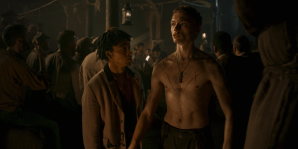 Jojo: I was chatting to someone the other day who said, ‘Creativity acts best when you feel like, you’ve got the line where you are, where you’re comfortable, and you’re just slightly pushing it further forward. I feel like every role that you take on you should be slightly pushing yourself slightly further each time just so you’re not comfy. You never want to be comfy; being comfy’s boring. I think in terms of playing Billy, he has a lot of emotional depth, he has a lot of trauma that isn’t necessarily on the surface level of his character. Dealing with that stuff is what makes the character, otherwise he’s just the muscle, the grumpy guy at the back. I think there is so much more to Billy than that.
Obviously Tom’s writing is an tour de force when it comes to dissecting that stuff but the opening stage direction for Billy’s first entrance is ‘Billy enters, he is absolutely ripped’ (laughs) I’m not ‘absolutely ripped’ or I certainly was not at the time. So I was, “Bloody hell that’s going to be a challenge, let’s go hit the gym!” I worked with some crazy PT’s and I did some crazy stuff – and I don’t know about ‘absolutely ripped’ but I definitely look better there. When it came to shooting that scene there right at the start, that was a challenge, that was the first time I’ve had to do that, which is cool.
How difficult do you find it, to switch off from those high adrenaline days on set?
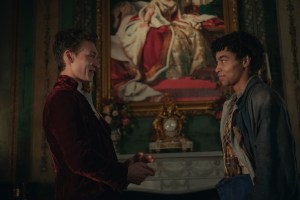 McKell: I think for everybody it’s different and everyone’s processes are different. For me, sometimes you have to put yourself into places where you don’t want to put yourself with your mind but it just makes you learn about yourself. I every role that I’ve played I’ve come away from it and been like, ‘Oh, I feel like I learned 30% more about myself’. I’ve been Spike for a year, you come away from it and there’s McKell and then there’s Spike and when you’re going into work being Spike and coming home as McKell you start to see the differences in the characters and you start to differentiate it.
I think hanging out with these guys is really good. We’ll get back from set and it’ll be McKell, Jojo and Harrison or the gang or whatever and we’ll be conversing.
Maybe if I was filming in Liverpool by myself for a year and I didn’t have anybody my age or anybody I could speak to and was friends with, then I think it would definitely be a lot harder.
Jojo: Yes, totally agree. It’s all about the gang, the gang keeps you sane.
 McKell, at times it felt like Spike was the voice of the audience a little bit. You were bringing things back to reality with all this crazy stuff going on around. Was that how you saw the character?
McKell: Yes definitely, I think that’s a credit to Tom and his writing. It’s leaving those little things there for the audience to catch or grab onto.
Also with Spike, he’s the straight thinker in the gang, he’s not going to run into a burning building unless his friend is in there. I think early on in the show, he doesn’t really understand why we’re risking our lives for this random guy that nobody knows, it doesn’t make sense to him. I think he’s more street smart than the other gang members. I think he can see when somebody is being manipulated and when they’re not and I think early on he was very worried about that.
Why was it so special working with each other?
 Jojo: The age thing definitely helps obviously but I think we really were a tailor picked group of people. Basically there’s not a bad egg in the crew, which is what makes it so good. And we all had things that we could do together: me and Thaddie made some music together at times, and McKell and Harrison would go out skateboarding every weekend. I know the guys would go out climbing, going to climbing walls and stuff which isn’t so much me and I’d be at home for that bit (laughs). I’d be organising the pub trip for afterwards.
McKell: I think as well it was the fact that we’re young actors but we’re all hungry actors, we’re all determined and we all know what we want to achieve and I think collectively we all understood that about the show. So I think us giving it our all and there weren’t any personality clashes so it makes it a lot more enjoyable. Once we started hanging out and properly getting to know each other it was like yes, there are the broskis.
Jojo: I think you’re right, McKell: when you’re surrounded by a group of people that are throwing themselves into something, there’s a little competitive thing that ticks over in your brain and you’re like ‘Oh OK, I’ve got to level it up’ and then they level up and it’s a constant.
McKell: It’s healthy competition.
Jojo: Absolutely. I remember Harrison used to do this thing: if he was doing a scene that was intense and he had to be walking with his walking stick, he gives himself a dead leg before shooting the scene which is (laughs) crazy. I remember seeing that and being like ‘OK… I’d better get stuck in.’ (Laughs)
 Did you have anything you would do to get into character?
McKell: I never did anything crazy like that. I had a morning routine because I’m not a morning person. It doesn’t matter if I’ve had 25 hours sleep or 5 hours sleep, I just hate the mornings and I’m quite grumpy. So my technique was get into the trailer, loud rap music to wake myself up. Two or three songs, that’s about nine minutes, and I’m good, I’m in the zone I’m ready, any scene I can do.
But without that it is hard, I need that dose of rap music in the morning to wake me up.
If you were going to sum The Irregulars up to somebody, how would you describe it?
Jojo: I think it’s a supernatural thriller set in the Sherlock Holmes universe that revolves around the dynamic of young people with a tough upbringing and that is a very niche genre. (laughs) It’s long but I’m sticking with it.
When you did have to halt production when the coronavirus pandemic started, how difficult was it, when you came back to film scenes given the restrictions since Liverpool had quite a high rate at that time?
 McKell: It wasn’t really difficult because the production was so good at getting the coronavirus people down and we had strict regimented routines of how to enter and leave set. And actually, filming maybe ran smoother because we had to have designated times for things.
I think what was difficult was getting to grips with it all because it was all fresh and some things felt very unnatural but to do anything, to be working at that point was a blessing so credit to our production team for managing to get us back up and going.
Jojo: Yes, absolutely saved the day. It’s obviously sad when you form these bonds with the crew and the people you’ve spent all this time with then you’re away for four months and you want to give them a big hug but you can’t. I think it made us all pretty hungry to get back in.
Were there themes that you could relate to or perhaps felt were quite relevant to today?
 McKell: I kind of touched on it earlier. Because we’re in this 1800s Victorian world it’s very easy to get strayed from who these kids are from when you look at them but they’re orphans.
Any of the other characters could be somebody else that’s getting looked at weirdly for who they are or what they represent, and I think that’s what The Irregulars is about. It’s these five kids being true to themselves. With Jessie and her supernatural power, she’s looked at like she’s weird, like there’s something wrong with her, when really we should be praising and making her feel good about this power that she has. It’s such a blessing that she saved the world with it!
I hope that in the bigger picture The Irregulars can maybe make the younger generation or all generations look at things from another angle.
 Jojo: Totally, and I think the show deals with quite heavy topics. We talk about grief a lot, talk about trauma and mental health and the importance of looking after yourself, not just physically but mentally. That feels very timely because it is being talked about more now than maybe ever before, especially for young people. That’s obviously incredibly important and I think it’s great that the show tackles that so head on but in a way that – and this is mainly down to McKell to be honest with you – never becomes too overwhelming or makes the show feel dirgey. I think we deal with those subjects in a productive way.
The Irregulars is streaming now on Netflix.
Click here to read our other coverage, including reviews and interviews.
 Doctor Who News Star Trek News
 Sci-Fi Bulletin: Exploring the Universes of SF, Fantasy, Horror and Spy-fi!