The Irregulars: Interview: Henry Lloyd-Hughes and Royce Pierreson
In Netflix’s The Irregulars we meet a Sherlock Holmes and Doctor Watson unlike any we’ve encountered before. In the run-up to the release, Sci-Fi Bulletin was part of the press […]



In Netflix’s The Irregulars we meet a Sherlock Holmes and Doctor Watson unlike any we’ve encountered before. In the run-up to the release, Sci-Fi Bulletin was part of the press […]
 In Netflix’s The Irregulars we meet a Sherlock Holmes and Doctor Watson unlike any we’ve encountered before. In the run-up to the release, Sci-Fi Bulletin was part of the press conference with actors Henry Lloyd-Hughes and Royce Pierreson…
Did you put a lot of rehearsal into the relationship between Holmes and Watson or did it evolve?
Royce: I don’t think we really thought about how we were going to build the relationship. It’s always so much about how you interact with the other person and luckily me and Henry get on really well. It felt natural, so there was never this spectre of “Holmes and Watson are so likeable that you have to get a dynamic”. It was just our dynamic and our dynamic happened to be whatever fits at that moment, whatever you wake up and bring to a rehearsal or a shoot day.
Actors get confused in ‘It has to be this’ or ‘I rehearsed it as this so what if I get to set and I’m not feeling like that?’ You have to let that go.
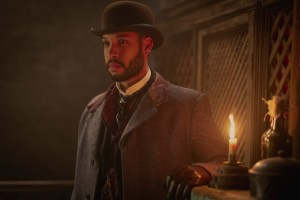 When you’ve done your work, you trust that whatever needs to be there will be there but also these characters are living through you so they inhabit your body and your voice. However much you want to change your voice, you still have to let them use whatever you’re feeling. I think if you don’t, you get two people talking at each other as opposed to people listening and reacting.
I’ve been a fan of Henry’s for many years, so actually getting to work with him was a great thing and to see our Holmes and Watson turn out the way they did, it’s great. Whatever we were feeling on the day, that’s what came across and really works.
Henry: You encounter the Watson character far sooner than you encounter the Sherlock character so I was getting that off the page and getting a sense of the mood and the atmosphere around this guy. Obviously Royce brought that day one. On our first day together he has a line in the scene that we were shooting: “Do you see me?”
Royce: “I wanted you to see me, do you?”
Henry: Exactly and wrapped around that line is so much meaning and so much import and yet it’s just one line on our first day. It wasn’t a perilous scene, it’s just a scene between the two of them yet we’re trying to navigate all of the subtext and all of the history in that.
So just to echo what Royce was saying, you have these ideas and you start cooking them up, and then on the day you’ve somehow got to put that behind you and just react to what the person is saying in that one line, and try and do it simply and truthfully. That’s always the challenge. You can’t play 150 years of literary history every time you say a line!
What was your reaction when you read the scripts through? Did you get all eight when you came on board or did you get the first four or five?
 Royce: Well, you shoot in blocks so you maybe get two or three scripts per block and they’re always rewriting, they’re always catching up, so you don’t get that much information but the conversations you have with directors and producers, you get what you need to get from those. As you start building the character I think that informs how they build the character as well, so it’s a kind of osmosis and a two way thing, which is great. It wasn’t a rounded picture but it was a collaboration, which was great.
Henry: I agree and I always think, in a weird way, people who are not actors underestimate how flexible things are, and how much can change, even within one’s own story arc. You’re often putting stuff down in early episodes and hoping that they don’t write you into a corner whereby decisions you made early doors suddenly become totally ridiculous!
Working on [a soap opera], I’d imagine everyone knows it’s seat of your pants stuff and you get a description in your letter box and you suddenly go ‘Oh no, I’m the murderer’. It’s not quite as dramatic as that but it’s not far from it. As you go to a table read, sometimes you will have had those episodes for just maybe 48 hours and you’re processing a huge leap that you’re going to make dramatically.
So there’s always surprises along the way and it’s very very very rare to begin a series knowing exactly how it ends and what your character does.
How good are you at handling scary things? Are you fans of the genre or are you scaredy cats?
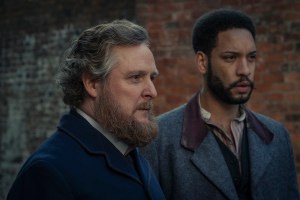
Royce: I’m a scaredy cat, I’m terrible. I can’t really watch horror films. I don’t like being scared. I know there are some brilliant horror films out there but I can’t put myself through it.
But I think filming is different. I didn’t have too many interactions with what you’d call ‘scary things’ in the show. Not like Darci, she got put through the ringer, I mean jeez Louise.
Henry: God, yes.
Royce: She went through some stuff, amazing work.
I think filming is different, it’s like when people talk about actors in sex scenes: ‘Was it awkward?’ No it’s just a process of filming a certain thing that when you put it together and you watch it on screen the elements come together and it’s scary or it’s sexy or whatever. I think until I do a full blown horror film it doesn’t translate the same way to me that watching something does.
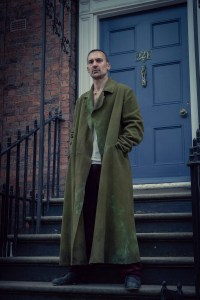 Henry: I’m the same as Royce. I almost had a heart attack this morning, I was in the shower and my wife walked in to do her teeth. I didn’t hear her coming and I almost died. My threshold for horror is incredibly low I’m afraid!
One of the things my wife and I have in common is we both had probably about a full decade of nightmares after seeing The Woman in Black, the stage version. It genuinely took us about ten years to recover, each, so twenty years in total. So yes, I’m afraid I don’t mind making it but you will catch me hiding behind the sofa in real life.
You’ve both worked on programmes where you’ve blended fantasy and reality. How much does that reflect in your performance when everything is real, everything is tangible, you can touch and feel it?
Henry: I think it makes a huge difference. It’s like the costumes as well.
Sets are always amazing and you have the extra added benefit of [studio] sets where you’re not going to get rained on, and there’s not going to be a snow storm, and there’s not going to be a plane flying overhead that you’re going to have to overdub the sound later.
Having said that, the luxury of being able to walk in one room, walk down a corridor that’s a real corridor in an old house, and walk in another and you’re continuously within the world of the character, I don’t think you can put a price on that. That’s unique.
Royce: I agree. I’ve never met an actor who likes working without it more than they like working with it.
 What did you find the biggest challenge shooting this?
Royce: For me it has to be the Covid break.
We had two weeks left to shoot, then everything shut down and we had about a six month break until we picked it back up again in August. So it was about a year from when we started to when we picked it back up.
These two weeks [of shooting] turned into five or six weeks because of all the new health and safety protocols and all of that stuff.
I live in Sweden so travelling anywhere for a job it takes me a while to settle in, even if it’s based in England and I’m going to another place in England. But coming from Sweden to the UK when everything was happening, being in a hotel trying to pick this thing back up and run with it till the end, it was really hard.
It’s only upon reflection that I realise how much we were all just trying to get through it. I think seeing everybody, seeing their fight and determination to come back and finish as strong as we started, [I must give a] shout out to everyone. It was an amazing, amazing way to end it in unbelievable circumstances.

Henry: For me, dramatically, it was trying to do a fifteen year time jump in between scenes. When for your character, fifteen years passes then you’re back in time then you’re forward in time and then back in time… That was an immense challenge. I couldn’t have attempted it without having [the help of] Oscar winning hair and makeup designer in Lucy Sibbick, who just won the Oscar for the Winston Churchill film. To work with her to create that transformation and do all that stuff – I’m an actor and things like a fifteen year time jump can be very intimidating but hopefully, visually we did it convincingly.
Did you feel pressure playing characters that are known and did you research them?
Henry: The first thing I’d say is that, as is not uncommon in the world of acting, you do an audition and then months go by and months go by and they ask for something else and then suddenly you’re thrown in at the deep end with about five minutes notice.
 Also because of the hybrid elements that are very new to this version of Victorian London, particularly the supernatural sci-fi elements that are transporting us, I was so focused on understanding and comprehending this new world that, even if I tried to, I couldn’t picture any of the previous incarnations [involved]. I feel like that research would have been slightly wasted if I tried to transpose that slightly traditional retelling onto our very new hybrid version. Especially given the young cast have a lived in, real quality that feels very different.
Royce: For me, whoever’s played Watson before it doesn’t inform me.
I think it was such an opportunity and to me, Watson was just a name: “John Watson”. I started to play around with the idea: what if he was a drifter or a traveller who would adapt to situations all throughout his life? He’s been around the world and he’s world weary. I started to formulate this idea that he’s an imposter or a chancer and he just happens upon situations, so when we pick him up in episode 1, this is just a character that he’s been playing for so long he now believes it. He believes he’s John Watson.
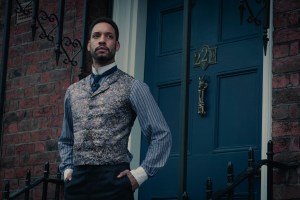 Even the accent: I wanted the accent to be slightly mismatched to the man. When you look at him and you haven’t heard him speak, you think he’s going to sound a certain way and when he does speak you think something’s off but you don’t know what it is and then it goes away.
I’m trying to find this weird balance that basically was all in my head to fuel my characterisation and it really worked, I think. It gave me this layer and then the next layer unravelled itself, and add that to Tom’s writing, it just built this really full character who just happened to be called John Watson.
The Irregulars is streaming now on Netflix.
Click here to read our other coverage including review and other interviews.
 Doctor Who News Star Trek News
 Sci-Fi Bulletin: Exploring the Universes of SF, Fantasy, Horror and Spy-fi!