1999: In the decades following the Apollo missions, humankind has established a permanently occupied lunar installation, Moonbase Alpha. The outpost doesn’t exist in isolation, as it also serves as the […]
1999: In the decades following the Apollo missions, humankind has established a permanently occupied lunar installation, Moonbase Alpha. The outpost doesn’t exist in isolation, as it also serves as the support platform for what is to be the first manned deep-space exploration effort beyond our solar system. For years, scientists and engineers have been studying a mysterious signal that appears to be transmitted from Meta, a distant planet which may be capable of supporting life as we know it. As the spacecraft is being prepared to launch on an extended interstellar flight to investigate Meta and the signal’s source, strange illnesses are befalling the astronauts slated to crew that mission. Add in a stockpile of unstable nuclear waste that’s heating up for inexplicable reasons on the Moon’s far side, and the result is…. well, we all know that September 13th, 1999 ends up being a very bad day for everyone on Moonbase Alpha.
Big Finish’s brand new series of audio dramas based on the cult classic 1970s science fiction television series Space: 1999 does not radically reboot or “re-imagine” the show’s basic premise for 2019. As he did with another fondly remembered British TV program, The Prisoner, writer/director/producer Nicholas Briggs instead opts to go all-in with his approach of an “alternate history” where human space activity was far more audacious than the reality of the 20th Century’s last quarter. This has the effect of providing us with something of a period piece from a different reality, in the same vein as James A. Michener’s novel Space, Stephen Baxter’s Voyage, or even the upcoming Apple TV+ series For All Mankind…. just with bell bottoms and groovier theme music.
Faithfully adapting the script of Space: 1999’s first televised episode, “Breakaway” also seizes the opportunity to update the story and the series’ entire setup for modern sensibilities. It also polishes a few of the program’s rough edges and introduces new wrinkles to its established lore. The Meta signal, all but forgotten by the time the second episode aired on television, is given far more prominence in this new version. Now it plays an integral part in the Moon’s violent ousting from Earth orbit and its headlong flight through the stars, setting up story possibilities never explored during the TV series.
“Breakaway” also spends more time fleshing out the days leading up to the disaster, including adding layers to the back stories of its main characters which hopefully will receive further examination as the audio series progresses. Mark Bonnar and Maria Teresa Creasey take the reins from their screen counterparts Martin Landau and Barbara Bain and bring solid yet respectful new interpretations of their respective characters, Commander John Koenig and Dr. Helena Russell. Bonnar’s Koenig is a little more hard-edged, while Creasey adds welcome moments of no-nonsense professionalism to the seemingly impassive Russell too often seen on the series. Professor Victor Bergman, the seasoned science officer who was our conduit to understanding many of the oddities our heroes encountered during Space: 1999’s first series, is portrayed here with easy aplomb by Clive Hayward. Commissioner Simmonds, a one-note antagonist for Koenig on the television version of “Breakaway” when he’s trapped with the rest of the Alphans on the runaway Moon, is given a little more nuance here thanks to Briggs’ scripting and the voice efforts of Timothy Bentinck. Simmonds remained noticeably off-camera following the screened events of “Breakaway” and did not reappear until the first series’ fourteenth episode, “Earthbound.” I’m eager to see how and if Briggs chooses to utilize him as an ongoing thorn in Koenig’s side during upcoming installments.
Big Finish’s plans for Space: 1999 include additional audio adaptations of various episodes from the TV series as well as all-new tales. With the “origin story” out of the way, I’m hoping Briggs will expand the premise in ways the original show couldn’t or wouldn’t touch on. I look forward to seeing (and hearing!) what’s next for the men and women of Moonbase Alpha. 9/10
DAYTON WARD is a New York Times bestselling author or co-author of nearly 40 novels and novellas, often working with his best friend, Kevin Dilmore. His short fiction has appeared in more than 20 anthologies, and he’s written for magazines such as NCO Journal, Kansas City Voices, Famous Monsters of Filmland, Star Trek and Star Trek Communicator, as well as the websites Tor.com, StarTrek.com, and Syfy.com. He’s also an unabashed fan of Space: 1999 from its original broadcast. Visit him on the web at http://www.daytonward.com.
It was the sad passing of Zienia Merton in 2018 that probably saw most longterm fans of Space:1999 finally give up hope on any kind of audio drama reunion for the original cast. Big Finish would doubtless have considered every permutation for this revival, but the halfway house of a few remaining key cast members across both seasons who may have been willing to contribute (the likes of Nick Tate, Prentis Hancock and Catherine Schell) alongside impersonators of their former colleagues would probably have satisfied no-one.
A reboot featuring the same characters and settings but with the freedom to create its own open-ended continuity for 21st century listeners is no doubt the most robust option going forward. All your favourite characters are here but recast and reimagined; purists may well be resistant at first but the performances are excellent and any tweaks, including the gender-switch of one series regular, feel right for the times.
The sign over the door says Space:1999, and, yes, this series is still set in that precise retro-futurist year, but the outlook of the characters is definitely 2019. Mark Bonnar as Koenig remains that four-square American hero we all love, with perhaps a more fiery passion than Martin Landau, but the most radical reworking is for Dr Helena Russell who, now played by Maria Teresa Creasey, is a ballsy, outspoken firebrand far removed from Barbara Bain’s more passive, soft-focus medical officer of yore. Certainly it’s impossible to imagine Bain’s Dr Russell calling anyone an “asshole” or exclaiming “Shut the front door!” but the character’s remoulding is the clearest indicator of this version’s 21st century overhaul and its efforts to appeal to modern tastes.
Fans may actually be more shaken to discover elsewhere Paul Morrow revoiced as a no-nonsense Yorkshireman but will be pleased to hear Glen McCready’s spot-on impersonation of Nick Tate as easygoing Aussie cobber Alan Carter. And no, your guess why there’s a curious slight surname pronunciation change for another of the crew is as good as mine.
While it’s impossible to say whether the crew of Moonbase Apha are still wearing their polyester flares in this reboot (that’s left to listeners to decide), die-hards have familiar pieces of sound design, from Eagle engines to Main Mission’s bleeps and bloops, to break them in gently to the revival’s more radical changes.
This new feature-length script of Breakaway has changed and expanded, largely to accommodate more, much-needed character moments – the oleaginous antagonist Commissioner Simmonds seems set to continue deep into the ongoing series – while the dodgy 70s science of the original has been built upon, revised and recalibrated to something more credible in a post-Hawking world. Scriptwriter Nick Briggs also adds a truly inspired continuity reference from one original series episode to provide a more satisfying explanation as to the moon’s departure from Earth orbit.
On the evidence of this début outing, this audio series looks set to retain the epic scope and tone of the TV original; only on a couple of minor occasions where the script feels compelled to make post-modern meta-reference (or is that Meta reference?) to the show’s title does the more accurate, serious tone momentarily give way to Terrahawks-style cheesiness.
Verdict: A mix of the familiar and the excitingly reworked, Breakaway is a firm basis from which this revival series can now freely springboard into the unknown. Fans should be in for a treat. 9/10
Alistair McGown
Big Finish’s licensed output tends to fall into three categories – there are the “Missing Adventures” that slot new stories into gaps between broadcast episodes of whichever show it might be (the majority of the Doctor Who material for instance); the “New Adventures” that continue a show beyond what we saw on screen (the much missed Tomorrow People, and the recent The Omega Factor); and finally the reinventions – where the core concepts of an idea are reworked for the new medium: The Prisoner, the forthcoming Adam Adamant Lives… and now Space: 1999.
It’s heading for 50 years since the show was first conceived, and it’s 20 years (to the day) since the catastrophic events chronicled were meant to have taken place. The show’s one that I enjoyed at the time – for all its occasional daftness! – and collected the tie-in material that came out around its broadcast. One of the best books, and one I regret losing somewhere over the years, was EC Tubbs’ reworking of the premise in his novel Earthfall – the first reboot of the first season set up.
Writer/director Nick Briggs, script editor Jamie Anderson, producer David Richardson and the team have successfully ‘updated’ the show for a new audience, and will hopefully attract far more than those who’ve been fans over the decades. Briggs’ script is based not just on the broadcast version of Breakaway, but incorporates elements that were in the original director’s cut of the episode (although not all, sensibly), as well as adding in twists of his own that try to address some of the issues inherent in the format. The play runs for just under two hours, but really doesn’t feel that long – it’s a little clunky in the opening section as there’s just so much exposition that needs to be delivered in some form or other, but even that’s enlivened by a near-disaster. Once the politicking over the Meta mission and the mystery of the dying astronauts come to the fore, things gallop towards real disaster!
By the end of this pilot, we’ve got to know quite a bit about the core trio – John Koenig, Helena Russell and Victor Bergman – as well as Commissioner Simmons, who I suspect will not get forgotten quite so quickly in this new version as he was in the broadcast episodes. Mark Bonnar, Maria Teresa Creasey, Clive Hayward and Timothy Bentinck all quickly make their mark in the roles (even if subconsciously you may be ‘seeing’ Martin Landau, Barbara Bain, Barry Morse and Roy Dotrice!) while Susan Hingley and Glen McCready share multiple other roles in Main Mission along with Amaka Okafor’s Kano – each character gets some moments to establish them but hopefully we’ll get to know them more in the upcoming box sets.
Iain Meadows’ sound design and Benji Clifford’s score both pay homage to the original series, with some of Barry Gray’s motifs hinted at within the incidental music. The first time I heard the reworked theme I wasn’t quite sure, but a relisten after hearing the whole play confirmed that it’s the right version for this incarnation of the show. There’s a couple of meta moments musically (as well as all the Meta moments!) that may throw you the first time, but provoke a smile second time around.
Those worried that “rebooting” means losing some of the “Anderson feel” to the show may be reassured by my wife’s comment, coming into the office as this played on speakers, asking if I was listening to a Thunderbirds play… As director, Briggs keeps that hyper-reality feel that the best Anderson shows have, with the script’s increased emphasis on characterisation ensuring that we’re constantly engaged, despite a lack of cool vehicles!
Verdict: Series openers always have multiple agendas, and Briggs’ script serves them well, backed up by strong performances and production values. Don’t go in expecting this to be a re-recording of Landau, Bain and co. – it’s a very valid retelling of the core ideas. 9/10



 1999: In the decades following the Apollo missions, humankind has established a permanently occupied lunar installation, Moonbase Alpha. The outpost doesn’t exist in isolation, as it also serves as the support platform for what is to be the first manned deep-space exploration effort beyond our solar system. For years, scientists and engineers have been studying a mysterious signal that appears to be transmitted from Meta, a distant planet which may be capable of supporting life as we know it. As the spacecraft is being prepared to launch on an extended interstellar flight to investigate Meta and the signal’s source, strange illnesses are befalling the astronauts slated to crew that mission. Add in a stockpile of unstable nuclear waste that’s heating up for inexplicable reasons on the Moon’s far side, and the result is…. well, we all know that September 13th, 1999 ends up being a very bad day for everyone on Moonbase Alpha.
 It was the sad passing of Zienia Merton in 2018 that probably saw most longterm fans of Space:1999 finally give up hope on any kind of audio drama reunion for the original cast. Big Finish would doubtless have considered every permutation for this revival, but the halfway house of a few remaining key cast members across both seasons who may have been willing to contribute (the likes of Nick Tate, Prentis Hancock and Catherine Schell) alongside impersonators of their former colleagues would probably have satisfied no-one.
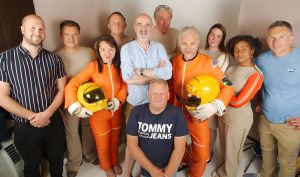 Big Finish’s licensed output tends to fall into three categories – there are the “Missing Adventures” that slot new stories into gaps between broadcast episodes of whichever show it might be (the majority of the Doctor Who material for instance); the “New Adventures” that continue a show beyond what we saw on screen (the much missed Tomorrow People, and the recent The Omega Factor); and finally the reinventions – where the core concepts of an idea are reworked for the new medium: The Prisoner, the forthcoming Adam Adamant Lives… and now Space: 1999.
 Sci-Fi Bulletin: Exploring the Universes of SF, Fantasy, Horror and Spy-fi!