The second season of CBBC’s Silverpoint saw the four youngsters who make up Dragonfly face plenty of new challenges. Earlier in the summer, Paul Simpson had the chance to speak to the three directors – Amy Coop, Louise Ní Fhiannachta and Aidan Largey – about the creation of the show…
How did you each get involved with Silverpoint?
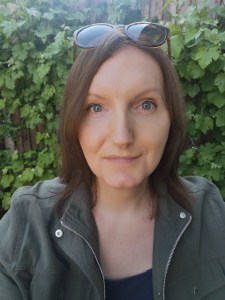 Amy: I love the genre and had been specifically looking to find something really interesting that I could get stuck into. When I opened the pitch document, and all of the references, all of the images, everything was an A-Z of all of my favourite stuff, I was like ‘OK, I have to work on this show.’
I pitched really hard for that. Dan Zeff and Marek Losey were the lead director and middle block director for season one and whilst I was pitching, having my meeting with Lee, Trevor and Stephen, my phone rang because I’d forgotten to put it on silent. My phone ring is the five tones from Close Encounters of the Third Kind, and it has been for a very long time. They were like, ‘Wait, this is a set-up, surely?’ I went, ‘No, I’m really sorry, I’ll turn that off.’ I think it was at that point that they said, ‘OK. I think you’re probably the right person for this show.’
So, I did the last five episodes of season 1 and had a brilliant time working with the cast, Trevor, and Lee. I really enjoyed it and we finished season 1 on a real high. I was very pleased and excited to be asked back as lead director on season 2. I couldn’t think of a better way of spending another six months on it.
Louise: I was asked by producer Ray Lau who I had worked with on Flatmates if I’d be interested in doing a family sci-fi series. He mentioned how Zodiak Kids & Family Productions UK was looking for a director whose core strength was the ability to direct young actors, for episodes 5, 7 and 12. Although I always had a great respect for sci-fi, it’s a genre I’d never considered doing but soon changed my mind when I saw episodes of series one. I was immediately engaged by the premise of a group of kids at an adventure camp discovering a strange artefact while also drawn to the mystery of why four children disappeared twenty years earlier. So, I did an interview, we all fell in love, the end. That’s how I got on board.
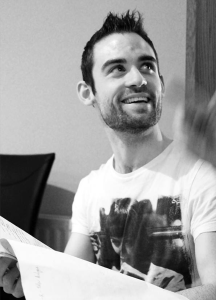 Aidan: I was quite lucky, in that I’d worked on a show with Ray Carlin who’s the DOP on all of series 2 and he’d also done half of series 1. A lot of crew that came in were in Silverpoint crew gear and they started telling me about it. I was left thinking, ‘This sounds amazing and it’s made here [in Northern Ireland]. How do I get onto this?’
I had made a single act sci-fi short that took place within a spaceship, and then I’d made a little short about time travel. I sent it to Trevor going, ‘If Silverpoint comes back for another series, I’d love to interview for it and here’s some of my work that I feel is in that world.’
When he got in touch and asked if I would like to interview for the series. I came in with a mood board of all these different images. I think everybody was always on the same page, in terms of the look and the feel and the identity of the show.
How much did the three of you have any contact during the shooting? Was there a degree of handover?
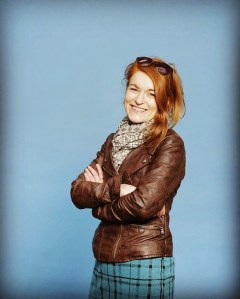 Louise: As you can imagine, the schedule was packed, but if you can grab opportunities to speak to the lead director it is worth doing. Amy was able to offer me insights into various areas which is incredibly useful. The benefit that I had as well, was that I was getting Amy’s rushes and her assemblies every week. So, I saw for myself stylistically where she was going with her episodes. The big things really were ‘What’s the end of episode 4 going into my episode 5? What’s the beginning of episode 6 going from the end of episode 5?’ and so on. I had the same kind of approach in the later episodes. Aidan and I had a lot of back and forth when it came to 12 and 13 as regards story and tone, and atmosphere. I think we managed to nail that communication.
Amy: Yes, it’s always tricky isn’t it, because we’re all working at the same time, but we have to cross over and in fact, in a few of our episodes there were bits where Lou was shooting elements for me, and we filmed little bits which end up in episode 5. We had to make sure that we were all shooting in a similar style so that it didn’t feel completely incongruous. I think those scenes all fit in seamlessly and it isn’t obvious it has been shot by a different director to the rest of the episode. We all, as a unit, managed to work very well together.
A big factor in this was also that the show has such a strong sense of self in terms of the vibe of it and the world that had been set up in season 1 and expanded in season 2.
Was there a particular guide that came through from Lee and Trevor in terms of how the alternates should feel? One of the things I loved was the airlock sequence where they’re trying to save Kaz – it’s only afterwards that you realise ‘Where the hell did Jay get that crowbar from?’ Were there very particular rules set up for what could and couldn’t be done in the alternates?
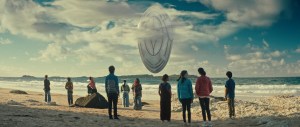 Amy: We set up, again, from fairly early on, that there are certain things you can and can’t do in the alternates, and some of the cast articulate that. There’s a moment on the beach when Alis’s character Isabel says, ‘We can imagine things and we can change things.’
Lee has thought about everything. He’s like an Encyclopaedia Britannica of Silverpoint! So, if there’s ever anything that I go, ‘Oh, I’m not quite clear on this’ then Lee will have an answer.
We had this great canvas to expand upon. We’ve got these three teams and we’ve got three new alternates which can have a fundamentally different pallet and a fundamentally different feel to them. We shot all of season 1 in a 2:1 aspect ratio but then for season 2 wanted to change it up slightly so talked to Kris Kelly, our visual effects supervisor and genius on the show, and the BBC about shooting the ‘real world in 2:1 but when they go into the alternates reframing into a more cinematic 2.35 aspect ratio.’ It’s almost imperceptible at times because you’re in the story but then you start to notice the little transitions from the real world to the alternate.
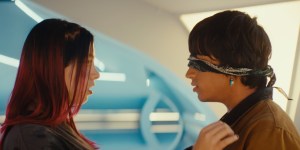 Then, with the setup of the spaceship, because they think that they’ve broken out of the alternate into the spaceship which [they think] is part of the real world, we’re back in 2:1 land and yet, the moment the penny drops in the final episode, when they realise that Jay created the crowbar, which means the rules are still the same here, there’s a wonderful moment where it comes back in from 2:1 to 2.35. It’s a really lovely way of being able to put the audience in the same place as the characters at that moment.
Aidan: That was such a big moment and a huge twist so everything from where I put the camera and how we framed the set was about trying to get the most out of that movement. I am proud of how it all came together when layered with the sound mixing, the score and the realisation for the actors. It’s a moment I find really exciting every time I watch it.
I think one of the things that really works for me in this series is that every episode has a moment that twists things around, and it never feels like the M. Night Shyamalan ‘We’re going to have the twist here, by the way there’s a twist coming. Look out, the twist is coming in five minutes’ feel to it. They feel organic. Were there any things that when you read through your scripts, during your prep, that you thought ‘I’m really not sure how I’m going to do that.’ or was it always a case of ‘Oh yes, that sparks a nice idea.’
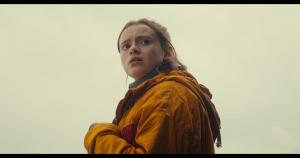 Louise: I think one of my biggest challenges was in episode 5. One of the characters has had her memory wiped but it’s discovered that she’s got all these symbols written on her arm and they mean something. The last clue on her arm is this squiggle. Reading the script and discovering that this is a mountain and living in Ireland, knowing that no mountain is really the same from the back as it is from the front. You’d have to be living in an Alpine region to get that design.
In the end, we decided to go down the VFX route, which was safer for the shape of the mountain, of course. And thanks to our great location manager Alastair Agnew we came across a viewing point in Glengarriff, one of the seven glens of Antrim – a beautiful location that I think worked really well.
Amy: There were many and various challenges for my episodes, not least when you’re reading the scripts and go, ‘Oh, OK. So there are eighteen cast in this scene’ which is quite full on at times. On top of that we’ve got the additional levels of visual effects and how we’re going to create some of these moments, and then also, introducing and establishing these new worlds.
Aidan: I think the one thing that unified all of us as directors was our ambition. Everybody had it – the cast, the crew – and that tied us all together. You have a finite amount of visual effects shots, of time, of sets, so how do you maximise that? I found that really exciting.
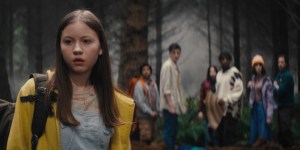 I really tried to do as much practically in camera as I could and then mix that with CGI to make it feel seamless. There were some things I was really proud of in our episodes. For example, I have a moment where Meg changes her T-shirt and that was basically a magic trick. You know when you pull the tablecloth off? It was trying to do that. So you’re sitting down with everybody – because that is a crew and cast effort and I find that problem solving together really bonds people. We got very lucky with that because the one thing no one thought about was her hair and actually the first take, you could see her hair move! Luckily the second or third take was perfect and there is that moment where you’re all gathered around the monitor when you get it in camera, and everyone just is so excited. I find those kinds of things take slightly longer but there’s a real comradery and there’s a real rush when you get it. That was really important to me and to be honest, that was a cool, fun challenge.
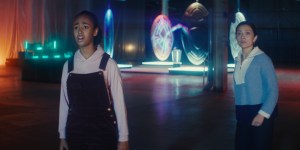 Amy: I remember seeing your rushes when you did the T-shirt trick and I was screaming. It was such a brilliantly done moment. There were brilliant moments across all of the episodes. You mentioned Louise’s episode 12 which I absolutely loved because it’s a proper claustrophobia horror film in twenty minutes.
Louise: Conor Rotherham’s work as DOP was fantastic – especially how the boiler room was lit in ep 12 along with special FX of steam, to give it that real horror vibe.
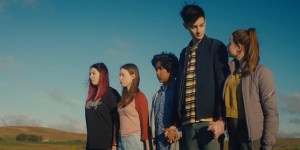 Amy: We were able to shift tone and genre between episodes. So it doesn’t feel like we start on episode 1 and finish on episode 13 and it’s just a straight line. We go off to these different worlds, whether it be the fairground or whether it be the castle… The tone and the style and the pacing can change but it all feels part of the same show. It all feels cohesive even though if you compared episode 2 to episode 6, each has a very different vibe to it but it all dovetails in together. I think that speaks to the ambition that all of us brought to the table.
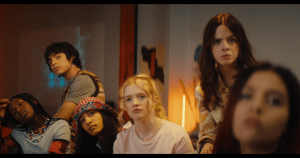 Louise: I had a great experience with the cast as well. I have a lot of experience directing teens, so we built up a trust very quickly and it’s all about the atmosphere you create on set – and back to these fantastic crews we have here in Northern Ireland, they are just the best. They are problem solvers and there’s always a good vibe. Creating a positive atmosphere on set is imperative for us as directors, no matter what we do, but it’s crucial that such an atmosphere exists for teens to thrive.
One of my highlights on the series was seeing Alis Waters and Lucy Chambers (Isabel and Monika) blossom as actors in episode 7. I just thought they knocked it out of the park. They put a phenomenal amount of work into that episode and I think their performances are quite layered because of that. And Ollie and Krish also feature in that episode and their experience from season one really helped that dynamic.
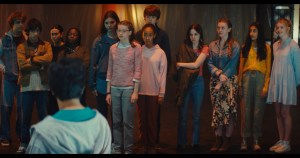 Amy: One of the really beautiful things about it as well is, when you cast sixteen teenagers in anything, there’s always the danger they’re not going to get on in real life. A lot of them are away from home for the first time and they are in this literal and figurative alien environment. They all clicked so quickly and they all got on so well, as a whole team of people, it was brilliant. I had the opportunity to sit down with each cast member in prep and said ‘Just enjoy the experience of this. This is something where you’ll make friends now who will stay with you for life.’ And I think they did, You’ve got Ollie and the original Dragonfly team who are all close but it was lovely to see other brilliant friendships blossom too.
Silverpoint is available on iPlayer.
Grateful thanks to Lisa Earnshaw and all involved for their help in arranging this interview, and their forbearance with its delay!




 Sci-Fi Bulletin: Exploring the Universes of SF, Fantasy, Horror and Spy-fi!