 Written by Peter Kosminsky, Declan Lawn, Adam Patterson and Amelia Spencer
Directed by Peter Kosminsky
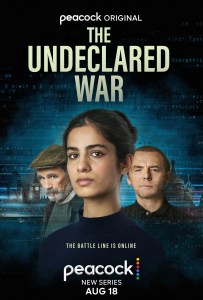
Saara Parvin (Hannah Khalique-Brown), Gabriel Davies (Alfie Friedman) and Vadim Trusov (German Segal) are the future. Student geniuses working the far edge of computer security. Gabriel graduates early and begins work at GCHQ. Parvin joins him not longer after on a year long work experience placement and Trusov returns to Russia where he’s drafted into the FSB’s cyberwarfare division. All three of them struggle with their home lives, all three struggle with the demands of the job and all three find themselves on the front lines of a very different kind of war.
This is such a frustrating show, because it tries to do some very ambitious, very necessary things and it fails in a crucial way. The good news first though: the visual grammar of the show does the near impossible and makes the process of cyber security visual and interesting and fun. The opening scene is a training exercise represented by Parvin looking for doors through an increasingly odd series of locations. Time and space both alter around her as she finds her way through, the process of hacking becoming a visual metaphor, a journey through the system represented by a journey through the world. It’s really, really smart and the show uses it to depict Parvin’s thought process throughout. My favourite example is a later episode where she’s asked to search through a colossal wall of apparently garbage code. We cut between her scrolling through it and her in a closed off yard bouncing a ball against a wall and catching it. A dozen times it comes straight back. Another dozen. Then, it lodges in the wall and she climbs up to get it as, in the real world, she finds something. It’s smart and witty and a really interesting way of showing her process.
The show also does some interesting stuff with the depiction of people on the autistic spectrum. Parvin and Davies, as well as Mark Rylance’s senior analyst John Yeabsley all present as having different levels of autistic process. The way that helps their deductive process, and the way that so few other people view them as anything other than a nuisance is where the show really shows its teeth. It also does some really smart stuff with the perils of being a young woman of colour in an office full of white, English men. Parvin and Yeabsley bond when Yeabsley asks if an apple is all she’s having for lunch. Parvin replies it’s the only thing that’s Halal and you suddenly understand just how lonely she is.
All of this is good, and the performances match it. Khalique-Brown does fiercely hard work here as a young woman hit with grief, guilt, social pressure, career pressure and ambient work place racism at the same time as finding herself on the front lines of an escalating crisis. Parvin is rarely likable but always compelling and understandable and Khalique-Brown does an incredible job of threading a very difficult line. Rylance is good too, his Yeabsley a distant but curiously warm presence. Maisie Richardson-Sellers impresses too as Kathy Freeman, the NSA secondee to GCHQ. The bond between them is logical, untidy and complex and becomes one of the hearts of the show.
But even as this continues to impress, the problems continue to stack up. The brave choice to set functionally an entire episode in Russian isn’t supported by the flat script and Segal and Tinatin Dalakisvili struggle with the material they’re given. They’re the most reserved performers in the cast and while that isn’t a criticism, the muted tone of the episode colours much of the rest of the season and throws the biggest problem into stark relief.
That problem is tone. There’s one. Every single character, from Adrian Lester’s pompous thug of a Prime Minister to Parvin herself, have a default mode and that mode is tetchy. Initially it plays like a deliberate choice, accentuating how alienated Parvin feels. But after six episodes of people being grim, dour, grumpy or all three you find yourself craving a joke or a single tone shift. Simon Pegg and Ed Stoppard are especially badly served by this, the former asked to look worried and ineffectual for six episodes and the latter asked to do nothing but sneer in Tory. Both performers are capable of so much more and if nothing else comes from this, go listen to Stoppard in B7’s Dan Dare to find out what he’s really capable of.
Worst of all though, this one-note approach ties to some dismal plotting. What should be an increasingly frantic show is instead a six episode trudge through a cyber attack happening somewhere else and the cliffhanger ending plays less like a hook for a second year and more like the whole thing juddering to a halt. COBRA, the Sky One spiritual sibling of the show, may be high end pulpy nonsense but it at least remembers to be entertaining as well as grim.
Verdict: The Undeclared War is getting a second season. Honestly, I’d start there. This is a six episode preamble that resolves a lot of its best plots and leaves the second season with some potentially impressive ground to cover but a lot of work to do. 6/10
Alasdair Stuart




 Sci-Fi Bulletin: Exploring the Universes of SF, Fantasy, Horror and Spy-fi!