Review: Scarred for Life Volume 1: The 1970s
A look back at the decade that gave us traumatising safety films, teatime telly nightmares and scary crisp packets. Lou Reed once said that he disliked nostalgia unless it was […]



A look back at the decade that gave us traumatising safety films, teatime telly nightmares and scary crisp packets. Lou Reed once said that he disliked nostalgia unless it was […]
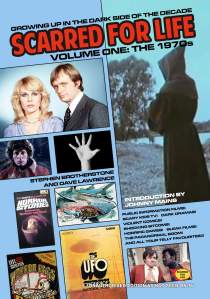 A look back at the decade that gave us traumatising safety films, teatime telly nightmares and scary crisp packets.
Lou Reed once said that he disliked nostalgia unless it was his own, and these days it’s often hard to disagree. We’re used to a seemingly endless stream of clip shows featuring talking heads giggling at flares and sideburns and sagely pointing out the obvious fact that racist and sexist jokes are racist and sexist. I’m sure we’ve all seen those jigsaws featuring old sweet wrappers or social media posts featuring an album cover per day, sans comment or context. There’s nothing really wrong in principle with all this and it can be fun, but it’s rarely very interesting.
So it’s really quite an achievement that Stephen Brotherstone and Dave Lawrence have come up with a book chock full of “scary things you might remember” which while ticking the nostalgia box is also informative, thoughtful and very entertaining. The authors began the 1970s as mere babes (as did I) so in some ways this is a personal journey of growing up into double digits. Being so young, and obviously pre-videos and internet, they were of course denied access to most popular works for adults; what we have here is, for the most part, snapshots of our culture as it was presented to and experienced by children at the time. When I say “our culture” I do mean specifically British on the whole – American TV and comics, for example, although abundant in Britain were generally very “safe” for various reasons and wouldn’t fit the remit, although there are exceptions. To be clear, this is no dry reference book; there’s no attempt to be encyclopaedic although it does cover a vast amount of material, the authors wisely avoiding reiterating information easily found with a quick google. Neither is it just a collection of gushing recollections; not all of this was experienced by the authors at the time, it couldn’t possibly have been (especially the section on films), but what gaps in their experience exist are made up for by thorough research and occasional remembrances from others.
Television takes up nearly half the book’s 740 pages. 1970s UK television pushed the envelope with regards to the kind of content it could show, as it took the freedoms of the 1960s and ran with them. Clean-up TV campaigner Mary Whitehouse was already having conniptions at the start of the decade, but for a few glorious years her complaints were seen almost as a badge of honour, certainly within the BBC, as if to say that if she was upset they must be doing something right, as this section clearly illustrates. A section on children’s shows such as The Changes and the earliest years of Grange Hill is joined by in-depth looks at adult dramas such as Callan and the late Philip Martin’s Gangsters (it has to be said that the authors were allowed to stay up a lot later than I ever was!). SF classics such as UFO and Survivors are present and correct, as are horrors like The Stone Tape. Doctor Who, by the mid-70s practically taunting Whitehouse with its murderous ventriloquist dummies and freeze-frame drownings, is covered with a list of the authors’ top moments, joined by looks as some of the show’s ephemera, including those very weird annuals which seem to have been written and drawn by people who’d been watching a different show entirely.
Probably the most fascinating TV section considers what we might politely call “difficult” sitcoms and light entertainment, by which I mean “horribly racist, sexist and homophobic”. Their accounts of such as The Black & White Minstrel Show, Top of the Pops’ dancers Pan’s People/Legs & Co. and Love Thy Neighbour for once take the time to provide plenty of background and context along with criticism. A useful read for anyone who would pine for the good old days because it was “just a laugh” and somehow perfectly acceptable back then (as the authors demonstrate, to a great many at the time it most certainly was not). Likewise for those who would dismiss it all out of hand on the assumption that everyone involved was basically wicked, rather than for the most part unthinking or ignorant of our ever-changing society, or just getting it wrong despite having the best of intentions.
TV is followed by over 100 pages on the horrifying delights of the era’s Public Information Films (PIFs). Apaches, an account of the horrible deaths of a group of kids playing on a farm, is my most vivid Scarred for Life memory. For years I thought I’d somehow exaggerated its horror in my mind, until I found it on YouTube and discovered I’d remembered it almost perfectly; it really was that traumatic, and a pleasure to read all about it here. This and so many others are covered in glorious detail, including the much loved, and much milder, road crossing campaigns of Tufty and the Green Cross Code man.
As previously mentioned, the section on film is largely retrospective for obvious reasons. However we still get a good look at the themes and concerns of the day, with well researched articles on the folk horror mini-boom (including the Wicker Man) and the fascinating fad for almost dystopian rock movies, with their drug addled icons paying the price for their largesse. We of course go down the rabbit hole for the deeply disturbing cartoon Watership Down.
If cinema horror was denied us we certainly were served up plenty of gory alternatives. Board games, short story collections and even sweets and crisps pandered to our desire for all things bloodthirsty. The delicious Dracula lolly (black on the outside and blood red on the inside) is joined by the classic Horror Top Trumps, with its vast array of copyright dodging monsters (Venusian Death Cell, an appropriated Sea Devil from Doctor Who, had a Fear Factor of just 69, despite having just decapitated some poor soul with a machete – madness). We also get a good look at horror books, James Herbert’s The Rats perhaps the most notorious, along with the numerous Pan Books of Horror, plus that most peculiar fascination with youth gang culture (Skinheads of course, plus Suedeheads and Knuckle Girls, whatever they were). Comics too get a Look-In, with the likes of 2000AD and Misty, even Roy of the Rovers’ hooliganism storyline (as with volume 2 there’s plenty talked about beyond just the obvious SF and horror genres).
We finish with the explosion of interest in the paranormal. This was the decade that saw a man who claimed to be able to bend spoons with his mind become one of the most famous figures on the planet. Along with such nonsense came a second wave of interest in UFOs, where even famous pop stars were calling occupants of interplanetary craft. Wonderfully, along with coverage of such as Close Encounters of the Third Kind and Project UFO, we get a top ten countdown of the greatest UFO songs of the era.
I’ve only scratched the surface, but one of the delights of this book is diving in and coming across some long-forgotten treasure or indeed something entirely new to you. It is fair to say that readers in their fifties and maybe early sixties will get something extra from this that others won’t, but that’s unavoidable. If you are a younger reader you will still find this fascinating, it’s as good an account of the pop culture of those years as you’ll find, plus you’ll finally realise just why your parents turned out like they did.
Verdict: A deep delve into ten years of the weird and wonderful provides endless delights for those who were there and those who weren’t. Practically indispensable 10/10
Andy Smith
Scarred for Life Volume One is available as print on demand or as a PDF along with the recently published Volume Two: Television in the 1980s.
 Doctor Who News Star Trek News
 Sci-Fi Bulletin: Exploring the Universes of SF, Fantasy, Horror and Spy-fi!