Nebula-75: Interview: Samira Ahmed
BBC Radio 4 Front Row presenter Samira Ahmed makes a guest star appearance in the Christmas episode of Supermarionation series Nebula-75, which launches on Christmas Eve. Paul Simpson chatted with […]



BBC Radio 4 Front Row presenter Samira Ahmed makes a guest star appearance in the Christmas episode of Supermarionation series Nebula-75, which launches on Christmas Eve. Paul Simpson chatted with […]
 BBC Radio 4 Front Row presenter Samira Ahmed makes a guest star appearance in the Christmas episode of Supermarionation series Nebula-75, which launches on Christmas Eve. Paul Simpson chatted with her about her love of the Anderson series and being transported 33 million miles away…
When did you first hear of Nebula-75?
I hadn’t heard about it until Stephen [La Rivière] was booked to come on Front Row [in May 2020]. I looked at it and read a bit about them; I saw they’d been working on the Thunderbirds 1965 stuff for ITV and I was intrigued that they had some of the original puppets, some of the Gerry and Sylvia Anderson puppets.
 When Stephen came in, it was very early on in the lockdown where we weren’t seeing many people, and looking back, it was also that point where we all realised how much we were turning to nostalgic treasures to keep us going. Stephen came in with Marina and I think he recognised that I really knew this world.
I was a little bit late to those shows on their original runs but they were repeated a lot in my childhood in the 1970s. My elder brother had grown up actually obsessed with Thunderbirds, it was always on in our house as well as Stingray and Captain Scarlet.
Nebula-75 had a great script and the episodes didn’t outstay their welcome. They were tightly written and they’ve got a sense of the archness of the original series. There’s the antique dealer, the slightly dodgy geezer, all those things that flirt with stereotypes without actually being the stereotypes. I just loved that aspect of it and all the different types.
I looked at the making-of footage they put together and I was astounded by how successfully they’d filmed in this tiny space and what they’d improvised – the little gadgets and wheels on the walls – and just the relationship between [Stephen, Géraldine and Elliot]. I just thought it was lovely that they were all involved and that they seemed to get on so well. In their own way they were trapped in their own spacecraft weren’t they?
Stephen and I got talking and afterwards I said keep in touch. I was quite fascinated by the fact that not only had they created something new, but drawn on some of the old Barry Gray music and stuff that was not so well known and that there was real cult interest around the world including from Japan.
So we kept in touch. I don’t know who first suggested it but the idea came up of would I be up for doing a voice? I just thought “of course”! I would be hugely delighted to be involved. I assumed I would just do a voice and then they would use one of the existing puppets. I didn’t realise they were actually going to get a new puppet. That, really, was quite touching.
What was the process for the modelling of your puppet?
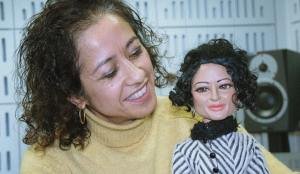 I had no idea they were going to do it. I think they just looked at photographs of me and when Stephen sent me an image saying, “This is what it’s looking like”, I was just amazed. The thing about Supermarionation is they all look like Supermarionettes; they’re not exact replicas of you but it absolutely did look like me yet it wasn’t me. I told Stephen that as a child watching, particularly, Captain Scarlet, I always wanted to be one of the Angels. They represented this glamorous version of grown ups that a three year old would imagine that’s what a grown up is like. And so the puppet version of me was the three-year-old imagination version of me as a grown up. I wish I were that glamorous in real life.
She’s not me but she’s the fantasy version of me, as a real grown up.
How did you record your lines?
 It was actually quite straightforward. I was more than expecting them to come back after my first version and say, “No, you need to do this, that and the other.” People in radio in particular, where I work a lot, have very strong feelings about what they think is a news voice, what they think is a more natural conversational voice and I sometimes think because of that experience you can overthink it. I was anticipating Stephen to be just as judgemental and he wasn’t. The only thing he said was “If you want to pay tribute to a character you could do a voice” but I don’t have that skill at all. I didn’t attempt to put a little bit of Uhura or anything like that or figures that inspired me.
I just thought, “Well she’s supposed to be a news reporter”. The script they’d written was actually pretty good, I wouldn’t have made any changes. It was a piece to camera when you’re slightly filling time and it’s a bit more relaxed, so I just did it the way I would do it. Which is, you treat it straight and you just emphasise the meaning of the words that are relevant.
I have a professional microphone at home so I recorded it and sent it in as a .wav file. And much to my surprise Stephen said, “This is perfect, you don’t need to do it again.” So, one take wonder! But then, I was just trying to be myself so I’d like to think I didn’t have to work too hard at being a news journalist.
You didn’t have to work out your own motivation!
 I have a lot of friends who are actors and sometimes people ring me and ask for advice when they’re preparing for auditions for roles as journalists. I realise how much harder it is for them because the thing about being a journalist, you think on your feet and you’re giving a kind of performance but the performance is essentially a version of you. Anyone who’s ever pretended to be a Blue Peter presenter – I’m sure we all have, not just me – it’s not acting, it’s just playing a slightly bigger version of yourself.
Often in films, they get journalists to play themselves and I interviewed the actor Nicola Walker quite recently who said she was really struck that when you got journalists to play journalists rather than actors to play journalists, it always went quicker and better.
All journalists want to be told is, “What’s the situation? And what tone do you want? OK, fine” and then you just ad lib it.
The thing is, you’re talking about your own experience, you’re talking about stuff you’re seeing yourself and also it’s something you’ve done many times, so you recognise the situation. There’s no substitute for experience of being able to think on your feet.
 The weird thing was having a script to read as opposed to ad libbing, which is often where journalists feel more comfortable. You tell me how long to fill for, I’ll know how long to go for and then stop, but it’s memorising a script to the word that I find hard, certainly when I was reading it.
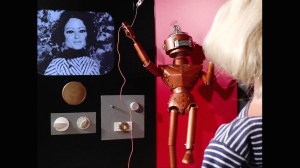
What I really liked was the way they cut it so it was on a black and white monitor with the robot holding up the aerial and the sound quality changes. There’s real subtlety to the edits they’ve made to the material and I just think the voice talents, the other actors are really good.
In the 60s and 70s there were records of the Supermarionation shows – you could go and get a Thunderbirds episode, just the audio. An episode of Nebula-75 could work that way, they’ve got such distinctive voices.
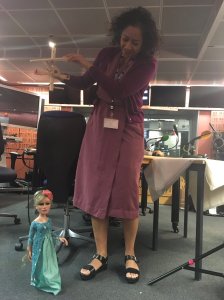 Yes. It’s funny, every time I listen back to any of those old classic episodes, the voices are a big part of why they had such an impact because every detail of them was so professional.
That was one of the things I loved that Stephen said when he came onto Front Row: he really felt the Andersons should have won a BAFTA for their work because it was technically so ground-breaking and atmospheric: the atmosphere of those shows about space travel and adventure, and also the atmosphere of being grown-up professionals. I really loved the whole atmosphere of them sitting around with cocktails at the end of a mission. Cocktails and cigars – you just thought, “This is what being a grown up is like: it’s an emergency service but you dress up and go for a bit of a boogie at the nightclub afterwards!”
Did you ever get the chance to interview Gerry Anderson?
 No, sadly. I have interviewed the actor who played Parker, David Graham, I think it was when Sylvia died. I interviewed him and I also interviewed Mary Turner on Front Row. It’s a really nice conversation with two of them about their impact, which was really touching.
I haven’t worked my way through the boxset but on my list is UFO which is I think is Sylvia Anderson at her peak. I love the interview that Mark Braxton did for the Radio Times Online where he spoke to Sylvia’s daughter Dee, and the fact that Sylvia was this great 60s character in her own right. She and Gerry Anderson were very different people.
I think what I love about UFO is it takes all the great ideas of Supermarionation, and you almost think it’s a Supermarionation show because the effects are the same, the wigs and outrageous costumes, and the humans are like puppets. I love it. It’s violent and dark. I promised Jamie [Anderson] I would love to come on his podcast and talk about that.
I have really strong memories of UFO, being two or three in 1971 when I think it was on a lot because it was on repeat having just run originally.
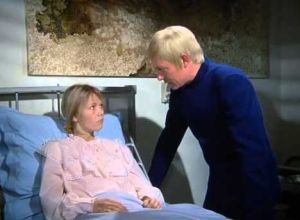 The BFI did a screening of the last episode of UFO with the opening episode of Star Maidens – for some reason, they put together this bizarre 70s sci-fi night – and Ed Bishop was such a nice guy. He said how much he enjoyed it. It’s a really dark episode, the very last one. It’s the woman who’s been in a coma all those years.
If you watch Diamonds Are Forever, he’s the best thing in it, in just one scene. He’s a guy who works for SPECTRE who’s a really nice guy and a really good scientist, he’s being really helpful to this person who’s a fellow worker and you just realise how class he was.
I think it says something about that generation of actors. There’s something about Americans who came and settled here in the 70s and you think, why? Why come to Britain in the 70s? There’s all kinds of reasons…
Vietnam had a large amount to do with it.
Also heroin. Robert Brownjohn, who was this amazing advertising talent, had a terrible addiction. He came to Britain in the late 60s partly because you could get methadone on the NHS to try and manage his habit. He designed the amazing titles sequences for From Russia with Love and Goldfinger. I did a piece about his career, a retrospective of his work for Channel 4 News, and he died incredibly young [just short of his 45th birthday] but he was one of those Americans who ended up coming to London because of these other factors. He did some amazing work including designing all these classic Penguin book covers in the 60s.
 As you probably know Space: 1999 is my personal favourite [of the Anderson shows]. It started transmitting when I was seven so that was the show for me and that had the best of both worlds. I think it got the human element right but it also had all the good stuff of the model work. I would argue season one of Space: 1999 was a high point.
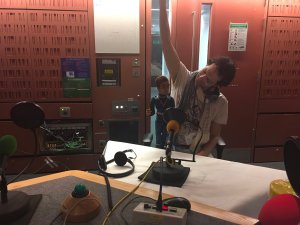
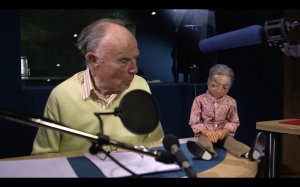
Image of Stephen La Rivière on Front Row courtesy of and copyright © Samira Ahmed.
Nebula-75’s Christmas episode will be available here on release:
 Doctor Who News Star Trek News
 Sci-Fi Bulletin: Exploring the Universes of SF, Fantasy, Horror and Spy-fi!