Inside No.9: Review: Series 9 Episode 2: The Trolley Problem
When a rural therapist saves a man from jumping to his death it sparks discussion of a philosophical bent. Could it be that a classic moral dilemma may well be […]



When a rural therapist saves a man from jumping to his death it sparks discussion of a philosophical bent. Could it be that a classic moral dilemma may well be […]
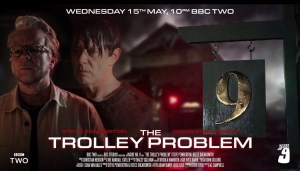 When a rural therapist saves a man from jumping to his death it sparks discussion of a philosophical bent. Could it be that a classic moral dilemma may well be less hypothetical than it seems?
After last week’s ensemble piece we’re offered up this intriguing two-hander. Steve Pemberton is Blake, a dubiously qualified therapist who’s decided to act where others stood by to save the life of Drew, played by Reece Shearsmith. The action starts, and mostly remains, in Blake’s kitchen, Drew having taken him home and offered some free therapy to someone he thinks is a depressive. It quickly becomes apparent that that’s not necessarily the whole story once Drew confesses that he may have killed someone.
What follows is discussion of the merits or otherwise of taking action to benefit others if that action will have negative consequences for someone else, or even yourself. It’s a variation of the well-known thought experiment of the title, first proposed in its modern form in 1967 by Phillipa Foot. You’re probably familiar with it even if you’ve never studied philosophy seriously, it crops up in lots of places; The Good Place had a whole episode about it and it’s a favourite of those “and Philosophy” books where centuries of deep thought is couched in terms of Batman or Homer Simpson. If not it boils down to the driver of a runaway tram deciding whether or not to pull a lever to switch tracks to save five men working on the track with the knowledge a lone worker on the other track will be killed. In its base form it’s essentially an illustration of the difference between utilitarianism (greatest benefit for the greatest number, so switch tracks) versus Kantian deontology (an action per se is moral or otherwise, so do nothing as switching would be actively committing murder).
As the story progresses a number of events, current and historic (including one very familiar to viewers of Breaking Bad), are illuminated by this dilemma and its numerous variations, culminating in a beautifully simple ending that sticks to the episode’s theme. It would be entirely possible to tell this story without any reference to philosophy but including it serves almost as a commentary on the action. This, as well as the carefully underlit lighting and always excellent direction from Al Campbell, lifts this fairly simple story and makes it interesting and compelling.
Oh and in case you were wondering, according to a 2009 survey, 68% of professional philosophers would pull the lever.
Verdict: A cerebral tale which binds a simple premise with a well-worn piece of ethics to create something darkly memorable. 8/10
Andy Smith
 Doctor Who News Star Trek News
 Sci-Fi Bulletin: Exploring the Universes of SF, Fantasy, Horror and Spy-fi!