Dead Pixels: Feature: Set Visit
As Dead Pixels reaches its third episode (on linear transmission – the whole season is on All4), Greg D. Smith recalls joining a group of journalists reporting from the set… […]



As Dead Pixels reaches its third episode (on linear transmission – the whole season is on All4), Greg D. Smith recalls joining a group of journalists reporting from the set… […]
 As Dead Pixels reaches its third episode (on linear transmission – the whole season is on All4), Greg D. Smith recalls joining a group of journalists reporting from the set…
We’re sat in a small room at West London Film Studios on a cold day in November 2019 (back when mixing with folks in the outside world was a normal thing) having just watched the cast of Dead Pixels in action on set, and writer Jon Brown is filling us in on exactly what has changed since we last saw Meg and Nicky.
Kingdom Scrolls has an expansion pack, and it’s left our heroes – one of them in particular – a little cold. The game has gone ‘more commercial’ and is now aiming at the ‘Fortnite audience’. What he was trying to capture, Brown says, is the feeling he as a gamer often gets when the expectation of a game is often more enjoyable than the finished article itself – he cites a game whose blushes I’ll spare here which he and his friends had looked forward to for months having enjoyed its predecessor and then when it dropped, it was a disappointment ‘so you put it on eBay and then think ‘I’ll see if I can enjoy Call of Duty again then.’

Is he worried that fans of the first series might feel a similar letdown when they see this new ‘expansion pack’ second series? He hopes not. Star Will Merrick (Nicky) is a little more assured. Jon, he says, writes from the heart as a gamer and the second season feels much better and bigger, having got all the groundwork of laying out who the characters are and what their deal is in season 1. Certainly, it sounds as though the show has expanded. There’s a more international feel with new characters Daisy (a New Zealand Game Developer designing a very specific-sounding platform game) and DVT, a Philippines-based character who Brown describes as ‘not really alt-right but sort of in that kind of Gamergate-style area.’
The show certainly speaks to its audience. As a keen gamer, Brown writes a show that is empathetic and never cruel to or about its characters’ obsession, and it feels like the inclusion of a character like DVT is deliberate. Brown insists he didn’t want to get too far into that rabbit hole, as he has no desire to give the Gamergate crowd any more oxygen, but he obviously feels it’s important to acknowledge that section of the gaming community exists, even as he says he doesn’t want too much of it as ‘there’s nothing really funny about that.’
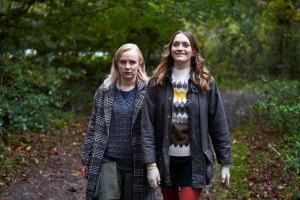 But it’s not just the subject of gaming itself in which the show goes deep. The relationship dynamic between Nicky and Meg has always been nuanced and complex. They need one another in many ways, but they are never really ready to acknowledge that need beyond the game itself. Speaking to Brown and to Alexa Davies (Meg) it’s clear that Meg is starting to move past that co-dependence, and it’s clear from speaking to Merrick that Nicky isn’t necessarily taking it that well.
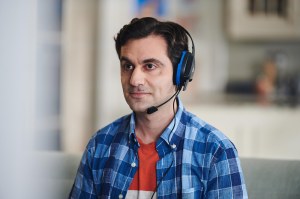 ‘She’s taking baby steps’, says Davies of Meg’s journey towards that ‘real life’ that flatmate Alison has always been pushing her towards. She’s got a promotion at work ‘which confuses her’, she just has a natural talent of ‘being able to answer a phone and tell someone the exact answer they need’ and then ‘it’s like ‘am I the only one around here who knows how to run a design studio?’ She’s also set to get romantically lucky this series, with a new love interest who isn’t a gamer and isn’t a part of that world – what will Nicky make of this? ‘He’s jealous, but not in the traditional way’, says Merrick. He fears that his friend is going to be taken away from him, that they will lose the dynamic, and the dependence they have through the game.
It’s brought up that the avatars – which remain the same this series, to the relief of all the cast – heavily reflect the internal makeup of the characters. Meg’s Greta is large, powerful and capable – a reflection of the maturity and strength within her that perhaps even she isn’t ready to acknowledge. Nicky’s Morrick is a slightly built, boyish character, reflective of Nicky’s desire to not grow up and move on (‘I think he still wants to be a little kid, playing with his presents on Christmas Day’, says Merrick.)
 Alison also gets a lot more to do this season, Brown commenting that he wanted to write more for her ever since Charlotte Ritchie was cast very late into the production of series 1. Is she a force for good or evil? Everyone seems to agree that she’s mainly for good – she genuinely wants Meg and Nicky to be happy, to live their best lives, even as she may hold a certain skewed perception of what that might mean. In this season, Brown tells us, Alison too has a relationship, but the details of that relationship, what it is, how it plays out and how Alison behaves and reacts to that reveal a lot about her flaws – maybe she thinks she has her life together in the way she wants her flatmates to have, but that’s not necessarily true. As Ritchie puts it ‘there’s nothing like surrounding yourself with flawed people to make yourself feel good’ and it feels like – maybe subconsciously – that’s exactly why Alison keeps her two flatmates around.
But how much like their characters are the cast? Davies is a huge Star Trek fan ‘thanks to my boyfriend’ who attends conventions and at the time we sat down was massively excited about the forthcoming Picard. She’s a Switch gamer, but has no interest in online gaming ‘I don’t want to share, I grew up with siblings, I’ve done that!’ Merrick used to be a gamer back in his teens but again the more solitary type. Ritchie isn’t much of a gamer but feels like she identifies much more with Meg ‘from her teenage years’ than she does with Alison – she can’t even hang up inspirational posters in her flat!
 What’s clear from the day on set and chatting with the cast and writer is that this is a show that is much deeper than its surface impressions may suggest. It’s a show about relationships. About finding meaning in a world that doesn’t always easily offer it, and about connecting and bonding with people even when maybe you aren’t trying to. Brown takes this seriously, and unlike other shows in the oeuvre, like The Big Bang Theory, there’s never any feeling – from the writers and cast to fans of the show – that it’s laughing at its central characters in a cruel way. It’s a show that understands that gaming is just another way in which people socialise and interact, and that the friendships that gives rise to are every bit as vital, meaningful and valid as any other. Here’s to seeing more of that in the world!
Dead Pixels, Tuesdays at 10pm on E4 or stream the full series for free on All 4.
 Doctor Who News Star Trek News
 Sci-Fi Bulletin: Exploring the Universes of SF, Fantasy, Horror and Spy-fi!