Black Mirror: Feature: Season 5: Rachel, Jack and Ashley Too
In advance of the fifth season, Netflix invited journalists to a preview screening in London with a Q&A session with writers Charlie Brooker and Annabel Jones. Greg D Smith went […]



In advance of the fifth season, Netflix invited journalists to a preview screening in London with a Q&A session with writers Charlie Brooker and Annabel Jones. Greg D Smith went […]
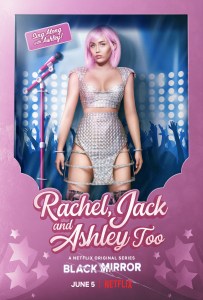 In advance of the fifth season, Netflix invited journalists to a preview screening in London with a Q&A session with writers Charlie Brooker and Annabel Jones. Greg D Smith went along to see what the dark sci-fi series has to offer this time out.
What’s striking, straight off the bat with this one, is just how good leading star Miley Cyrus is, and just how very perfectly cast she seems in a role that might have been tailor-written for her. That she took it on both speaks volumes to the quality of the idea and the writing and well of Cyrus herself, who is famously unafraid of controversy and of speaking her mind. Indeed, Charlie Brooker and Annabel Jones were keen to point out that many of the key story points and ideas in the script had benefited from Cyrus’ experienced input, and that, combined with knowledge of who Cyrus is and what she has accomplished, lend a verisimilitude to proceedings that helps ground things and keep the slightly more far-fetched elements of the show from distracting too much.
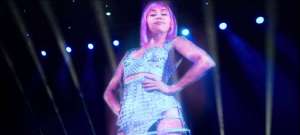 And it is – in the tradition of Black Mirror – a story which takes the fundamental fears and concerns we have about technology and society’s massive embrace thereof and plays with them in a semi-fantastical ‘very near future’ setting which can almost be believable. Angourie Rice as Rachel delivers a sympathetic performance as a lonely, awkward teenager who strongly identifies Cyrus’ pop megastar Ashley O as her one big idol and influence – unironically taking on board every manufactured positivity mantra and listening endlessly to her music, to the eternal, sneering frustration of big sister Jack, all moodiness, eyeliner and rock music as she mourns the passing of their mother by diving deep into her ‘old’ music and tastes.
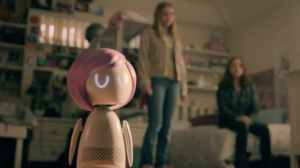 The technology at the heart of the episode – the ‘Ashley Too’ electronic doll which serves as a mini robotic companion with a sampling of the pop star’s personality and voice – is the sort of gizmo that’s believable in form because it’s a real prop that reminds you of the sort of mini household robots and electronic pets which already exist. In shape and movement, it called to my mind the robot EVE from Wall-E, with surprising amounts of expression being made possible via the simple LED display in its ‘face’ and the stubby ‘arms’ which retract seamlessly into the body when the device is ‘asleep’.
Just when you think you might see where it’s going though, the show upends things and goes in a direction that’s bold if not entirely original. Oddly, there are again parallels with real-world uses of technology here – something which Brooker commented upon in the Q&A, assuring the laughing audience with a cheeky wink that he’d be seeking royalties to be paid from various parties for the obvious cribbing of his script’s idea.
 Despite appearances to the contrary, both writers insisted that the initial script hadn’t been written for Cyrus, though her name had come up when considering who could play an international pop star for them. The thought of it actually being her was ‘a stupid idea’ akin to ‘resurrecting Oliver Reed’, according to Brooker. But as Jones tells is, when they reached out to her – more in hope than expectation – Cyrus turned out to be a fan of the show, and was taken by the script. She identified heavily with certain elements in it, and her acerbic sense of humour and natural delight in subverting things proved a perfect match to the project. According to Brooker, Cyrus’ comment was ‘It’ll piss people off, and pissing people off is my thing.’
That notion of the idea not being as tailor made to Cyrus as it might appear goes even deeper. It turns out that Brooker has been kicking this one around for a while, and had started off trying to write it as a sitcom about a punk band from 1977 being resurrected in the modern day. It had then progressed to a rapper, and then a random conversation about Alexa one day prompted Brooker to comment that ‘eventually there would be ones based on celebrity personalities’. Suddenly the previous idea, which had apparently evolved at that point to a musician in a coma and technology being used to extract music from their head, took on a new life, but still at that point there was no fixed idea of who it would be.
 Jones confirmed that Cyrus had a lot of input in all aspects of the script and the character when she came on board, for both the initial Ashley O character and the eventual metamorphosis we see at the end into Ashley Fuckn O. She was able to offer deep insights into aspects including the relationship between idol and fan – a powerful thing in the modern entertainment marketplace – which obviously lends an element of authenticity to the way the plot progresses. There’s a powerful message in there about the ideas which celebrities promote, how manufactured even the most authentic-seeming of these may be, and how carefully that relationship of power should be managed.
Brooker also confirmed that it was nice to occasionally break the expected Black Mirror model, as this episode does, and have an episode that’s a bit of a romp. People expect, he said, for Black Mirror to be a person frowning at a transparent phone until their life falls apart. Upending that, as he did previously in series 4 with USS Callister, was part of the fun, and regardless of the serious message of the episode, having proceedings turn into a sort of extended chase was something he had definitely felt attracted to.
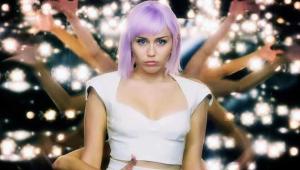 One thing which had escaped my attention entirely as the episode proceeded was that every one of Ashley O’s songs in the episode was a Nine Inch Nails song, mostly adapted into ‘pop standard’ with permission gladly given by Trent Reznor who got it ‘pretty quickly’. This did require some rewriting of lyrics by Brooker, who gladly admitted that this wasn’t his strong suit, and that some of the lyrics he penned were somewhat lacking. It’s difficult to miss the Head like a Hole finale of course, but on first viewing the rest of the songs had managed quite artfully to slip right under my radar.
Jones took up the conversation here, saying Reznor had found the dark humour of the episode very funny, and explaining how it had allowed them to get into some quite dark ideas. Chief among these was the extremely troubling notion that artists are becoming more successful when they’re dead (I’m sure a few painters would have something to say on this matter from beyond the grave). Jones mentioned Prince performing as a hologram on stage and a recently proposed Whitney Houston hologram tour as examples. No drug abuse, no scandals, she’ll turn up reliably and perform as scheduled.
 There is indeed much dark humour in the episode, which has the usual tendency of the show to offset the grimness of its subject matter and the preachiness that might otherwise creep into the sort of storytelling it represents, and it’s to the show’s credit that these laughs never feel incongruous next to the heartfelt emotional beats and serious subject matter dealt with elsewhere.
It’s also well worth leaving the show running once the credits have started, to make sure you catch that postscript. If anyone doubts Cyrus’ range as an artist, that should keep them very quiet indeed. As Brooker himself cheerfully says, he is a hypocrite in this regard, massively resenting filmmakers who make him stay in his seat through the credits, but happy to employ the gambit himself to provide a postscript to proceedings.
Verdict: A solid entry in the genre that provides some nice surprises and made an unlikely fan of its star out of this reviewer. 8/10
 Doctor Who News Star Trek News
 Sci-Fi Bulletin: Exploring the Universes of SF, Fantasy, Horror and Spy-fi!