Behind Her Eyes: Interview: Erik Richter Strand
Sarah Pinborough’s Behind Her Eyes was released earlier this week on Netflix and has been surprising audiences worldwide with its particular brand of twists. Paul Simpson caught up with Norwegian […]



Sarah Pinborough’s Behind Her Eyes was released earlier this week on Netflix and has been surprising audiences worldwide with its particular brand of twists. Paul Simpson caught up with Norwegian […]
 Sarah Pinborough’s Behind Her Eyes was released earlier this week on Netflix and has been surprising audiences worldwide with its particular brand of twists. Paul Simpson caught up with Norwegian director Erik Richter Strand to discuss the challenges involved.
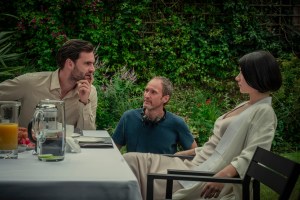 How did you get involved with it initially? Was it a project that Netflix brought to you?
It was actually Left Bank Pictures that came to me originally with the book, and they asked me to read it to see if I’d be interested in adapting it. At the time it was not something I could do, so I very politely said ‘No, I can’t’. Then they came back when Steve Lightfoot had adapted it and were ready to shoot it. They asked if I’d be interested in reading the scripts, with a thought to directing it. They were fans of a show I’d made previously, one I’d written and directed.
I read the scripts and I thought that Steve and Angela LaManna had done a fantastic job, really in a way I couldn’t have, so I was really happy that they came around a second time.
I thought, ‘I can have so much fun with this material. This really turns in ways I couldn’t foresee and every scene has this very fun subtext that just seems plain weird and fun.’ I loved it.
Although it’s six episodes, it doesn’t feel like there’s any fat on it. Every scene moves one of the four stories forward in one way or another.
That’s right, it’s very lean and I have to say it’s very cleverly orchestrated, very cleverly layered by Steve and Angela in the way they lead you to believe [what’s going on]. It’s tricky because there are things in there that are meant to give you a hint that maybe something’s not quite as it seems but when that’s written out in a script it’s different trying to translate that onto the screen. There were a lot of good challenges for me as a director that way.
One of the things I loved was the use of the overhead shots and that was actually where it triggered memories of the book, whereas my wife’s reaction [who hadn’t read the book] was ‘That’s an interesting way of shooting it’.
Exactly yes.
It wasn’t until we get to episodes 5 and 6 where you start realising what’s been going on.
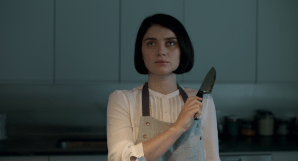 Right, there’s actually a scene in episode 4, where we’re really trying to say this is what’s going on. Adele is actually able to witness this scene without being there and lying on her bed in her big house. But yes you’re right, overhead shots combined with some clever sound design, a little at first and then even more. We gradually turn up the volume knob on that way of telling the story.
It starts in episode 1. If you’re really clever or you’ve read the book you might catch on to it and if not, like you said your wife did, she’ll just think of it as an interesting way of framing a scene. It is meant to give you that sense that you’re observing something from the outside and you’re somehow removed from the action.
I tried different ways of finding the perfect technique for doing that that would also not be too much in the way of the actors.
So were you experimenting with that before you actually started shooting with the actors or was there a degree of trial and error?
 It’s a little bit of both actually. We did some tests, we had a couple of days where we tested some different techniques we were trying to figure out. We tried different circular tracks, very clever grip things we can do, we tried zooming in and pushing out, that whole Jaws / Hitchcockian thing. We tried doing more with sound, we tried this hovering handheld closeup style variety – and then we went into the editing room and tried putting these things together.
We tried three or four different techniques, and ended up with one that we then took into the final shoot. But as we started shooting the scenes I wasn’t quite feeling it, so I had my editors work overtime on a scene that we just shot that day. They came in in the evening and worked on it, I saw it the next morning and it changed the way I felt about it.
So we actually changed the approach during shooting as well because it became a little bit too technical, it became a little bit too much drawing attention to itself as a narrative ploy.
I’d rather have that be just a little bit more subtle, like something’s happening, and I decided to do more with the sound rather than just the images. That was, like you said, trial and error and trying to find the right volume for it.
Just stepping back a moment, given that you were asked to adapt it, what was your reaction when you read the twist in the original novel?
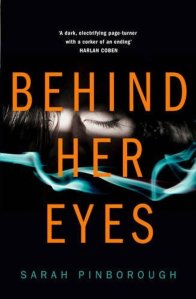 I didn’t see that coming at all, I was completely surprised by it. I have to say, I wasn’t 100% pleased with it, I was annoyed by it but annoyed because it made me feel that I’d have to reconsider everything I’d just seen – or hadn’t seen obviously, aside from inside my head, everything I’d just read.
And I felt like, ‘Oh OK, well at least it explains a hell of a lot of the things I was wondering about’ and that’s, in a way, satisfying but it still feels a little bit like all the thoughts that you have invested in, especially, Adele’s character [have to be reassessed] because you have invested feelings and emotions in Adele’s character… even though in the book she comes across as a much more sinister person than she does in the series.
She is sinister in the series as well but in the book I feel it’s more overtly clear that she has this hidden agenda all the time. She’s sitting back in her chair twiddling her moustache thinking ‘This is going according to my plan’. There’s more of that in the book than there is in the show.
So when I read the book I felt a little bit… not cheated but surprised in a way that didn’t just feel comfortable. It felt really uncomfortable and I think that’s an experience a lot of people have with the book and probably with the show.
It was one of those things where I asked myself, “How the hell do you convey that in the show without it feeling like a huge cheat?” When I read the script and talked to Steve about how he saw it when he’d written it, I found there is a way to do that. Obviously people are going to have all sorts of opinions about it but I think there is a way now where you don’t foreshadow so clearly Adele’s evil intent, that you just play along that whole “Who can you trust? Who can you not?”
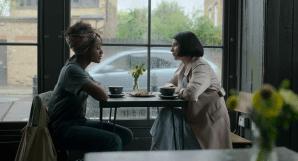 The lines are constantly shifting from Louise to Adele to David even to Rob and then back. You keep on thinking “He’s bad… no she’s bad… Actually, what about him?” The way that the script ended up doing that took care of a lot of reaction I had to the end of the book.
That’s something you can do more in the show I think because you have more instant identification with the characters – and also Rob has been built into the script throughout the story. He’s been given more of a voice of his own I feel in the script than he has in the book. In the book he comes in as a sort of epilogue at the end and has the villain speech of how he so cleverly did this. That’s something that I didn’t love in the book that I think the script did differently.
You’re also helped by terrific performances from all four of your leads, Eve in particular, when you know the twist and you realise she’s playing two different characters. Did you shoot the flashbacks or the contemporary material first?
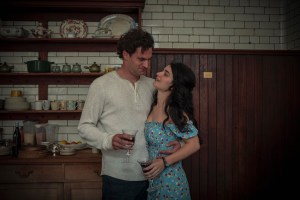 We shot everything in Scotland in the first two weeks, the flashbacks. That’s everything with Adele and Rob at the psychiatric institution and everything with Adele, Rob and David at the house that she grew up in, the big estate.
So we filmed the backstory first, which was great because then the actors get the experience of being innocent with their characters in a way. Eve got a chance to play Adele when she was actually Adele, so there was this great opportunity for them to play their characters and then add more layers of clothing to them afterwards when all of a sudden they are different. I’m really happy that it worked out production-wise that we could do it that way.
What was the biggest challenge of working on the production?
I think the biggest challenge was what we already started referring to, the big conceit with Adele/Eve’s character, to keep, as we say in Norway, ‘my tongue straight in my mouth’ with all these different layers of subtext, because we were shooting, obviously, out of sequence, when we came back from Scotland. Everything was whatever works on the production schedule. Because I was directing all six, I could jump between the episodes as we saw fit, so I could film something from episode 2 and episode 4 on the same day.
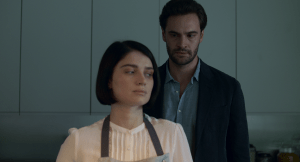 For me one of the big challenges was finding the right level of the unknown and unexplainable subtext. In the Adele character, for example, ‘Why is she behaving this way? It feels a bit strange – what’s going on between David and Adele that we’re not aware of?’ All the time, I was keeping that puzzle in my head as to when does the audience get revealed this important plot point, that might explain why David and Adele had this weird dynamic, what is it that they’re referring to [when they say] “We know things that we can never tell anyone”…
You take all that into the editing suite afterwards and you can fine tune and adjust it, but it was a challenge making sure I was finding that right balance, and making the characters immediately relatable in the scene so the audience would like them and identify with them, but also keeping enough of that weirdness that is relating to something the audience, as of yet, are unaware.
 That was a challenge for me because all the scenes were wonderfully playable, the script was really good. All the scenes I could find my directorial approach to them very easily. The actors are really good and that helps. So it was more trying to find, “OK, beyond just what’s on the page, what is it that’s important the audience feels?” A lot of the time what I want them to feel is curiosity and suspicion. So what is the right level of that? How do I add that to the mix without interfering with what the scene’s actually about.
Another challenge was obviously was to try and find the right visual expression of the astral projection. How do you visually present this out of body experience? You don’t want to look Star Trek or cheesy or something that the audience will immediately reference with something else. We wanted to try and make it subtle enough where you tell the story clearly and straight, but at the same time where it doesn’t look like all of a sudden the show becomes this weird sci-fi. That was a real challenge, finding the visual representation along with the VFX crew that could convey that.
So what we ended up doing was using real lights on sticks, on poles.
The good old 1920s way.
Yes, we went back to the old analogue way of doing it. The lights and the reflections and the shadows that you see on the walls and the things that we pass, are real lights that were actually in frame in front of the camera that were then removed and replaced with what would have been behind them and given a slight sort of shimmering 3D looking kind of effect that was partly transparent and see through.
You’ve got a terrific performance from Robert Aramayo as Rob.
 He’s an amazing actor. I loved working with him. He was, honestly, the very first actor I saw audition for the show, for any part. Me and the casting director Olivia Scott-Webb had a good idea about which scene to try for potential candidates. Robert came in and met her and delivered this wonderful performance and I remember thinking, ‘Wow, that’s really good’ as soon as I saw him but, you know how it is, it was so early in the process you think, ‘Well, I’m sure we’ll get many others that will be equally as good or better’ but I ended up going back to the very first one.
He just blew everyone else out of the water. He was really mesmerising, enigmatic, playful and just the right amount of unwholesome as well.
What was that scene that you gave him?
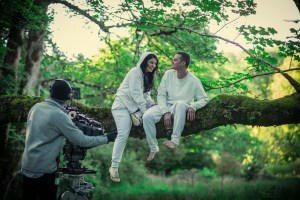
It was the scene where he first meets Adele, which is in episode 1 and is the first flashback. He’s sat up in the tree and then he starts talking to her. ‘You’re the girl that paints fires’ and ‘Did you see your parents, did you see them all burned up and that?’
 When you look back in a few years’ time, what will be your overriding memory of working on Behind Her Eyes?
It will probably be just the thrill of it because I had a really good time. I really enjoyed it. It was my first job in the English language – I’m Norwegian and I’ve been working in Norway. I really enjoyed the opportunity of doing this job as my first English language show, I loved working with the actors.
I think from start to finish it was just a very good collaboration and the material was so fun. I just enjoyed it. That’s not always the case but this time it really was.
Behind Her Eyes is streaming now on Netflix; click here to read our review
 Doctor Who News Star Trek News
 Sci-Fi Bulletin: Exploring the Universes of SF, Fantasy, Horror and Spy-fi!