The Equalizer: Review: Series 1 Episode 10: Reckoning
When Delilah is threatened after witnessing a shooting, McCall has no limits… If for any reason anyone was asking themselves what happens when people get fully on the wrong side […]



When Delilah is threatened after witnessing a shooting, McCall has no limits… If for any reason anyone was asking themselves what happens when people get fully on the wrong side […]
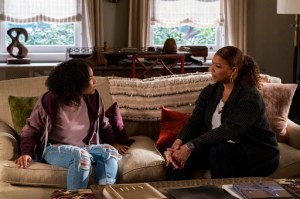 When Delilah is threatened after witnessing a shooting, McCall has no limits…
If for any reason anyone was asking themselves what happens when people get fully on the wrong side of McCall, this episode provides at least some of the answers. As might be expected, she does not mess around, and nor does the season finale.
With hardly any of the show underway, Delilah and her friends are caught up in the crossfire of a gang hit whilst skipping school for an outing, with deadly results for one of them. This leads to numerous consequences, with one of them being Delilah’s increasing trauma highly visible. It is her most lengthy involvement in an episode to date as her day of skipping school proves to be a living nightmare for her.
Laya DeLeon Hayes does an excellent job of taking us on Delilah’s journey of terror, grief, anger and shock, Yet she also displays Robyn’s observational skills, her relentlessness, her cunning and her investigative talents over the episode, ultimately leading her to discover that her mother is not who she says she is at all. Given the rest of her ordeal, such a revelation arrives at a terrible time for her personally, but we shall not know the fallout from this until the beginning of Season 2. It follows up from the deflected suspicions in an earlier episode though, and is going to take quite some explaining on McCall’s part when the time comes.
McCall is back to her calculating, ruthless best, the personal stake she has in the matter only driving her on further, and she never requires any additional motivation to get the job done. Yet the show finds time to delve into her experience of similar hurt of her own in the past. A little exposition with Aunt Vi reminds us that she has been through similar to Delilah in the past. It is well handled, not exactly normalised, rather, made clear that this happens far too often, to too many. The experience bleeds over to her encounter with the parents as well, where Samantha Roberts, mother of the only white member of the fateful truancy group, gets into some serious victim blaming on the shot child and his less fortunate background than hers. That she is only spared from McCall’s wrath because Delilah gets there first is a smart little hint at her sharing some of her mother’s personality traits. From the backstory given, how Delilah has been forced to grow up fast very much follows the pattern McCall herself followed. It provides an additional commentary on a lot which needs to change.
Dante’s place in the story echoes this in that his own history is explored much the same way. Not only this, but it follows on from his previous episode appearance perfectly. His involvement then in tackling the dark side of the law brings us to him here, managing crises of faith. There is a crisis of faith in himself, as to whether he is doing the right thing; his focus upon reassessing where exactly the (thin blue) line falls. There is also a crisis of faith in the very institution he upholds. Having seen recent corruption first hand, he returns to one of his key driving forces to be a pillar of justice, that of not turning out like his father.
Benjamin ‘Big Ben’ Dante is serving time for having been caught on the take. He stands by what he did and repeats this justification of stealing money to Dante. His presence gives the audience a representation of someone who went too far and yet still believes he was justified convincingly enough that we have to ask ourselves the question just long enough to be certain that he did. His reasoning makes sense, but he’s not quite credible about it. And whereas he was once obviously everything Dante swore not to become, it is a measure of how much damage Dante has taken to his conviction on the matter that he even entertains asking Big Ben the question in the first place. Indeed, he doesn’t even have to ask. His father is ahead of him at every turn, even knowing about McCall, and how she has influenced his world view. It is a wonderfully knowing setup as it nags us to ask where we draw the line ourselves.
This ties in nicely with one of the other reasons his arc works so well; that McCall has learned from him as well that there are times to at least try and do things by the book; to meet him halfway. She intentionally denies herself an obvious opportunity for immediate retribution in order to give a chance to the law to work. Although it is not long before that decision lets them both down, by the end of the episode, they agree that they are a good balance for each other. However, even though he appears to agree to this, Dante leaves the warning that the law enforcement authorities will likely send someone far less sympathetic after her in the future. At least when that day comes, McCall’s entire family are likely to be in a position to help, should they all wish to.
For all of this wonderful character nuance, the plot itself centres around the big mistake the bad guys make is threatening her family. I have not yet mentioned Victor Shishani, someone who was a one-time counterpart of McCall’s in a former life who, for all his connections and considerable threat that he carries, wouldn’t have been a match for her on his best day. That his schemes have provided her such supreme motivation makes her nigh-on unstoppable, as he inevitably discovers to his cost and that of his entire organisation. That said, the destruction wrought upon the drug cartel Shishani is a part of does not feel entirely final to me. It feels perhaps part of something bigger which the series can come back to, and I have said this previously about any of the underlying threats in the last three episodes.
As a brief note, yet one which fits the episode theme, McCall somewhat escalates her interrogation technique with an informant, but the show plays entirely on the psychological rather than the graphic. It’s a fine line, but one they get very right here.
Verdict: The conclusion of season 1 did not disappoint. Serious action and tension throughout, and McCall at her absolute best, which she needed to be given everything she has been up against. We leave the season knowing that nothing will be the same again for these characters, Delilah especially. McCall’s secret is out to the family, and we do not yet know how Delilah is going to take it. There are seeds sown for a major antagonist for McCall from episode 8, who it seemed at the time the most likely candidate to have come after her in this episode, but this does not, at least on the surface, appear to have been the case. However something about that particular cartel hints at a higher power. Similarly we may not have seen the last of the Truth Trappers. My imagination is running wild at the possibilities, which means that for me, the show pulled off an important trick: always leave them wanting more. And I can’t wait for Season 2.
9/10
Russell Smith
 Doctor Who News Star Trek News
 Sci-Fi Bulletin: Exploring the Universes of SF, Fantasy, Horror and Spy-fi!