 After a stellar run of seven seasons from 1966-1973, garnering numerous award nominations and wins, and a rather lacklustre follow-up two season remake/reboot/continuation in the late 1980s, the one thing missing from the Mission: Impossible brand’s resume was a feature film. Enter Tom Cruise, with a newly formed production company and a passion for the original series he had watched as a child. Could Cruise and Paramount Pictures resurrect the IMF for a whole new generation of fans?
When his entire team and commanding officer are killed on a mission in Prague, IMF agent Ethan Hunt finds himself in the frame, suspected as a mole who orchestrated the slaughter and hunted by US Intelligence Agencies. As the net closes in, Hunt uses his skills to form a new team and drag the real culprit out into the open, to gain revenge for the dead and clear his own name.
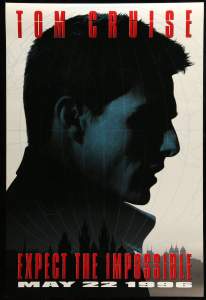 1996 was an interesting year to resurrect a franchise like Mission: Impossible. The previous year, James Bond had returned to screens in Goldeneye, with new incumbent Pierce Brosnan delivering a smash hit that seemed assured to keep the series going after it’s post-Dalton hiatus. Mission: Impossible had never really been a competitor of Bond, but by stepping off the small screen and into theatres, living broadly in the same genre of super-secret spies, flashy gizmos and the fight against global bad guys, and installing a name and face like Cruise at the helm, it was arguably occupying the same turf. What makes that more fascinating is that – unlike Bond when confronted with new kid Bourne, Mission: Impossible did not cut its cloth to match is stablemate. Instead, it remained very much its own thing.
We begin with a classic opening, director Jim Phelps, played by Jon Voight, (the only character brought forward from the original TV series) receiving his orders in the usual Mission: Impossible fashion, message set to self-destruct after the briefing is imparted. Unlike Bond, there’s no big arch nemesis with some flashy and improbable plot to destroy the world – instead, Phelps is charged with assembling a team to intercept the theft of a top secret database of secret agents, which is being sought by nefarious types for obvious reasons. It’s a fairly staple plot for the genre, and one that younger viewers may find familiar from – for example – 2012’s Skyfall. Phelps assembles his team, and we get to meet them in turn.
 Front and centre is Cruise as Ethan Hunt, the general get-in-there-and-get-stuff-done guy. This is a fairly standard Cruise performance, all cocksure confidence, winsome smile and that charm which has remained a staple of the man’s career no matter whether he’s playing a racing driver, jet pilot or conman. Alongside him we get Emilio Estevez as Jack, the team’s technical and computer expert, Emanuelle Beart as Phelps’ wife Claire as the sort of multitasking backroom fixer, Hannah (Ingeborga Dapkunaite) as the fading-into-the-background-to-keep-an-eye-on-the-mark person, and Sarah (Kristin Scott Thomas) as the capable, just-like-Ethan-but-a-woman character. If it seems unfair to assign these fairly cursory labels to Hunt’s comrades, remember that by around twenty minutes in, all of them are dead, the mission a total bust leaving only Hunt himself to survive and escape. The movie does do enough in the opening scenes to make the team feel like a team who have known and worked with one another for a while, from the constant ribbing of Claire for her appalling coffee to Jack’s hopeless attempts at flirting with Sarah and Sarah’s playful, affectionate rebuffs. The film builds its case strongly that this is a bunch of characters who work well together and will be entertaining to watch.
Of course it then blows all that up. First there’s the gruesome fate of Jack – a clever move given Estevez was a fairly big name at the time and his character’s early check out indicated to the audience that all bets were well and truly off. By the time Sarah slides slowly to the ground, having been stabbed by a mysterious unseen assailant, as Hunt cradles her in his arms, things really do feel a little desperate. And that’s just the beginning.
 What follows is a film that on a first viewing surprises a great deal, and is still watchable even today, despite some creaky technology and dated references. The plot – Hunt being on the run from IMF who suspect he is a mole, working in collusion with a shadowy arms dealer known only as Max, forced to try and clear his own name the only way he knows how – barrels along at a fair pace, and the surprises and double turns come thick and fast. Sitting now, with the benefit of hindsight and the knowledge of the rest of the franchise, it’s easy to see where the twists and turns are coming, and that’s all part of the inherent fairness of the franchise. It never gives you a twist or a surprise that it can’t justify, it feeds you just enough information as you go that when the big reveals come, they’re shocking but they’re not unbelievable.
So when Claire reappears suddenly, yes it seems a bit fishy that she escaped when Ethan was so certain she had died, but the character’s arguments make sense – she’s stayed out of the way until the appointed time for everyone to meet back at base in the case of everything going wrong. Her husband is dead – we saw him fall off a bridge covered in blood, connected to Ethan by video call as it happened. There is no reason to suspect either her or Jim, right up until the point at which the movie starts telling us to.
And it’s when Jim does reappear that the movie starts to play fair. It could string its audience along, but instead it chooses to let us know what Ethan must work out on his own – that Jim is behind the whole thing, that he faked his own death and that he’s spinning Ethan a line now. The movie doesn’t hit you over the head with it, but it gives you just enough flashes of what’s happened that as the viewer, it’s easy to put together.
It also establishes Hunt as the sort of character we really want to follow because it’s unlikely to ever be boring. As a super-secret agent disavowed by his government and framed for a crime he definitely didn’t commit, it would be easy for Hunt to use his considerable skills to simply disappear off the grid, or be so hidebound by authority and protocol that he gave himself up and tried to prove his innocence the normal way. Instead, he goes off grid, contacts a few other ex-IMF agents to help (Ving Rhames’ technical/computer wizard Luther and Jean Reno’s pilot and muscle Franz Krieger) and sets out to perform the ultimate Impossible Mission of his own – breaking into the CIA Headquarters at Langley to steal the real list of spies so that he can set up a meeting with Max and use her to find the real traitor. That’s some epic bravado right there, and leads to one of the movie’s most memorable and oft-referenced/parodied set piece scenes, as Cruise dangles above a pressure-sensitive floor in the maximum security computer room to steal the information he needs.
 It further establishes Hunt as a gambler – witness the scene in which he bluffs Krieger that he’s got the real disc and the one Krieger is attempting to hold to ransom is a fake. Or his initial attempt – based on a hunch – to contact Max via the internet as ‘Job’. Having assumed that ‘Job 314’ – the mission reference for the hit – refers to the Book of Job, 3:14, he spends an evening sending out emails to multiple places in every language he can think of. The ‘Internet’ usage is laughable by modern standards, but you forgive it, because the plotting is sound. Then there’s the heist at Langley itself, and the final set-piece plan as he attempts to deliver the correct list to Max (played with glorious understatement by the wonderful Vanessa Redgrave) to detect the real mole, while also avoiding Max actually making use of the list without her finding out. In and of itself, this finale would be tense and gripping, but the movie elects to give us an explosive action sequence featuring a helicopter being flown down the Eurotunnel behind a high-speed train while Ethan pursues Phelps to prevent him getting on it. It’s dizzying stuff, and importantly, the movie juggles all of it well, the action scenes neither overshadowing the spy stuff, nor feeling out of place or lacking compared to other action set pieces in the genre.
And of course, there’s all the standard Mission: Impossible stuff – self-destructing messages, double and triple crosses, and prosthetic masks to add to the sense of confusion. Again, the movie plays fair here – when Claire goes into the train carriage to meet Phelps and inadvertently reveals all to Hunt, wearing a Phelps mask, it doesn’t feel like a ‘gotcha’ for the audience. Phelps’ stillness and silence, combined with Claire’s wondering whether they ought to kill Ethan after all, combine to alert the viewer that something is up before the actual triumphant tearing off of the rubber and reveal of Cruise’s face. The following exchange, Hunt’s clever use of the glasses to make sure he isn’t the only person to know Phelps is alive, and Phelps’ shooting of Claire in petulant rage as she tries to stop him murdering Hunt, all add up perfectly. Hunt isn’t just a clean-cut action hero who smashes through your window with a witty quip, gets the girl and saunters off – he’s always thinking, always playing the odds like any successful gambler, and always using everything at his disposal to get the win.
And on that point, the other nice thing is that beyond some mild flirting, there’s no girl for Hunt here. No disposable arm-candy or starry-eyed enemy agent who falls for his charms. After Bond dominating the genre in cinemas for so many years, it felt like a brave move indeed to have a bankable, chisel-jawed and sparkly-tooth-smiled lead like Cruise and not give his character a girl – indeed it seemed out of character for Cruise himself – but it was the right choice, further cementing a key feature of the character that would feature in his development as the franchise wore on. He’s here to save the world, regardless of whatever else might be going on around him, and distractions like falling into bed with every attractive woman he meets, attending lavish parties, driving fast cars etc don’t feature as part of that. It would be wrong to describe Mission: Impossible as gritty, per se, but it does commit very hard to its genre, and ignores the bells and whistles a certain 007 had added as a standard over the years.
 That seriousness also means that Hunt’s apparent decision to get out of the game altogether once he’s cleared his name feels believable, rather than just the standard motions of the grinning hero. As he reclines on a luxury plane seat and is offered a movie by a persistent stewardess in a mirror of the opening shot with Phelps, there’s a genuine sense of suspense as the credits roll before he’s made his choice.
For a movie that’s over two decades old, in a genre that doesn’t traditionally age all that gracefully, what with pushing all manner of gadgets on the viewer, Mission: Impossible holds up surprisingly well, and that’s because it’s a surprising film. It eschews the simple theatrics of ‘gotcha-ing’ its audience, instead letting them be just enough of a part of the proceedings as to be involved without being bored. It uses spy tech sparingly and (mostly) in a way that ensures aging isn’t really a factor (yes, the internet is silly in it, but it’s one single factor that doesn’t detract too much), and it avoids as many tropes as it actively uses. It commits as a proper spy thriller, rather than a simple action movie fantasy-fulfilment vehicle draped in the mere fripperies of the genre. And it manages to tell a compelling story without the hero either having to save the entire world. It’s definitely well-worthy of a re-watch even today, should you choose to accept it.




 Sci-Fi Bulletin: Exploring the Universes of SF, Fantasy, Horror and Spy-fi!