 After the phenomenal success of 2011’s Ghost Protocol, it might have seemed that the franchise had gone as far as it would ever get. After all, how would a series with at least one foot in the realm of semi-realism manage to top that world-threatening plot? And could the character of Ethan Hunt really be taken any further than Cruise had already gone with him? Greg D. Smith investigates.
In the middle of pursuing a shadowy terrorist network known as The Syndicate, Hunt finds himself cut off and alone after IMF is shut down, with its salvageable assets (including Brandt, Luther and Dunn) absorbed into the CIA at the behest of CIA director Hunley. Disavowed and acting off the grid, Hunt must try to track down the mysterious leader of the Syndicate to clear his own name and put a stop to the activities of this Rogue Nation.
 How do you follow the most successful entry in a two decade-old franchise? How do you create a narrative more compelling than a madman stealing nuclear weapons as part of his fanatical plan to literally bring humanity to the brink of extinction so that they might rise again all the stronger? How do you better a film that was loaded with a driving narrative and half a dozen or more side plots and twists intertwining through it all?
How, in essence, do you capture lightning in a bottle twice? Short answer: you don’t, but that didn’t stop Christopher McQuarrie, writing and directing, from having a damned good go with 2015’s Rogue Nation.
The setup for this came from that final line in Ghost Protocol from the briefing to Hunt about his next mission, but those few lines can’t do justice to the breadth of vision that McQuarrie’s screenplay brings to the table. In many ways, you can view the basic conceit as a tried and tested one – once again former secret agents are going their own way using the skills they were taught for more nefarious purposes. However, the key here lies in the wider scope the movie brings to that idea – this isn’t simply another pissing contest between Hunt and some ex-IMF agent who has beef with either him or the agency for whatever esoteric reasons they have. This is a literal global network, formed of former agents from dozens of agencies around the world, and run by an ex-MI6 operative, Solomon Lane.
 The opening scene sets the stall early, promising a continuation of the formula that proved so successful in the franchise’s previous entry. Overblown action mixed with comedy, yes, but also a progression. Brandt is sitting at HQ tearing his hair out like some over-worked parent as he watches Hunt and Benji on the ground trying to stop a plane loaded with deadly chemical weapons bound for the Syndicate from taking off. It almost fools you for a second that perhaps this is the wheelhouse in which the film will seat itself, Hunt, Benji and Luther getting into improbable scrapes while Brandt pleads comically into a mic for them to grow up and take things more seriously. However, once that opening sequence is out of the way, and the now-traditional montage of scenes from the upcoming movie plays in the background to that timeless score as a lighted fuse burns down to completion kicks in, the movie takes a distinctly darker turn.
We’re used to nice/good people being killed off early doors in Mission: Impossible movies. Hell, it’s practically one of the staple parts of the series at this point, but somehow it’s still one of the more unpleasant examples we see here, Lane brutally executing a young woman who clearly works, at best, tangentially with IMF as a sideline from running a record shop in London. The corrupted briefing she gives Hunt before this happens, delivered by the Syndicate themselves, adds to the sense of threat. This is something very new. As odd as it may sound, the briefings delivered to Hunt by whatever gizmo the film chooses, are one of the more sacrosanct parts of the whole conceit. Having that blown up so comprehensively so early on in the movie’s run time, the audience is left in a state of genuine apprehension – suddenly the whole cosy nature of that opening, of feeling that we know where the movie is going to take us, is undermined, and all bets are literally off.
 It’s that sense of keeping the audience ever so slightly off balance that persists for much of the movie’s run time. When Hunt wakes up bound to a post, about to be tortured, his rescue at the hands of someone who apparently works with his captors who then refuses to come with him leaves the viewer more than a little confused. Thus we are introduced to Ilse Faust, English spy and genuinely the first completely rounded and well-realised female protagonist of the franchise. From that initial meeting to a further encounter in the opera house of Vienna, and then a joint mission in Casablanca, Ilse proves to be a complex character who refuses to be pinned down by either the narrative or the audience. Her tale, gradually revealed to us as the movie goes on, is one of the more fascinating of any character in the series, and she occupies a delightfully balanced role partway between comrade and antagonist to the IMF team. A hard-bitten English spy who has infiltrated Lane’s network to try to discover as much about it for her paymasters as possible, she’s left in an impossible position by her mission and her conflicting loyalties. She never has any intention of killing for Lane if she can help it, but her continued failure to do so obviously raises questions about her true loyalties with the hyper-suspicious Lane.
 As the movie goes on it becomes ever clearer that despite her own intelligence and capability, Faust is not fully aware of the motivations of either Lane or her MI6 handler, Atlee. Used as a pawn by both men, each for their own agenda, Faust survives by sheer capability and toughness alone. Not at any point is there a hint of her using feminine charms to get the job done, in a refreshing change of pace for the series as a whole, and Rebecca Ferguson’s performance and undoubted screen presence combine with excellent writing to ensure that this is one character you’re always glad to see on the screen.
And that encounter in Vienna keeps the viewer off balance with more than just Ilse’s unclear motives and agenda. Having saved the Chancellor of Austria from death by shooting him – in possibly the most Ethan Hunt solution to a problem ever – the poor man dies anyway when a bomb under his car explodes shortly afterward. This is a movie which likes to remind you that it has real stakes, in keeping with the tone set by its predecessor. This then allows a little more willing suspension of disbelief when you get to the inevitable last moment saving of the day, and also keeps the viewer on their toes, with a sense that there are never any ‘safe’ conclusions to draw until the credits roll.
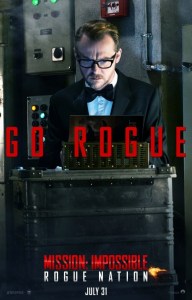 Pegg’s Benji Dunn gets much more to do here as well. Introduced in that opening scene as now being a fully-fledged field agent (though still looking ridiculous in his full ghillie suit), Dunn ends up on the run with Hunt after a brief stint being bored working for the CIA. His expertise is vital to the mission at several points, and though he lacks the self-sufficiency of Hunt or Faust (or even, to be fair, Luther) he’s always necessary to the plot, as well as providing some welcome comic relief at various points amidst what is probably the darkest entry in the franchise to date. This point is important – it is fair to say that despite varying quality, one unifying factor of the first three movies was that they mainly involved Hunt saving the day single-handedly while the rest of the team stood back and watched, occasionally pressing a button to help. That dynamic began to shift with Ghost Protocol but it really falls away in this entry. Every member of the team contributes. Every specific expertise and skill set is used to complete the mission, and when you get to the final denouement, it really feels as if success is only achieved because of the team effort, nicely visually emphasised by Lane’s glass cage being immediately surrounded by the various team members.
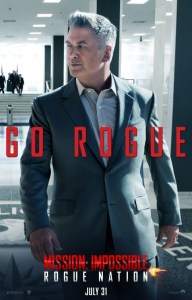 As much as the movie does to keep its audience off-kilter, it still remembers one of the most basic rules of the franchise – play fair with your audience. So although there are genuine surprise twists in there, there are also those certain sections where a twist is subtly telegraphed just a minute or two before the reveal, so that if you’re a fan of the franchise and tuned into the general rhythm it follows, you’ll be clued in just before the reveal. Nowhere is this more evident than when Hunt, Brandt and Hunley cleverly gain the revelations they need about the Syndicate from the British Prime Minister (played with just the right mix of keen intelligence and slight bumble by Tom Hollander) under the pretence of a plot by Hunt to abduct the PM on Lane’s demand to save Benji from being killed, before cornering Atlee for his part in proceedings. When Hunt rips off the Atlee mask and the truth is revealed, you’ve already got there a few moments before, and if you haven’t, then a re-watch will confirm that the clues are there without being obvious. Again, it’s a conclusion that relies on team effort (it’s nice to see Baldwin’s Hunley get at least a few minutes ‘in the field’) and it’s a twist you’ve been waiting the whole film to see. Unlike the first three movies’ Secretaries/CIA bosses who hate Hunt right up until he saves the day and all their concerns about him evaporate, or the Secretary of Ghost Protocol who’s already on board with Hunt and ends up dead, Baldwin is allowed some actual depth. His conversion to belief in IMF and its methods and personnel is organic, coming as the result of being immersed in following Hunt and slowly realising the truth behind events.
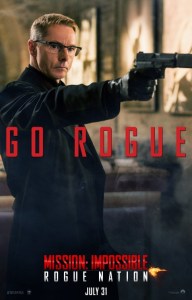 Following this sterling bit of teamwork, Hunt does get to go it alone again – his memorising of the entire contents of a flash drive full of bank account details seems improbable, but then as Anthony Hopkins’ Secretary said all the way back in M:I-2, this is Mission Impossible, not merely Mission Difficult, so the film encourages you to go along with it. This does briefly lead to a creeping doubt that we will get a rousing standard Tom Cruise Movie Star finish, wherein Hunt suddenly rounds up the bad guy and saves the day solo, but instead we get the nice reveal at the end, the glass cage springing up around Lane, the team surrounding him.
It’s noticeable too, that Lane is a clever hybrid of previous series antagonists. For all that he’s an ex-spy using that training to head up a global network of terrorists, ultimately what he wants out of the proceedings here is money. Though we begin with the Syndicate attempting to acquire VX gas, we are never really clear on what they wanted it for. The final revelation that the Red Box contains not some master list of spies around the world, but simply bank account details totalling £2.4 billion, and that this money is what Lane is after, is almost mundane next to the previous movie’s villain and his lust for nuclear war. That said, it’s implied that Lane wants the money for operations for the Syndicate, not simply as an end in itself, but it still reduces our main antagonist in the movie to – to paraphrase Holly Genarro in Die Hard – ‘a common thief’, for all his airs and graces.
 Though not quite as financially successful as Ghost Protocol, I think there’s little argument that Rogue Nation is the better movie. Blending in staples of the series to date with some genuinely refreshing angles, it reinvigorates what was in danger of becoming a formula. It’s nice to see the movie take an organic approach to developing Benji, from the desk-bound geek analyst we originally met to a competent (if still slightly inept at times) field agent. It’s nice to have a female character front and centre who neither needs nor indeed ever asks to be saved by Hunt. It’s nice to have a CIA director who goes on an actual journey from hating IMF and its methods to understanding the necessity of both. McQuarrie pulls off a near-miracle, in effect taking what seemed to be the best entry possible for the series, and springboarding from it to even greater heights. This is one mission that should definitely stand the test of time.




 Sci-Fi Bulletin: Exploring the Universes of SF, Fantasy, Horror and Spy-fi!