 Though a sequel to 2000’s M:I-2 was originally planned for 2002, creative differences, several changes of director and cast led to JJ Abrams’ directorial debut finally landing 6 years after its predecessor. With the previous film garnering mixed reviews and two Golden Raspberry nominations despite a healthy box office (the highest grossing film of 2000 and John Woo’s highest grossing film ever), it was easy to see that difficult choices lay ahead of Cruise and the creative team for this third entry in the franchise. Would they commit to the action-heavy stylings of Woo’s entry, or return the franchise to its roots?
Called out of retirement to rescue a former protégée, Ethan Hunt finds himself drawn into a personal vendetta against a shadowy arms dealer known only as Davian, who is attempting to steal a superweapon known only as the ‘Rabbit’s Foot’. But it soon becomes clear that Davian is operating with assistance from within the ranks of IMF itself. Hunt must decide once again who to trust as the fate of the world and his own family lie in the balance.
 M:I-2 was not a great movie. It dragged in the best box office of the year, it had nice explosions and big name stars, but it forgot most of the lessons its predecessor seemed to have taught. Small wonder then, that it took six years and an almost complete changeover of names and faces both in front of and behind the camera to get this third instalment off the ground, and in fairness, the wait was worth it.
In what some might think of as a typical JJ Abrams move, the film opens in the middle of a scene actually taken from near the narrative end, with no context given. Hunt, tied to a chair, is helpless as a woman we haven’t met yet but who is clearly important to him is tortured in front of him by Philip Seymour Hoffman’s bad guy, demanding to know something from Hunt. It’s a jarring scene – how did we get here? Who is the woman? What is Hoffman’s character asking Hunt for, and most important, does Hunt have it? There’s a genuine struggle to know what’s real as Hunt cycles from defiance to pleading, from insisting he’s given this man what he wants already to promising to help him get it. Given the nature of the character and the franchise, it’s honestly difficult to know on a first viewing which of the things Hunt says is true and which is not, and that sets proceedings up nicely. The final gunshot, occurring literally as the camera pulls away, sets up a sense of foreboding which then won’t leave the viewer for the majority of the film.
Then we get into the meat of it. Gone (thankfully) are the nu-metal stylings of the theme tune – here we get an honest to goodness instrumental rendition of the classic Lalo Schifrin original as a fuse is lit and burns down past a montage of scenes to come from the film, before we get to Hunt playing the dutiful fiancé at a family party. Gone is the shoulder length hair and the need to wear vests, the broody, self-important po-facedness of the second film. Here we see the Hunt we remember from the original film – calm, relaxed, happier to use subterfuge than direct action, as evidenced in his lip-reading of his fiancée’s various girlfriends’ comments about him at the party, or his deployment of a calculatedly boring office drone persona to the men in the room who ask what he does. There’s a genuine sense of an old spy who’s done with the game, even if he can’t shake the habits it trained into him.
 The meeting which disturbs this idyllic calm, with Agent Musgrave, is in hindsight incredibly well done. There’s no hint of anything but respect and admiration between the two men. No clue as to what Musgrave will reveal himself to be later, which is in keeping with the basic tenets of the franchise (second film aside) of playing fair with its audience. On a re-watch, you will see that the signs are there, but the film never hits you over the head with them. The film simply lays the groundwork and invites you along for the ride, and it’s that feeling of involvement that really sets it above what could otherwise be a routine action spy flick.
It’s in introducing Keri Russell’s Agent Lindsey Farris that the movie jars with itself a little, for multiple reasons. First, Farris is of comparable age to both Thandie Newton’s Nyah from M:I-2, and Hunt’s current fiancée, Julia Meade, played by Michelle Monoghan. In and of itself that’s not the issue, but Hunt’s feelings towards the woman as a sort of ‘little sister’ figure don’t really add up because of it. It’s nice that we see the character having an interest in a woman that isn’t romantic, fleshing him out as more three-dimensional than certain other characters within the genre, but it doesn’t quite add up having him feel so paternally protective towards a woman who – to all intents and purposes – is around the age of the women he tends to be attracted to. It just chimes wrong.
The second issue it creates is an inconsistency in the character herself. Though flashbacks show us Hunt signing her off as the only agent he’s ever trained who he feels is competent enough to work in the field, what we see of Farris is her being needed to be rescued. Then as the rescue is taking place, and she desperately tries to tell him something which she needs to tell ‘only him, no listeners’, he ignores her. Granted, they’re in the middle of a daring escape and being fired at, but Hunt is a capable multi-tasker and this woman is supposed to be someone he implicitly trusts and in whose abilities he has the utmost faith. Why then, not at least ask her what she’s got to say? Her death comes as a shock in so much as we’ve had a whole mission to rescue her and we are used to seeing the IMF (mostly) succeed, but it also feels slightly cheap, and when later on Hunt discovers a microdot she mailed him with an encrypted message, one is forced to wonder why she was trying to tell him anything at all in the middle of a firefight. It feels like the kernel of a decent idea for Hunt passing the torch on was there, but it gets muddled in inconsistency and the almost immediate fridging of the character to then allow her posthumously to act as a device driving certain plot elements forward as and when necessary. It doesn’t ruin the movie, but it is a blemish on it.
 On the plus side, we have villain Davian, played by the late Philip Seymour Hoffman. The great thing about Hoffman was that you could always guarantee a masterclass performance in every role he played, and this is no exception. Davian is cold, calculated and effortlessly confident. When captured as part of an elaborate set piece heist sequence in the Vatican, which is truly up there with some of the best the series as a whole has to offer, he’s unruffled. He doesn’t ask who is kidnapping him or why. Even when Hunt dangles him from a plane, threatening to throw him out, he says nothing, settling for learning Ethan’s first name from his comrades screaming it at him. When he promises to find whoever Ethan loves and punish them in front of him, it’s a scarily credible threat, in spite of him making it while tied to a chair being shipped back to IMF HQ.
Joining the IMF gang alongside Hunt and Luther we have Maggie Q as Zhen Lei and Simon Pegg’s first outing as analyst Benji Dunn. Q gets a strong set up in the opening rescue mission but then rather fades into the background, operationally. Her main function in the Vatican sequence is to turn heads, knock wine over Davian and drive off in a Lamborghini, which she then blows up. That aside, she doesn’t play much of a meaningful role in what follows, and it’s a shame because she’s the sort of actress who would have been a solid addition to the permanent roster, as we have seen from performances elsewhere. Pegg gets to play the desk-bound geek but still actually gets more to do than Q, playing a pivotal role in guiding Hunt to where Julia is being held by Davian in the third act. Pegg’s presence is a welcome injection of comedy in what is mostly quite a dark and serious film, and you can sense even from this early point that the character will be getting more to do as the series progresses. It’s just a shame the same couldn’t be said for Q.
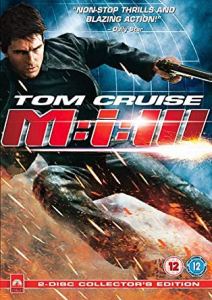 The heist which breaks Davian free from his prisoner convoy is another rousing set piece which the film manages to swing just the right side of ridiculous on, with Hunt inevitably ending up being the only one left single-handedly trying to shoot down the helicopter which arrives to take Davian away even as the rest of the team simply herd innocent people off the bridge and out of the line of fire. Mission: Impossible has never been shy about having Hunt front and centre and saving the world by sheer force of his own amazing qualities, but unlike the dire second entry, this film at least mostly allows the rest of the team the appearance of contributing to achieving whatever goal Hunt has in front of him. Still, the bridge scene is mostly about him, doing what he does best. Having failed to stop the escape, he then gets the call from Davian about Julia, and runs to try and stop her being kidnapped, in vain of course as she’s already gone.
Then the movie returns to a well-worn trait of the franchise – suspicion by the IMF and CIA that Hunt is a traitor, in this case one who calculated the escape of Davian and allowed it to happen. Those who are paying attention will recognise that this is not dissimilar to the set up of the first movie, or that it’s one that repeats as the series goes on. When Musgrave intervenes to slyly mouth the location Hunt needs to go through in the interrogation room, and leaves him a means of escape, is around the time at which you begin to realise that the traitor Farris and the movie have us pointed at – Laurence Fishburne’s Theodore Brassel, head of the IMF – probably isn’t the bad guy we are looking for. He’s no-nonsense, by-the-book and has little patience for Hunt’s methods, which immediately sets the viewer against him. Farris’ message seems to confirm the suspicion, but it’s really when Musgrave makes that intervention that you start to think on the exact wording of Farris’ warning – not that Brassel is the traitor, but that the call she traced was made from Brassel’s office. Again, the movie is playing fair.
 The third act – of Hunt escaping custody, shooting off round the globe to Shanghai to retrieve the Rabbit’s Foot and exchange it for Julia’s life – is a fairly standard series of action sequences that once more edge towards the same sort of line M:I-2 basically had as a baseline for its entire runtime, but staying just the right side of it. When we get to the scene we recognise from the opening, we now have an increased sense of investment, heightened not only by knowing who Julia is but by the sinking feeling that we know where this is going. When the shot goes off, and Davian walks away, Hunt’s life falls down around him, and we fear we know exactly where the movie is now going to take us, as Hunt exacts bloody and painful revenge on the killer of his beloved.
And then Musgrave appears, and we get the reveal that it’s not Julia, that it’s really Davian’s head of security disguised as Julia, who he was willing to sacrifice as she had failed him at the Vatican. This was all a test, to ensure that the Rabbit’s Foot that Hunt delivered was the genuine article. Suddenly what was looking like another standard action movie ending gets flipped on its head. There’s a plausible quality to the actual masterplan, albeit it’s revealed very late. The idea of allowing terrorists to acquire the doomsday weapon to give the US a pretext to declare war on another country is believable in its banality. The idea of Davian just being another pawn – even a monstrous one – in this wider game somewhat detracts from his role as the central antagonist but also oddly increases his menace. This isn’t a bad guy with an arch master plan he’s desperate to protect. Rather it’s simply a bad man who is willing to inflict extraordinary cruelty and suffering for reasons of simple revenge as well as just to get paid. It’s a refreshing change from the arch nemesis who wants to take over the world, and even if it does have echoes of Ambrose’s plan in M:I-2, it’s executed here with far more flair and effectiveness.
The final showdown, with Hunt vs Davian again as he attempts to save Julia, leads to an entertaining enough brawl between the two, Davian having the advantage as Hunt struggles against the micro-explosive sitting in his head. This is where things get a little too overblown, with the gun being handed to Julia, and then her responsibility for shocking Hunt to death to deactivate the bomb and then bringing him back to life in time to shoot dead the last bad guy. It’s silly, but you forgive it, because by that point the film has mostly given you an excellent and compelling ride, so when Hunt and Julia wander off on honeymoon to the cheers of the rest of the gang, it feels like it’s been earned.
It’s far from perfect, and it does make some very odd decisions, struggling still to find much depth, involvement or agency for its female characters (which I’ll say again, is frankly odd after the first film got so much of this so right), but this is a solid, pacy film which would set the basic framework and ground rules for the movies which followed it, while undoing a lot of the damage of its predecessor. In terms of set pieces alone, it raises the bar quite significantly, not just for the series itself but the genre as a whole. It’s definitely a mission worth accepting.




 Sci-Fi Bulletin: Exploring the Universes of SF, Fantasy, Horror and Spy-fi!