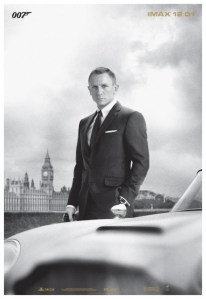
 Following a somewhat mixed reception to the slightly messy Quantum of Solace, and financial issues for MGM, it’s fair to say that a lot of expectation was piled on Skyfall ahead of its release, aided by the publicity of Bond’s mission during the Olympics. That pressure only increased with the film coming out in the 50th anniversary year of the franchise. Could Craig recover from the unevenness of his second outing? And, wonders Greg D. Smith, could Sam Mendes, not noted for his action credentials, deliver a movie worthy of the Bond legacy?
It’s been a few years since I had watched Skyfall, and I had mixed feelings about what I recalled. I remember enjoying it well enough in the cinema, but I also remembered elements which brought it down. A main plot which was too similar to Christopher Nolan’s The Dark Knight, an intensely creepy moment with one of the many Bond girls and a general sense of a self-congratulatory vibe running through the whole thing, all too aware of the goodwill it was likely to be afforded in an anniversary year.
 What this viewing has taught me is that I should return to the source more often and that the influence of a certain genre of YouTube video critic is even more insidious than I had imagined – you can watch these things for fun, you tell yourself, but do you ever really know exactly how much they may influence your thinking?
Skyfall is, in many ways, a complex film. It plays around with the darkness of the material while also hinting, often and occasionally less than subtly, that it’s very much in on the joke. It harks back to other movies in the franchise conceptually, doing better with the ideas they played with. It subverts some of the expectations of the audience, both of the film itself and the genre more broadly. It’s beautifully shot.
It’s also not without certain issues. It leans into one or two tropes of the franchise as a whole a little too hard, it doesn’t really know what to do with its female characters and ironically, arguably shares more in common with The Dark Knight Rises in certain tonal elements, though nobody at the time seems to have noticed.
So, to that opening. Frantic, breathless and with a couple of excellent set pieces which feel refreshingly analogue from a time where CGI was beginning to somewhat dominate the big screen. Craig here feels a lot more committed and less cocky than we last saw him. Here is a Bond on the edge, angry at authority and not bothered who knows it. When he does finally get pitched off that train roof into the water by Moneypenny’s misplaced shot, you can almost believe for a moment that he could actually be dead.
 Once we have the opening credits done with, Adele’s theme tune committing itself to memory as possibly the most Bondian of modern themes against all expectations as silhouetted naked or scantily clad women gyrate on the screen, we of course find out that Bond is alive (shock!). Here, I am forcibly reminded of the opening to Die Another Day – a broken down, abandoned Bond drowning in bitterness and misery, pulled back reluctantly to the life he’d left behind by a sense of duty. Except here the movie actually commits to the bit. Bond here really has vanished off the grid, and when he returns, he’s not just instantly the hot shit super agent we remember. This Bond is suffering from the abuse his body has taken. Poor reflexes, bad aim and a general downturn in his physical capability. When we learn that M has basically fudged his results to get him back on active service, the surprise isn’t that she’s had to do that but that she would. That’s when you start to appreciate how desperate her position is.
 Because make no mistake, whereas this movie definitely is a celebration of Bond as a character and franchise, this is absolutely M’s story. The main villain is from M’s past. The impending end of her career is the other looming threat, as she battles not only to defend her own tenure but the very existence of her agency in light of a colossal failure early in the film and the circling of governmental elements who’d rather pretend she and her agency didn’t exist and were not necessary. It’s a film about a woman fighting against every institution she’s spent a lifetime serving, while also fighting off a demon of her own creation by betting on his younger, smarter and more noble successor. M doesn’t ever really think she’s going to last this one – you can see that in her eyes. But like the movie as a whole, her struggle here is for legacy – to ensure that what she’s created survives and thrives when she’s gone.
 And so to that villain. Javier Bardem’s Silva doesn’t even appear until over an hour into the movie itself. This in itself is often used by certain sources as mentioned earlier as a criticism. But consider equally threatening presence in the shadows. Someone who is able to infiltrate any computer offices. The sinister message, constantly repeated, that M should ‘Think On Your Sins’ is stark and powerful, made creepier still by bad animations of M accompanying it. When the identities of agents around the world (what Bond was after in the movie’s opening) start being leaked online, it just ratchets up the tension, and then when we meet the man, it is a hell of an entrance.
But what’s most fascinating about Silva is that he is very reminiscent of the concept of Scaramanga in The Man with the Golden Gun. A dark mirror to Bond who actually is a dark mirror. Craig’s version of Bond at this point may well still be in his ‘women as disposable pleasures’ phase, but he’s not the casual murderer Silva proves himself with Sévérine. He may be a killer, but he’s doing it out of a sense of duty to Queen and Country, rather than for the highest bidder. Most important of all, Silva may tell himself that he’s the smarter of the two of them, but Bond here can easily outwit his opponent when he needs to – he may lack the technical genius of Silva on a computer, but in the game both of them are playing, you sense that Bond has an edge Silva never quite appreciates or expects.
 The one thing the two share in absolute common is M. Where Silva feels like a sulky teenager, seeing her as a mother figure who has betrayed him and is therefore deserving of retribution, Bond is more the young adult son, angry that M let him down, but able to put that aside. It’s odd that in a Bond film of all things, the lesson of the subtext seems to be that our hero is actually more emotionally mature than the villain, but it’s testament to Mendes as a director and Craig and Bardem as actors that they pull it off.
But what of our women? Well, as we’ve already covered, this is M’s story, and Dench gets a hell of a send off. Raging against bureaucrats who don’t understand the half of what her job entails, genuinely scared that maybe she is missing a step, and suspicious of Mallory, who seems intent on shooting her down, she is the magnetic central presence around which the film (as well as it’s main characters) revolve. I don’t think she could have wished for a better or more fitting end to the character she’d portrayed for seven films and nearly two decades.
 Unfortunately, that’s sort of it. Naomie Harris is always a joy to see but her Moneypenny unfortunately feels like she’s being undermined by the script from the start, between swipes at her driving, then ‘accidentally’ shooting Bond and finally ‘giving in’ and accepting that she’s just not cut out for fieldwork. It makes a sort of sense from the point of view of the franchise and wanting to establish the character we know, but it also feels like the script just starts from an odd place and then can only manage to get her to that destination by undermining her.
 Still, at least she gets lines and an arc of sorts. Sévérine gets to smoulder at James for a bit before apparently willingly going to what she must know is her own execution. And the only other female characters of any note are Helen McCrory’s Clair Dowar MP, there to play the micromanaging minister who just doesn’t get why MI6 is a thing, and the woman James loses himself with for a bit after being shot. Her credit in the film? ‘Bond’s Lover’. Hmmmmm.
Of note in the bait and switch department is Ralph Fiennes’ excellent turn as Mallory. Fiennes really excels at playing the sort of quietly villainous character you are waiting to see stab someone in the back, and the early appearances of Mallory convince the audience that he’s the big threat to all that is proper and true at MI6. His redemption, coming well past the halfway mark, is both excellent and welcome and more importantly, isn’t overdone. We don’t get the movie stopping expecting a parade for him for not being a shit, we just get a workmanlike acknowledgement that he’s not such a bad sort after all.
 In terms of plot, the movie really doesn’t imitate The Dark Knight as much as some would have us believe. Nolan hardly invented the ‘Villain with a complex scheme’ plot and Mendes executes it well here. Some may point to the fact of Silva’s ‘deliberate’ capture but in context, this all feels like Silva being well-prepared for all eventualities. He is, after all, an ex-MI6 agent like Bond. When we see Bond trapped in a cell, we don’t expect him to just give in and be done and we don’t complain when his complex manoeuvre out of there is revealed. The reality is that Silva is the sort of villain (much like Ledger’s Joker) who doesn’t neatly fit into the boxes we expect of these kinds of heroes. Villains are supposed to want infamy and world domination, and they’re supposed to be weak men (or women) who crumble at the first sign of setback. Silva doesn’t, proving resourceful, skilful and evasive. If you accept Bond as all these things, it makes no sense to object to them in his adversary.
 As to that final third of the movie? Home Alone is often quoted sneeringly in connection with it, which is to somewhat view the text without taking any notice of the context. Sure, there are some traps laid in the house which may feel a little reminiscent of the antics of Kevin McAllister defending his home from the Wet Bandits. But nothing about the movie to this point has been ‘light’ or ‘funny’, and the stakes are much higher and more serious. This is Bond on the offensive, taking initiative by stripping Silva of whatever advantages he may normally enjoy by going analogue. Is the reveal of the Aston Martin, replete with BMT 216A plate, a little cheesy? Sure. If you haven’t been paying attention, this is a Bond film. Moreover, revisiting this older, non-digital element to the character’s mythos makes sense in terms of the plot. You can pick holes and wonder how he has it but ultimately as Grant Morrison once said, nobody blows up the tyres on the Batmobile, it’s just not a relevant question to what’s going on.
 Ultimately, as the film winds to a close, the feeling I am left with is one of slight disappointment. As a fan of media, I always want more of a good thing, even if that may not be the best thing for the media itself. Craig hit the ground running as Bond in Casino Royale, but as was explicitly stated at the time, the film was deliberately stripped back. No gadgets, no fancy stuff, because they felt they had to ‘earn’ them. Here, in his third outing, the literal midpoint of his tenure, we see those elements, those tropes of the character and the franchise, coming together. We get Moneypenny, Q, some slight gadgets. The ending in particular feels like a beginning – the start of the adventures of Bond as we know him, but reimagined through a 21st Century lens. It’s hard to see that and know that we are so close to the end of Craig’s time in the tux, like it’s all just got going but will soon be taken away.
 It’s not a perfect movie, and it does, I feel, get a little bit of extra credit from some quarters because of it being the 50th anniversary piece. That said, it’s a bloody good movie, easily the equal of the best of any previous Bond actor’s tenure and almost (though not quite) on a par with Casino Royale itself. This one has definitely stood the test of time.




 Sci-Fi Bulletin: Exploring the Universes of SF, Fantasy, Horror and Spy-fi!