 With the massive success of Thunderball (which exceeded the box office of every film in the series before it and quite a few after) the studio was happy to get on the ball with another sequel. Having rejected On Her Majesty’s Secret Service because of location restrictions, it settled on You Only Live Twice, tasking acclaimed children’s author Roald Dahl with an adaptation that really stretched the meaning of the word. Having managed (just) to persuade star Connery to return one final time with a significant pay rise, and with parody Casino Royale having beaten them to the box office, much was riding on the success of the movie. But, wonders Greg D Smith, could they pull it off?
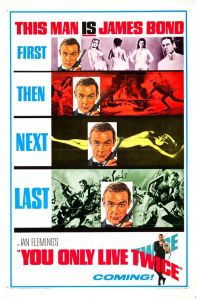 So here we are, five films into Eon’s Bond franchise. I know the score by now – elaborate pre-title sequence, string of women falling into bed with our hero, improbable villain with evil scheme, gadgets, action, shaken, not stirred, helicopter chase, big finish and one final romp with the girl as the credits roll and we get told ‘James Bond will return’. It’s a formula that was strong enough to basically endure with minor alterations over a span of five decades and counting. And this is the fifth go, so they must have it down to a fine art, right?
Well, yes. And also no. Ish.
You Only Live Twice is something of an oddity. It’s got almost the same budget as Thunderball, but rather than the usual globe-trotting it restricts itself to one location (Japan) and largely contrives to look cheaper than its predecessor. It has a pre-credit sequence, but one which specifically sets up the plot of the actual movie itself, rather than one showcasing some small part of Bond’s other adventures (indeed, Bond himself doesn’t appear in it until nearly five minutes in). At one point, Bond is offered a Vodka Martini with the words ‘That’s stirred not shaken, that was right wasn’t it?’ and replies ‘Perfect.’ Bond doesn’t even get a car of his own.
 Of course, that doesn’t mean that a lot of the old favourites aren’t here. There’s gadgets, the mandatory Q appearance (here slightly more bad-tempered than usual), SPECTRE (with a first on-screen appearance of leader Blofeld) and of course, the usual bevy of young women to be randomly thrown at our hero as he progresses. But there’s an odd quality to You Only Live Twice which makes it stand out from its predecessors. They’re all of their time, of course – and I’ll come to that – but this is the first of them which really feels like it’s mostly going through the motions.
It starts with Dahl’s screenplay, his first at the time aside from an uncompleted project, and one which he freely admitted was significantly different from the source novel, which he described as Fleming’s worst. Having retained only a handful of the original story ideas, and with little idea of what to actually have Bond do, Dahl said he had decided to do a similar basic plot to Dr. No. He’s not wrong – the interruption of space flights, a secret underground base and so on all fit that very basic template, but it’s not even that which makes the movie feel overly formulaic despite its oddities.
 For starters, let’s take the girls. Yes, it was the Sixties, and yes the movie is set in Japan which to this day has lingering and significant cultural differences to the West in its treatment and expectations of women. We know by now – five movies in – that Bond is an inherently misogynistic franchise in which women are either passive objects to be enjoyed or feisty hellcats to be conquered by our all-powerful swaggering manifestation of the Male Ego writ large central character. But this is the first movie where even the sexism feels both obvious and half-hearted. When head of the Japanese Secret Service Tanaka takes Bond to his home and invites him to enjoy all the property therein, you just know somehow that we are about to segue into a scene involving lots of young women. Hell, when Bond gets mentioned (not by name) by a British MP in the pre-credits sequence as ‘working on it now’ you know it’s going to fade to Bond romping in the sack with a young woman. When he’s captured by sub-villain Osato’s assistant Brandt, and is literally at her mercy with a range of torture implements at her disposal to extract information from him, he barely smoulders at her for a moment or two before she’s untying and seducing him (before then taking him on a plane with the express intent of killing him). And I’ll point out that for failing to do so, she is then executed by Blofeld, dropped into a Piranha pool because – ironically – she couldn’t keep it in his pants.
 And it’s not just the women who get such perfunctory character treatment. Blofeld has a large, powerfully built male sidekick whose main job seems to be to feed the Piranhas and look menacing, for example. Couldn’t tell you his name because he doesn’t get one, nor does he get to speak. His entire role is feeding some meat to the fish, standing around looking menacing and then getting involved in the most bland and quickly finished fist fight with Bond. Charles Gray, who would go on to play Blofeld in a later movie, and was a well-known and talented actor of stage and screen, gets a sort of bit part as a contact for Bond in Japan who delivers exposition in the form of naming Tanaka before being immediately being killed off. Tanaka himself gets very little to do besides the aforementioned invite to allow Bond to enjoy his property and then presiding over Bond’s ‘training’ as a ‘ninja’ (and we’ll get to that too) and then leading the Ninja Army attack on the secret base in the final act. Osato is a cypher. Blofeld, played with a sort of detached boredom by the superb Donald Pleasance, is literally a caricature, the cat stroked far too furiously, the reveal of the face robbing the character of the air of mystery which was – to date – his biggest asset. The most standout performance is Desmond Llewellyn’s extremely irate Q delivering his customary lecture to Bond about The Gadget for the movie, and it’s honestly difficult to tell how much of that irateness is actually acting.
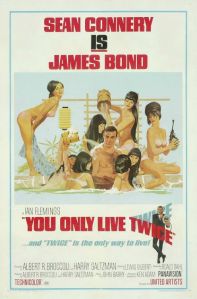 But if the character development is bad, the actual plot and basic narrative structure is where things get really odd. Casino Royale was all over the place but had the excuses of being a deliberate parody, having numerous writers and directors and being subject to last minute editing and re-writes to accommodate one main star walking off before shooting was finished. This though feels genuinely like someone at EON is sending themselves up, whether intentionally or otherwise.
For a start the central premise is bonkers. A secret, spaceship-gobbling spaceship being launched repeatedly by SPECTRE from an actual Secret Volcano Lair™ in Japan that nobody is able to track despite them actually tracking it when it appears to gobble up spaceships. The apparent purpose being to stoke up conflict between Russia and the USA as each accuses the other, at the behest of some un-named (but heavily implied to be China) government for reasons that are never explicitly given. Why the crews of the ships captured are then kept imprisoned instead of being killed isn’t clear, especially given that the intention is apparently to blow up the whole ship on the third go around, killing not only the American Astronauts on board but also the SPECTRE crew themselves. Given that and the Piranha antics, it’s not exactly like squeamishness could be the reason.
 Moving a little deeper into narrative, the movie starts with the interesting idea of faking Bond’s death because he’s become too famous and they need his enemies to believe that he’s dead. This would work if not for the fact that they then plaster his death with a picture all over the newspapers and he carries on going about his work with no facial adjustment for the whole first half of the movie (yes, I am getting there in a moment). This is compounded when Brandt and Osata both demonstrate extreme shock when informed that the agent they had failed to kill was Bond – they both look stunned, despite supposedly being key players in SPECTRE’s Japanese-based plans and Bond’s face having been plastered all over local papers. It’s also just a pointless move overall – the man always tells people who he is, almost never uses disguises and doesn’t even take one day off after his funeral. It’s an elaborate setup that films well and is narratively redundant – and that feeds into the film as a whole.
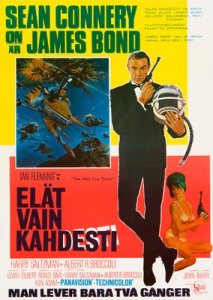 And then of course there’s the ‘Ninja Training’ which also includes Bond’s *ahem* transformation into a Japanese man. Again, it was the Sixties, sensibilities were very different, and what we now understand to be tasteless and racist would – at the time – have seemed perfectly reasonable. Though Fleming was a man with certain attitudes we would recognise as problematic at best and abhorrent at worst, and Dahl himself was anti-Semitic, there is no reason to suggest that this part of the plot was intended to be disrespectful or hurtful towards the Japanese people – indeed much of the film was shot on location in Japan and the overall narrative is very deferent to the capabilities of the Japanese people. That all considered, looked at today, the idea that sticking some plasters under Sean Connery’s eyes, slapping on some dark bronzer and giving him a bowl cut makes him ‘look Japanese’ can’t come off well. But that is really not the main issue with this part of the movie.
 No, it’s much more the whole structure. The ‘training’ amounts to little more than one fight scene with what turns out to be a SPECTRE infiltrator, the ‘change’ itself and the brief tour Bond gets of the compound (bringing back memories of the SPECTRE training camp in From Russia with Love, itself basically a pastiche of Q’s lab/training area). The concept of Bond’s disguise is relevant for all of about five minutes, and basically serves really as an elaborate setup to introduce the Bond Girl (i.e. the woman in the movie with whom Bond will share the final clinch as the credits roll) to the audience. It also brings us Ninjas, who are essentially presented by the screenplay with much the same gleeful joy that a six year old might introduce their army of ‘cowboy robots’ or ‘armoured unicorns’. When we meet them, they’re just there because they’re ‘cool’. We get no indication of their abilities, purpose or strength.
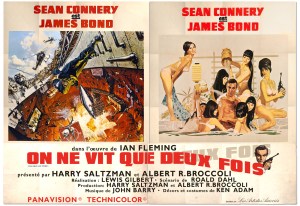 And that’s kind of how the entire film presents as a whole really. When Dahl said he had no idea what to do with Bond, it seems he wasn’t being modest. The film just goes from one odd scene that I’m sure sounded great in isolation on paper (imagine a Gyrocopter built from components in four suitcases, now imagine it takes on four attack helicopters) but when strung together with others as a whole just comes off as incoherent and rather silly.
 Maybe it was Connery’s disillusionment with the role. Maybe it was Dahl’s inexperience. Maybe it was the poor strength of the initial novel itself. Maybe it was a realisation, with the release of Casino Royale and Our Man Flint in the preceding months that the whole idea of Bond was just preposterous by definition. Possibly it was a combination of all these factors and more. Whatever the real truth behind it, the fact remains that You Only Live Twice comes off as a poor shadow of its predecessors, a sort of autopilot checklist exercise of the tropes associated with the franchise, shot and packaged to satisfy… someone. From a twenty-first century viewpoint, the idea of a franchise made for the sake of it is not especially new or surprising. But it’s a little sad to see an example of it so relatively early on in perhaps the most famous and certainly the most enduring cinematic franchise of all.




 Sci-Fi Bulletin: Exploring the Universes of SF, Fantasy, Horror and Spy-fi!