 Despite mixed critical reception, The World is Not Enough had continued the Brosnan era trend for commercial success, with its director being invited back (though ultimately not returning) for the twentieth instalment in the EON franchise. With The Bourne Identity having dropped months earlier, could Bond still retain the crown as the king of the spy movie franchises?
And so we reach the end of Pierce Brosnan’s tenure in the tuxedo with perhaps one of the most infamous instalments in EON’s run of Bond films. Conventional wisdom has it that this is the really bad one, and certainly my hazy memories of watching it on DVD twenty years ago were not favourable, but given how poorly the previous entries had aged to my eyes, how much worse might this one be? Surprisingly, not all that bad at all’ in fact, I’d rate this as one of the better efforts in Brosnan’s run.
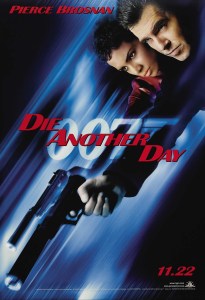 Of course, it didn’t help at the time that The Bourne Identity had beaten Bond to the punch by a matter of months in terms of release date. Paul Greengrass’ visceral, gritty thriller had delivered something the audiences of the early 2000s hadn’t really anticipated or known they’d needed – a spy movie that wasn’t all endless drinks in casinos, fast cars and ludicrously named temptresses falling into bed with our hero at a moment’s notice. By comparison, any Bond movie that stuck to the template of its predecessors wasn’t going to fare well. And yet…
Look, I’m not saying that Die Another Day is a great film. It’s maybe not even a good one, but set against its three immediate predecessors, it’s hardly the worst of them, and in many ways may be the best, albeit that feels like a low bar at this point.
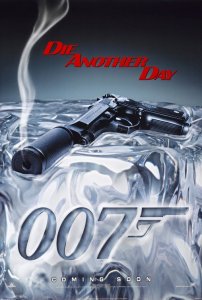 It starts off really very well in a way, if you ignore the rather clumsily handled political elements that would see the film be very unpopular on both sides of the 38th parallel. The idea of Bond being captured at the end of a mission and then tortured for 14 months as he finds himself abandoned by a government that must, as a matter of course, deny his existence is a bold one in the context of the franchise to date. The fact the movie chooses not only not to shy from depicting his suffering but actually to overlay it on the opening credits really feels like it’s ramming home that this is a very different kind of Bond movie. I remember feeling hopeful all through that opening sequence when I first watched the movie and even this time it was difficult not to be impressed.
Even after that sequence, when Bond is exchanged with Zao and brought back to MI6, the movie seems set on an interesting, Dalton-esque trajectory, whereby Bond is in trouble with the powers that be because they believe he has betrayed secrets to the enemy and has his 00 status revoked as he is confined in a medical facility. The tense exchange with M really cements this feeling, and you’re settled in for a story of Bond the rogue agent, fighting against the very systems which created him as well as his enemies in order to clear his name. Elements of this fresh sort of direction for the franchise will persist throughout the movie’s runtime, but unfortunately they increasingly take a backseat as the movie wrestles with the basic tics of the series as a whole, and loses more than it wins.
 Let’s look at the women. Halle Berry is our Bond Girl, Giacinta ‘Jinx’ Johnson, an NSA agent whose path and mission intersect with Bond’s own. Jinx is sassy, confident and apparently capable, revealing herself as more than she might appear with a positively Bond-like exit from a sticky situation, throwing herself from a considerable height to the water below and a waiting escape boat. She’s also pretty ruthless, executing her target without an apparent care at all, though in fairness he has just revealed some abhorrent stuff to her. Why then, is she called ‘Jinx’? And why does the movie have to have her a) conveniently less competent when the script decides Bond needs to Do A Rescue and b) condescend to have her engage in catty rivalry with the movie’s other main female character over the fact that both of them were ‘done’ by him? It feels like the movie wants to have its cake and eat it with Jinx, having her simultaneously be a competent foil to Bond while also being a return to the days of girls who just instantly melt at the sight of Bond’s smile. It doesn’t help either that the movie deliberately recalls Andress’ emergence from the sea in Dr No with Berry’s first appearance, but then this is a film that likes to indulge itself in nostalgia, being the twentieth EON entry.
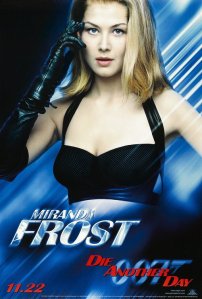 Turning to that other female lead we have a young Rosamund Pike in her first major movie role as Miranda Frost, an MI6 agent who turns out to be the source of Bond’s betrayal. If Jinx is a mess of conflicting impulses and character beats, Frost is worse still. Introduced as the executive assistant to the movie’s villain, we find out (by exposition rather than any demonstration) that she’s an ex Olympic fencer who won gold (in controversial circumstances) and then later that she’s MI6’s agent keeping an eye on the villain. The movie also heavily (and clumsily, unfortunately in line with the time) hints at the fact that Frost may be gay, with a Madonna cameo in the ‘Blades’ scene helping lend credence to this idea and the script having various characters (though mainly, it has to be said Bond) allude to the fact that she’s ‘cold’ and basically sexless. Even M comments that Frost didn’t ‘fraternise’ with any of her colleagues in training, with the implication being that this is somehow ‘weird’. Basically, the character is ‘queer coded’ with all the baggage that idea came with in the early 2000s in a franchise like this. Worse, it then has her sleep with Bond anyway (albeit because she is trying to distract him). Finally, it has her wear a stunningly impractical outfit for her final fight scene for no apparent plot-relevant reason whatsoever, and she goes out in a disappointing way, given her supposed skill.
 M at least gets good in this instalment though. We see flashes here of the steel that Dench would bring to the role during the Craig years. No more of the sniggers from corners at her being the girl in charge, or the ‘bean counter’. This M is a cold-blooded boss every bit the equal of her agents in terms of dispassion, and happy to throw Bond to the wolves when expedient, equally so to bring him back into the fold when he might be useful. It’s not a perfect version of that character, and there are still some hangups from the previous movies, but it’s a definite improvement.
Samantha Bond’s Moneypenny on the other hand, just gets a whole lot worse, apparently infected with same mega-dose of Horny as Brosnan’s Bond himself. A gag at the end of the film where she’s found by Q using his new VR glasses to cop off with Bond is a low point, and not a fitting send off for Bond’s feisty version of the character from the previous three films.
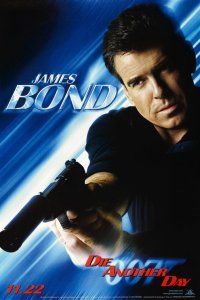 Speaking of Brosnan, ‘Horny’ is the main impression I get left with of his incarnation of Bond with this send-off. The man seems incapable of not immediately pawing at every woman he meets, and the queer-coding of Frost just makes this more uncomfortable than ever as we basically see an older man attempting to will himself into the pants of a much younger woman, against her very explicit distaste for the idea. Brosnan feels like he’s going for maximum Connery/Moore hybrid here, with lots of anger and cold-bloodedness (the best he’s done at that side of the character in honesty, likely because there’s no attempt at the ‘tender, brooding moment under the armour’ moment here) but also almost camp levels of sexually loaded quips, meaningful glances and an almost Sid James level of wilful filth. In a movie so obviously torn between impulses (to be more serious but also retain the Bond ‘tics’) it’s not a surprise but it does rather take away from the overall effect which is a shame.
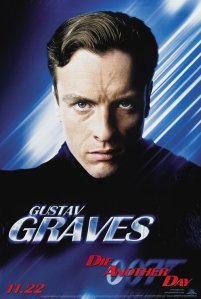 As to our villain, Gustav Graves may well be one of the more interesting ideas for a villain in recent Bond canon but unfortunately handled in a ham-fisted, politically insensitive way. Sure the Russians weren’t allowed to be the bogeyman anymore (ironic given contemporary politics) but having the villain be a North Korean army colonel who not only plays to the worst stereotypes but then literally becomes a White Man as a path to riches and success is… tone deaf to say the least. The idea of the villain shifting identity to fake his death and continue his plans for world domination is sound, but the context is poor, and could have been done better in a dozen different ways. That said, Toby Stephens gives a good performance as Graves, the billionaire tycoon who never sleeps and who has attracted the eye of MI6 even as he gains a knighthood. A bit of monologuing later to Bond wherein he explicitly tells us he’s modelled the Graves persona on Bond rather spoils the impact (given that it was obvious in context to anyone watching the film) and he does rather munch on a lot of the scenery, but he’s a magnetic villain to watch, rather undermined by the eventual reveal of his ‘true’ identity and the rather cartoonish nature of his ultimate plan to use a space-based laser to blow a path through the minefield of the 38th Parallel therefore leaving South Korea open to attack from North Korean forces.
 As far as plot goes, the film rather catapults from interesting to bonkers and back again throughout. The idea of Bond being set up and betrayed, and working to clear his name rather gets lost as the things wears on beneath Graves’ Big Evil Scheme, and it’s difficult once again to escape the notion that a lot of the stunt sequences in the latter half of the movie are there for the sake of being there, narrative being a secondary consideration. Sequences once again drag too long, the main offender being the ridiculous sequence wherein Bond escapes in a rocket sled and then improvises a paraglider from its parts and surfs off over a very obviously CGI tidal wave. But there’s also the Obligatory Car Chase, over ice, in which an Aston and a Jag sort of do a bit of a Top Gear show-off sequence while occasionally vaguely firing various projectiles at one another. It doesn’t feel tense or especially interesting and the length of it doesn’t help that at all. This is also a film where a lot of the stunt work is green screen, and that can’t help but feel poor next to earlier, live action sequences in the franchise.
 Gadget wise, the film rather overdoses. An early scene sees Bond have a satellite transmitter hidden in a knife hilt. Fair enough, but for the fact that the knife is part of an infiltration kit, so there’s no need to hide that transmitter in it beyond showing off that you can. The same might be said for the hypersonic ring and the disappearing Aston, though the latter is less ridiculous than you might think it sounds. John Cleese gets promoted from R to Q in the wake of Desmond Llewellyn’s unfortunate passing, and brings a very Cleese energy to the thing, which is to say he’s prickly and slightly buffoonish, with an inherent dislike for Bond. After so many years of Llewellyn’s chemistry with his various onscreen Bonds, it feels disappointing that the franchise should have to take this backward step.
Overall then, it’s perhaps the most mixed bag of the Brosnan era, redeemed significantly by the fact that at its core are some interesting ideas which rather get lost in the various morasses of trying to retain elements that were beyond dated by this point and sensitivity mis-steps with certain plot elements.
 It’s easy to say in hindsight that the movie very much feels like Brosnan saying goodbye to the role but at the same time that feeling is inescapable from the first frame to the last. It’s a shame that the actor missed out on his first crack at the character – one feels that perhaps given the opportunities Dalton had, in a different time, Brosnan’s type of Bond would have gone over much better, and that Dalton by contrast could have made much hay with the more serious elements with which Brosnan struggled in his own tenure.
It’s a film which will rarely grace the top of any Bond fan’s list, but in context against the others of its run, it’s hardly the worst of them, and it’s by no means the worst Bond film either, no matter what some might say.




 Sci-Fi Bulletin: Exploring the Universes of SF, Fantasy, Horror and Spy-fi!