 With two decent returns from the box office and solid, if unspectacular reviews, it was time for the third act in Brosnan’s run as 007, and this one would be inspired by a news report on oil pipelines and titled using the ‘Bond family motto’. What could possibly go wrong as a franchise famed for its silliness and leaning more heavily into its ludicrous roots delved deeper into contemporary geopolitics for inspiration?
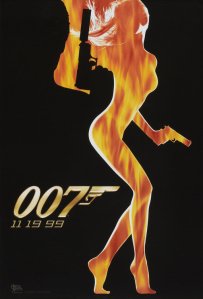 For many people, the movie which follows this one is viewed as incomprehensibly bad, as if it suddenly showed up with its terrible CGI, wacky ideas and tonal dissonance out of nowhere. But we’ve already seen the personality crisis deepening for the franchise from GoldenEye through Tomorrow Never Dies and I’m sorry to report, dear reader, that it gets no better in The World Is Not Enough, a film so schizophrenic that between its two female leads it produced both critical acclaim for a bravura performance and the franchise’s first ever win of a Golden Raspberry Award. Honestly, in hindsight, it’s difficult to think of a more apt metaphor for the entire enterprise.
Opening with a fourteen-minute-long pre-credit sequence (the longest up until No Time to Die), the film sets out its stall early, and not in the good way, whether its Brosnan’s Bond at his absolute leeriest (an early comment on the ‘rounded figures’ of a female banker being a highlight), ludicrous stunts which bypass ‘Oh wow, I can’t believe they did that’ and go straight to ‘Oh no, why did they do that?’, terrible puns or just a meandering plot that wanders peripatetically all over the place without ever really seeming to know what it wants to do.
 Yes, this one is a mess. I hadn’t actually seen it since an ill-advised trip to the cinema back in ’99 with my father, and I honestly only recalled one particular sequence in any sort of clarity. That sequence stood for me as an example of why Brosnan was a great Moore-style Bond but terrible at the sort of Bond they were also trying to make him be at the same time, though in hindsight even Moore could have pulled this stuff off better.
But I digress. Let us start, as ever, with the women of Bond, and oh my, with each passing instalment of Brosnan’s tenure this just gets worse. M by this point is just a lost cause. The idea of casting someone with the presence and charisma of Judi Dench utterly wasted on a character who has lost all that ball-busting, ‘I don’t give a damn’ shine she briefly strolled onto the screen with in GoldenEye and has become instead a hand-wringing middle-aged mother figure who clucks about how terrible it is that she gave the advice her job demanded to an old friend. Worse, she now seems every bit as wrapped up in the charms of Bond as she firmly declared herself to be immune to them back in her debut. Disappointing isn’t even the word, and I am glad that Dench was given the chance to reprise the role in a different era because this is well beneath her.
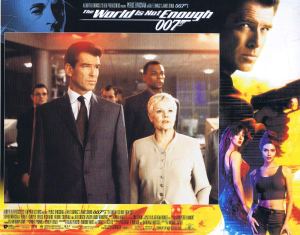 Samantha Bond is reliable as ever as the incarnation of Moneypenny whose job is to make snarky comments about Bond’s conquests even as she flirts with him, and that’s literally all we really need to say about her.
Maria Grazia Cucinotta gets to appear in that opening 14 minutes before topping herself as ‘Cigar Girl’ (literally her credit and indicative, I’m afraid of the movie’s general attitude towards its female cast).
And then we get to the real female leads of the story – Denise Richards’ Christmas Jones and Sophie Marceau’s Elektra King. Of these, one is a half-decent attempt at a nuanced character which sort of falls apart in the second and third acts of the movie and the other is a classic ‘Bond Girl’ set of tropes squeezed into hot pants and tight tops at every opportunity. Can we guess which is which?
 Much of the criticism of Richards, who was the recipient of that franchise first Razzie, screams of the sort of misogyny the franchise itself is steeped in. Much of it focused on the fact that she wasn’t ‘credible’ as a nuclear scientist, as if credibility was ever the aim of a screenwriter who came up with a name like Christmas Jones. The film lets us know from her first appearance, deep into its second act, that Jones is a character there to titillate the men around her, one of the soldiers who has been working with her assuring Bond that she isn’t interested in men because he’s tried and got nowhere. Her every wardrobe choice in the film is designed to accentuate Richards’ figure and the script gives her nothing to work with beyond the odd feisty comeback and an assertion that she’s ‘heard all the jokes about her name already.’ One of the few chances the movie gives her to be competent, spotting that Bond cannot be the nuclear scientist as whom he is masquerading, is presented as her getting Bond into trouble and enabling the villain to escape. Let’s be honest – Richards may or may not be the world’s most gifted actor, but to judge her on a script this bad, where her character is written so poorly and with such a specific angle in mind, feels somewhat harsh.
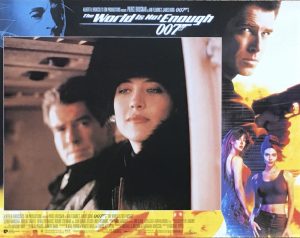 And then there’s Marceau’s Elektra. This was the performance that got all the praise, and whereas I cannot deny that Marceau appears to be having fun with the character, for me it’s not one who makes any kind of sense from one scene to the next.
The idea at the core – that she’s a woman reclaiming her family’s legacy from a man/men who took it away from her mother – is not a unique one in genre and certainly not a bad idea on its own merits. Buried underneath a poor script and some truly awful and stilted exposition dialogue is the kernel of a great villain, one which Marceau does her best to realise. She’s a kind of devil-may-care, lackadaisically cruel character, who is capable of inflicting immense hurt with a beatific smile plastered across her face. Where the script runs into issues with her is in trying to delve deeper into the psychological reasoning of why she does what she does. The base mentioned of reclaiming an ancestral legacy then gets mixed up with anger at her father and M for their having ‘abandoned’ her to her kidnappers. This is then further muddied by another stilted exchange between her and Bond as she tortures him, in which she declares that she’s always had power over men, and used it to woo her kidnappers and essentially make Renard ‘her’ creature. Bond’s stiff recitation of the basic definition of Stockholm Syndrome (at least as it was understood at that point – things have progressed a lot since) just adds to the whole mess. Credit to Marceau, she does a stellar job with a script and screenplay which are always actively working against her, but ultimately the lack of clarity as to her exact motivations (Revenge? Money? Reclamation of her mother’s legacy? Shits and giggles?) just mean that her character fails to properly land for me as the main villain.
 And that’s a problem, because the other ‘main’ villain of the piece is Renard, played by Robert Carlyle. In true Bond villain style, Renard’s backstory is complete nonsense dressed in cod science terms. A bullet is lodged in his brain and is slowly killing him but also killing off his capacity to feel pain etc as it goes. So far so (reasonably) believable. But then a doctor – who has already been seduced by Bond of course – says that he’ll become stronger and more unbeatable until the day he dies. Why? He’s not invincible. The idea that he can endure beyond what normal men could is restricted purely to his ability to feel pain. His lungs and heart won’t perform better. He will still die if he overexerts himself, or indeed gets stabbed somewhere vital and can’t feel it. It’s supposed to make him scarier and sinister, but unfortunately, just like the prosthetic scar (as the franchise continues to equate deformity with villainy) it just comes across as silly. All of Renard’s ‘capability’ is told, not shown, with Carlyle getting relatively little screen time and being ultimately defeated fairly easily.
 On that writing, it has to be said that this script is easily the worst to this point in Bond canon for clunky dialogue mixed in with bad exposition. The apex of this – and that one scene I mentioned remembering – is Bond attempting to execute Renard the first time they meet, monologuing about how he feels nothing despite usually not liking cold-blooded murder. Brosnan is a decent actor and in fairness to him to this point he’s done his best to give what the studio has demanded – something halfway between Moore’s camp and Dalton’s murderousness – but it’s here where the mask finally slips irretrievably with dialogue so bad I’m not sure even Dalton could have saved it.
It’s not just that though – it’s the extended torture scene as King monologues her evil plan, the endless hand-wringing by M over her decisions as a professional versus her instincts as a mother and basically every bit of dialogue given to Richards that isn’t relating to smut. None of it feels natural or believable, and it all chips away throughout the run time at any sense of immersion the movie might have generated.
 On the subject of natural and believable, the other big issue the movie is carrying is a persistent sense that it’s parodying its own self as it goes. There’s the ‘Bond Tics’ being overused like Bond adjusting his tie in the middle of an action scene (and underwater). But there’s also a general sense that the movie is really a collection of action scenes the second unit wanted to film which have then had a script loosely cobbled around them afterward. The opening speedboat chase goes on too long and is too silly to enjoy, the various explosions feel dull and the sequence in a caviar factory with helicopters swinging big forestry saws around is surpassed only by the earlier scene of paragliders attacking our hero for sheer ‘Oh look it’s the baddies’ silliness. It feels, in its action scene sensibilities, like a cliched pastiche of the Bond oeuvre, rather than a serious attempt at a Bond movie.
As far as its central star goes, Brosnan is at his least likeable as Bond here, whether it’s the over-used innuendo, the frankly disturbing x-ray specs used to quietly perve on every woman in a casino or the aforementioned clunky dialogue. It calls to mind the disdain with which Connery treated the role in his final EON outing, Diamonds are Forever, and it feels like Brosnan has, if not quite checked out, at least already grown bored with the whole endeavour. Brosnan’s performance here feels like he resents being on the set, and with a script this bad, it feels difficult to blame him.
 I should also mention here that I’m not certain if this is an issue with the Blu-ray cut I was watching but the climactic scene in the submarine feels weirdly cut, as Bond and Jones agree to meet at the top of the submarine while she tries to fix something and then suddenly they’re just at the top and off into the water, Bond declaring (to the NUCLEAR SCIENTIST) that the reactor is flooded so it’s ok if it goes boom. By this point, the movie has no credibility to speak of anyway, but it’s still bad.
It’s not entirely without merits if you look. Desmond Llewellyn’s final performance in the role (he would die in a car accident shortly after the movie was released) is loaded with pathos as well as the character’s trademark snark. Robbie Coltrane returns as Valentin Zukovsky, Bond’s frenemy from GoldenEye, and is by far the most likeable cast member in the whole thing, with a good rapport with Brosnan’s Bond (so of course he has to die) and the music is pretty good. David Arnold’s second Bond score riffs well off the title track, and produces, if not a memorable accompaniment to the nonsense on screen, at least a less anonymous one. That title track, by Garbage at the height of their late nineties fame, is an absolute solid gold classic, Shirley Manson’s lyrical talents a great match to the understated yet orchestral music.
 But these are bright spots in an overall dull package. It is clear as the credits roll that any sense of invention or evolution of the franchise or its central character has been abandoned at this point, and that the way in which scripts were being produced at the time was deeply flawed. It’s not necessarily the worst Bond film ever made, but it’s definitely far from the super spy’s finest hour.




 Sci-Fi Bulletin: Exploring the Universes of SF, Fantasy, Horror and Spy-fi!