 With Dr. No having set the box office alight, United Artists were happy to greenlight a second Bond film. As the President of the United States, John F Kennedy, had publicly declared From Russia, with Love to be among his favourite novels of all time, producers Cubby Broccoli and Harry Saltzman decided it would be the perfect follow up. But could the studio repeat that initial success – had they really hit on a winning cinematic formula? Greg D Smith finds out.
From Russia With Love didn’t have to do a lot in order to better its predecessor for me. Viewing Dr. No as someone who was only really familiar with the later entries in the series was a weird experience, with so many of the ‘standard’ Bond tropes missing, so little action compared to what I was accustomed to, and overall a fairly ‘muted’ feel compared to what I had expected.
But what I wasn’t prepared for, given the whole brouhaha of 2008 with a certain other Bond film and a whole chorus of people saying that ‘Bond films never do that’, was for this to be a direct sequel.
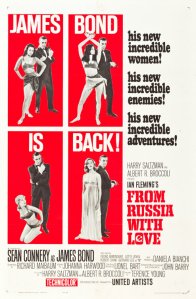 Sure, the carry throughs could be argued to be minimal. There’s no attempt at building a literal ongoing narrative as there has been in the Daniel Craig era (to which we will of course eventually get with this series), but there is no arguing that this is a genuine, bona-fide direct follow up to Dr. No. The plot revolves around S.P.E.C.T.R.E deliberately targeting Bond in their latest scheme as revenge for his killing of Doctor No. Moreover, Bond’s England-based sophisticated regular squeeze, Sylvia Trench – she of the infamous casino scene which introduced us to the character of Bond in the previous movie – is here, present and correct. Same actress, same character and she even references the fact that the last time Bond promised her he’d be right back he vanished to Jamaica for quite some time.
Of course, it’s not really that much of a surprise in hindsight. This was only the second movie – at the time neither the studio nor anyone else involved could have dreamed that they were making the initial entries in what would become a successful franchise that ran for more than half a century over multiple actors. They were just following up a successful movie.
 And an interesting follow up it is. In many ways, it’s far more of a staple Bond movie – we have the pre-credits action scene, some gadgets, Desmond Llewellyn’s beloved Q makes his first appearance, we have a theme song with lyrics (albeit only over the end credits) and a postscript action scene with the legend ‘James Bond will return’ as the finale. It’s still not quite the Bond we know and love today – still no ‘shaken, not stirred’ and the ‘gadget’ is a trick briefcase with an explosive gas canister surprise as well as some concealed weaponry and hidden money and containing an extremely compact rifle. If anything, the main adversary gets more of a ‘Bondian’ gadget in the form of his watch with its strangulation wire.
But in most other respects it’s solid Bond, not least with the way in which it treats its women. If Dr. No was poor for female representation, From Russia With Love actually manages to take several steps further back. Main ‘Bond Girl’ Tatiana Romanova is somehow a loyal Russian Consulate clerk who is drafted into quite possibly the daftest secret spy mission of all time and then shows absolutely no aptitude for any of it, not really seeming clear on what she should do, when or how at any given juncture. It’s also fairly uncomfortable to watch a scene in which Bond violently interrogates the poor girl, physically smacking her around to try to get her to confess something it turns out she didn’t do, given Connery’s twice-expressed opinions on the matter of domestic violence in real life. Add that to a subplot that sees the pair of them filmed having sex in a hotel room – a fact which Bond never bothers himself to explain to Romanova – and it’s easy to see the troubling roots of the misogyny that would permeate the franchise for years to come.
 Mainly, Romanova – played with the most unconvincing Russian accent ever by Italian actress Daniela Bianchi – is there to be a trophy. Her abilities, thoughts and opinions are irrelevant next to her appearance, and the script never treats her as much more than set dressing.
Elsewhere, if anything, it gets worse. Villainous henchwoman Rosa Klebb, S.P.E.C.T.R.E’s ‘Number 3’ and former SMERSH agent now operating as a double agent is played by Austrian-American actress Lotte Lenya as a lesbian. We know this because she openly and quite awfully leers over Romanova. Quite what relevance the fact of her sexuality has to the character as a whole is never once investigated, and other than this one scene it’s never addressed. Again, as someone who comes to these movies from the ‘opposite end’ as it were, I couldn’t help but notice how Austin Powers’ Frau Farbissiner was clearly lifted wholesale from the Klebb character, with her severe tone, tendency to walk around with a swagger stick and, of course, her sexual orientation.
 Aside from these two, the only other female characters of note are a pair of ‘gipsy girls’ who get to have a catfight for a while over the affections of a man and then end up essentially ‘gifted’ to Bond for the night after he asks them to be stopped as reward for saving the life of the head of the clan, and Moneypenny, who remains behind her desk wistfully wishing she could be one of the girls with whom James is constantly falling into bed. And Sylvia Trench, who despite having almost no screen time at all somehow manages to get the best treatment of all of them. You get the impression that her refusal to be wide-eyed and blown away by James, her obvious treatment of him as an equal, is probably what attracts him to her, and yet again, she manages to make him late for the thing he should be leaving her immediately to do.
Bond himself is played with no small relish by Connery, in a turn which instantly feels more assured than the last outing. Though Connery could never have been accused of looking ‘uncomfortable’ in the role in Dr. No, there was a sense that he was somehow feeling his way into the role at the time. Again, this is understandable given it was an unknown quantity rather than the globally-famous franchise we know today, but there’s an undeniable sense here that Connery has his feet firmly under the table now. His every line is delivered with utter confidence, his every gesture assured. Even when he’s apparently on the back foot, you can see the wheels turning, looking for the angle that will give him the advantage. Simply put, Connery inhabits the role, whether it’s in the way he deals with villains or women, for good or ill.
 As to our main antagonists, we are introduced for the first time to the character who would go on to become Blofeld. Here he’s referred to only as Number One, and we only see his hand stroking his white cat as he speaks. We also briefly meet Kronsteen, also known as ‘Number Five’, a S.P.E.C.T.R.E agent who is also a chess master and all round genius, and who is behind the complex plot devised to both grab a Lektor cryptography device and snare Bond in the process. Neither plays a particularly large role in proceedings, and nor does Krilencu, a Bulgarian assassin working for the Russians whose main role here is to orchestrate the attack which leads to one of the movie’s bigger action scenes and then die not long afterward.
Ironically, our hero’s main adversary in the movie spends the first half of it keeping him alive, and only openly meets him for a small part of the third act. Donald ‘Red’ Grant, a sociopath taken by S.P.E.C.T.R.E and trained as a lethal assassin, is a captivating character right from that pre-credits scene where he executes someone disguised as Bond in a training exercise. He doesn’t get an awful lot of screen time overall, but Robert Shaw makes the most of it, exuding quiet menace for the most part and then switching to a quite passable impression of an English gentleman spy when the movie calls for it. His confrontation with Bond is quite tense, with the way he overpowers Bond and has him at his mercy feeling quite believable. True, he’s eventually outwitted by Bond (because obviously he has to be) but even that feels – relative to some things we would see in the franchise to come – quite believable. Shaw is genuinely almost the star of the entire film, outshone only by Connery himself, and the nuance he brings to the character helps to carry the fairly ludicrous plot.
 Ah yes, that plot. It’s quite telling that even the script itself acknowledges how preposterous the idea of its main plot driver is, even as it and all the characters go along with it anyway. The very notion that a Russian agent should have seen a picture of a British one, fallen instantly in love and elected to defect but only to him, is silly enough. That she would elect to do so and bring a top secret cryptography machine as well just sends it over the edge. The supposed four-dimensional chess game played by Kronsteen in this – that the British will know it’s a trap but being British, will be unable to refuse anyway, is bettered only when M and others agree that it’s definitely a trap, but that they should send Bond in regardless. That S.P.E.C.T.R.E only seem to want the machine so they can ransom it immediately back to the Russians only adds to the bizarre quality. But then, the movie gets as weird as its predecessor in a very specific way.
Dr. No was, I noted, a fairly uneven movie, which was one half serious-ish espionage drama and one half overblown movie villain in a secret lair attempting to take over the world because he could. From Russia with Love has similar tensions, but essentially in reverse. Starting from the ludicrous premise of the Lektor/seduction/revenge plot, it goes on to carve out a believable back-and-forth bit of spy drama in Istanbul in-between. The notion that the Russians and MI6 are just sort of watching one another in fairly peaceful détente in Istanbul, going through the motions of monitoring one another, following one another’s agents etc, without any real aggression feels oddly plausible. Bond’s experiences with head of station Ali Kerim Bey feel mostly fairly grounded and realistic (random ‘gipsy’ girls being thrown at Bond aside) and Shaw’s prowling through the shadows in Bond’s wake, eliminating the threats to his target while ensuring he gets what his bosses need before he takes him out himself all feel like things one might see even today in a more ‘serious’, ‘grounded’ take on the genre. These elements just grate really oddly against that overall meta plot.
 It’s a far more action-heavy number than its predecessor as well. Where Dr. No had a couple of limited fisticuffs and one car chase, this has an extended helicopter chase, a whole fleet of boats chasing our hero, and quite a few explosions and a large, extended gunfight. As an indicator of where the franchise as a whole would end up going, it’s a solid one, in good ways and bad. Certainly it brings more excitement, more action and more ambition. It also cements some of the more troubling qualities that would go on to define the character for some time to come.
Seen from the point of view of the 21st century, it’s in many ways a quaint oddity. The treatment of women, the preposterous main plot and the casual misogyny of almost every male character just feel alien by contemporary standards. But the throughlines of what we know and understand as Bond are nearly all established here, from the character himself to his gadgets, weapons and exploits. It’s hard to dismiss that influence, even as it’s tempting to try. Goldfinger will certainly be an experience.




 Sci-Fi Bulletin: Exploring the Universes of SF, Fantasy, Horror and Spy-fi!