 Six years of legal wrangling (who would have thought it) had left Timothy Dalton not wishing to continue his tenure as Bond (agreeable to do a third film, he couldn’t commit to the four or five total Cubby Broccoli said would be needed after such a gap). A new post-cold war era and a new star meant a reboot of sorts for the franchise, and incoming star Pierce Brosnan, originally denied his shot at the role in 1986 due to other commitments, finally got to don the famous tux. But would this new rejuvenation bring the success the franchise had once enjoyed?
GoldenEye represents a bit of a personal milestone to me for this series, being the first Bond movie I saw at the cinema. 15 year old Greg was not all that impressed on a first viewing, but copious re-watches on home video (ask your parents, kiddies) and the (for its time) superb N64 game gave it a special place in my heart. So cam the movie still match up to all that today? In a word, no.
In several words – oh gosh, I probably shouldn’t have watched this so soon after Licence to Kill.
 If Dalton’s last turn as 007 was mixed – showing much promise while still occasionally falling back on the franchise’s less agreeable tropes – GoldenEye is a full fat reversion, trying to turn the clock back to the Connery-Moore era in terms of tone, villains, women, plot and, most centrally, its main hero. In doing so, it certainly pleases fans and remains reckoned as Brosnan’s finest outing in the role. But as I watched, increasingly disillusioned by a movie I had once deeply enjoyed, I couldn’t help but ask myself why.
It starts well. We get to see James working with another 00 in the field – a series first in a flashback scene never explicitly dated by the movie but reckoned to be 1986 given timelines and the contemporaneous assumption of the movie’s ‘present day’. Bond and Trevelyan (played with some gusto by Sean Bean, who feels odd without his trademark Yorkshire burr) are sneaking into a Russian base blowing it up to ‘save the world’ for some reason or other. Trevelyan is captured, James escapes, does the job and leaps from a motorcycle into a diving, pilotless plane before wrenching it over the mountains and into the distance. From the first frame of its opening bungee jump (a record itself at the time) to the shot of a light plane flying away with a badly aged model shot of the soviet base blowing up behind it, it’s classic Bond. And it only continues in that vein, unfortunately.
 Let’s talk about the women, because they’re often a reliable gauge of the tone of a Bond movie. Main femme fatale duties go to Famke Janssen’s Xenia Onatopp (ha ha), a Russian operative who kills her victims by squeezing the life from them between her thighs. Her character development consists of this details, her name, and the fact she apparent derives sexual excitation from murder (of any kind – even just shooting people has her making Meg Ryan in that scene noises.) Oh, and she’s an ace pilot. Which is why she’s able to steal the McGuffin helicopter that forms part of the movie’s over-elaborate villain plot. Not that we see her do any fancy flying or anything like that, we just get told she’s an ace pilot. Ok…
Of course before we even properly get to Onatopp (sigh) we have James being ‘assessed’ by Caroline, a woman who – in best Bond tradition – is presented as slightly prissy and uptight but is inevitably undone by James’ irresistible charms and ends up being seduced by him. This rather sets the tone of the whole piece (which is about twenty years in its own past).
 On Bond Girl duties we have Izabella Scorupco’s Natalya Simonova, who actually gets to be competent at her job (which is, for the purposes of the film, ill-defined computer geek) but also inevitably falls into bed with James as soon as the explosions have died down (and hooo boy we will get to them). She’s then left in the slightly awkward position of being the walking exposition for James’ ‘emotional side’ – I think this is perhaps the most ill-advised part of the script. Essentially, Brosnan is flashing that handsome smile and devil-may-care attitude as hard as he can and doing all the ’Bond’ moves and then the film occasionally shudders to a halt as Natalya berates him for being an ice cold killer while he moodily stares into the distance and explains it’s how he survives and then forcibly kisses her for just long enough that she gets into it and oh my god why? In fairness, Natalya actually saves the day several times (it’s she who diverts the second satellite ending in its destruction and it’s her who rescues James in a commandeered helicopter from the exploding radar dish) but so much potential goes to waste when the movie keeps reverting her to the standard Bond Girl duties of making moony eyes at Bond.
 Of course, the most high-profile bit of female casting was Judi Dench as M, and wow, the movie really wants us to dislike her. It’s easy to forget after the Craig era in which Dench was allowed to make her M ruthlessly efficient and capable, how badly the script of her introductory movie in the role serves her. Presented as a ‘bean counter’ who basically goes against the instincts of Bond and his like, she’s despised by the ‘manly men’ she works with and shown to get things badly wrong when the intelligence which says GoldenEye couldn’t possibly exist is demonstrably proven false by its first firing. We get no sense of why she got the job, and every sense that she’s basically getting in the way of Good Old James getting the job done the old-fashioned way. To make it worse, having established her ‘credentials’ by assuring him his charms are lost on her and that she thinks he’s a ‘sexist, misogynist dinosaur’ she then ruins even that sliver of character development by making eyes at him as he departs and telling him to come back alive.
Moneypenny – now played by Samantha Bond – is also here, and to be fair to Bond, gives possibly one of the better female performance as a Moneypenny who isn’t simply sat there waiting for a glimpse of Bond and hanging on his every word. Shame she has basically one scene.
So, a sexual psychopath, a nerd with low standards in men, a boss who’s clearly been promoted above her station and a sassy secretary form our main female players. What about the guys?
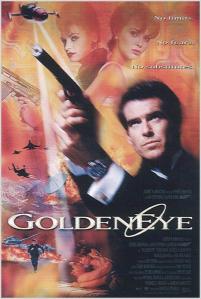 Brosnan does his best as Bond, and to be fair makes a good fist of the Roger Moore-ish style. He’s a gifted comic actor and obviously has the looks and the sense of style to seem like he belongs in a tuxedo with a fancy watch, driving a expensive car, smoking cigars and playing cards in high end casinos. The problem is that the script doesn’t really seem to know how to get the best out of him in any of the other elements of the character. He’s not really believable as the cold-blooded killer because he doesn’t really get the chance to be, the action scenes too short and not really fighty enough to get that sense across and the script preferring to lean more heavily on quick-witted quipping. Adding in the supposed psychological torment makes it worse because the script isn’t really equipped to properly deal with it and gives its star almost nothing to work with. Natalya prods at it clumsily, and Bean’s Trevelyan mercilessly digs at his adversary’s lack of ability to save all the women in his life but there’s never really any sense of ay of it landing because the character isn’t really a character so much as a collection of Bond-ish tics wrapped up in the handsome exterior of Brosnan and whatever suit he happens to be wearing.
Bean, for his part, struggles to make a mark because he’s not in half the movie. Having Trevelyan be a big reveal at roughly the halfway point works in terms of what the plot is trying to do, but the issue here is that because we only have that one flashback scene, laden with stiff upper lip-ish ‘banter’ to introduce us, it’s hard to buy into the angst James is supposed to feel at Trevelyan’s death, let alone the sense of betrayal at learning he’s alive. Consequently, Bean just does what any actor in his position would and chews the scenery for all he’s worth. The fact of his tragic family backstory also fails to land because there’s no sense of any hint he might be redeemable – he’s shown to have no issue forcing himself on women, he’s a murderer and a traitor and only really interested in enriching himself and damn the cost to anyone else. It’s a character and an actor that could have been something much more special in a better script. Here, it’s just disappointing.
 Other characters sort of float at the periphery of the story – Robbie Coltrane puts in his first showing as a Russian mobster who is an old acquaintance of Bond, Tcheky Karyo stands in for John Rhys-Davies’ General Pushkin as Defence Minister Mishkin who is definitely in this film and Gottfried John gets the thankless job of being General Ourumov, a Russian General with so many inconsistencies and Russian tropes as to be impossible to do anything with. Drinking habit? Check. Ruthlessly efficient? Also check. Misses obvious clues which undermine his whole plan? Also…wait a minute…
And so, having delayed enough, to the plot. Or rather, the series of contrivances which push the movie from one explosion to the next. It’s not that GoldenEye lacks a story (certainly it shouldn’t given the laundry list of writers whose hands it passed through on the way to the screen) but more that the story fees a bit tacked around the stunts, in a way that only the worst Bond movies can do.
Trevelyan’s motivations present issues as discussed already, as well as the fact he isn’t revealed until midway through the film. Not only that, but it’s never really clear why he has the help he does. We get no idea what Onatopp’s deal is – she was an ace pilot, she continues to wear Soviet uniforms (albeit stylised) yet she’s apparently happy to betray her country for… money? Trevelyan makes no mention of sharing his wealth. Ourumov too is an enigma – why is this dedicated General betraying his motherland? Why is he engaged in a plan with Trevelyan at all? How did he not know (because apparently everyone else in Russia does) that Trevelyan is a Liensk Cossack? Never mind all that, here comes another explosion.
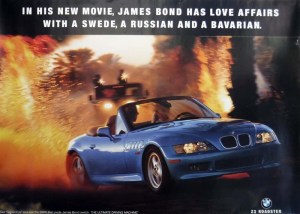 There’s a nineties action movie trope which for me peaked with the Christian Slater/John Travolta vehicle Broken Arrow, which involves characters running towards the camera (and sometimes jumping) as explosions happen behind them. GoldenEye sits firmly in this trend, and I don’t care how many jokes the script gives Natalya about how every vehicle Bond gets in ends up exploding, it doesn’t make it OK or distract from how silly it is.
And adding to the problem here is that as the budget was relatively low ($60 million), the FX do not stand up to modern scrutiny. For every genuinely jaw-dropping stunt like the opening bungie jump, there’s a cheap looking model shot which is clearly a model shot as a building explodes, or some poor CGI as the art was still in its comparative infancy. Bond films of old, often with questionable plots, lived and died on their set pieces, and while GoldenEye may have impressed at the time, on a modern TV in HD, it just fails to capture that same feeling.
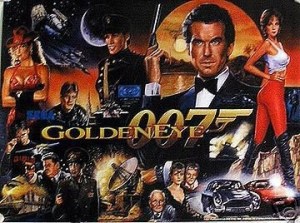 Musically, once again the score is a little nondescript (provided this time by Eric Serra). Parts of it lodge in the brain of any person of a certain age thanks to that N64 game that kept us all playing so hard back in the day but overall it’s another one you’d struggle to recall. Tina Turner’s performance of the opening song is as smoky and rich as you’d expect from the singer, but can’t help but feel a little understated and muted next to the Bassey et al anthems of yesteryear – a mood that would continue as the franchise went on into the 21st Century.
So is GoldenEye a bad Bond film? Yes and no. It certainly knows the audience it’s aiming for and it plays to them competently enough, making sure to get in all the standard tropes, but it comes against a script which meanders, a star who isn’t really able to transcend the material and visual FX which have failed to stand the test of years. GoldenEye has the occasional good idea, but it doesn’t do enough with any of them to really do itself justice.




 Sci-Fi Bulletin: Exploring the Universes of SF, Fantasy, Horror and Spy-fi!