 With Moore finally stepping down (though accounts vary as to whose decision it was) the studio needed a new Bond and the franchise needed a shot in the arm after a poorer than expected performance commercially and critically for A View To A Kill. After a lengthy saga which involved a future incumbent (which isn’t a tale for here) stage actor Timothy Dalton was selected to don the tuxedo. But, asks Greg D. Smith, could he and director John Glen restore the franchise to its previous heights?
I start with a caveat on this one. We are now into the ‘modern’ era of Bond (as I think of it) and from this point onwards these cross the line from ‘movies I saw as a child with varying degrees of recall’ to ‘things I have watched many times as an adult and know well.’ Moreover, The Living Daylights is and has always been one of my absolute favourite entries in the series, and Dalton one of the best incumbents of the role. That said, I will attempt to remain as objective on this one as I have the rest of the series.
Think of The Living Daylights and perhaps the first thing that comes to mind is that theme song. Norwegian pop band a-ha (one of the few non-British or American groups/singers to take on theme song duties for the franchise) produced one of the most enduring and catchy themes the franchise ever got (while also managing to annoy veteran series composer John Barry enough that he wouldn’t return to the franchise after this), selected over Chrissie Hynde’s Pretenders (who still get to do the closing theme and henchman Necros’ apparent favourite soundtrack to murder) after the commercial success of Duran Duran’s A View To A Kill had impressed the money men. The theme is catchy but also encapsulates the movie as a whole well. A relentless, thudding beat, a seriousness to its tone and lyrics which also suggests a slight air of whimsy. And it comes from that breathless opening sequence which lays out that here, we have a Bond quite unlike what came before.
 That sequence, impressively done with live action skydiving, immediately sets a grittier, more serious tone to the franchise than had been the case for chunks of Moore’s tenure in the role, while also demonstrating that it hadn’t quite lost its sense of humour. Killing off one of Bond’s fellow 00 agents so early on is quite the statement, leaving the audience wondering exactly which is 007 with Dalton being relatively unknown at the time, his first appearance, in a bruising pursuit and then landing on the yacht of a bored rich woman who he immediately charms, cementing exactly what to expect, and the pace of the film barely slows from then on.
Dalton’s Bond is quite unlike anything which has come before, and proves that the man was worth the substantial wait after screen tests in 1969 & 1971 when he turned the role down feeling himself too young.. One shudders to think what might have happened had some of the other choices taken this movie instead – at one point Mel Gibson was favoured by the studio – but thankfully, Broccoli finally got his man.
 And the man delivers. Dalton brings the role into the modern era with much apparent relish, ironically by focusing on the origins of the character. Having read the novels, Dalton sought to bring their tone to the screen. ‘I definitely wanted to recapture the essence and flavour of the books, and play it less flippantly’, he was heard to say, reiterating that Bond’s lifestyle of chain-smoking, hard drinking and womanising all related to the stress and danger of a job in which he could be killed at any moment. Dalton’s Bond is a harder feeling character than Moore’s, not lacking for charm (or heart) but able to switch off and do what is necessary as and when required.
The plot of the film, involving a crooked Russian General and his bogus defection to the West to try to ensure the murder of a rival so he can carry on making illicit arms deals with a Walter Mitty style military cosplay enthusiast, is fairly boilerplate Bond. There’s a sinister henchman, a flamboyant villain, some double-crossing, a pretty girl and so on. Nothing about it really sets it apart narratively from most of the Moore era, and that’s both good and bad. Tonally, it actually works because while Dalton plays the role a lot straighter than Moore, he never overdoes it or becomes po-faced. That commitment to ‘living on the edge’ that Dalton wanted to get into the role includes being able to crack a smile or a deadpan pun at any moment.
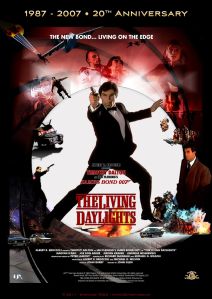 However, some of the holdovers from the earlier era, including convoluted villain plots and a main villain who somewhat disappoints, hold fast. Brad Whitaker is entertaining enough, but feels as if he should be a henchman or sub-villain. Jeroen Krabbe’s General Koskov feels much more like main villain material, not least because he comes across as far more ruthless, has more screen time, and Krabbe basically fills the screen in every scene he’s in, having the time of his life as the slightly camp and deliciously duplicitous General. Whitaker, by comparison, comes across as a genial idiot – he’s an eccentric who collects toy soldiers and military artefacts and fancies himself a General despite having been kicked out of West Point. Joe Don Baker (who like Charles Gray would return later as a different character) does his best with what he has, but what he has is fatally undermined from the off by the narrative itself.
In terms of its treatment of women, while The Living Daylights could hardly be accused of being progressive, it certainly feels like things are starting to move in a better direction. Yes, we have the opening sequence suggesting he randomly beds a woman on whose yacht he unceremoniously lands, but aside from that and some gentle flirtation with Moneypenny (re-cast to the younger Caroline Bliss) Bond only gets the one girl in this film, and genuinely goes out of his way to protect her. The old trope of a Bond girl falling in love with our man and immediately getting herself killed is, thankfully, ditched here, and Maryam D’Abo’s Kara provides a refreshing change from the standard template of Bond Girl.
 Neither kickass assassin nor screaming damsel, Kara is a woman in over her head but with courage and inner steel to spare. Her first appearance, as a phony assassin shot at by Bond, is misleading. Bond quips to his colleague that she must have had ‘the living daylights scared out of her’ but in fact we go on to see that Kara is actually brave. When she’s picked up by the secret police for what we infer is a non-too-gentle interrogation, she doesn’t give up what she knows. When Bond poses as a friend of Koskov, her boyfriend who has got her into all this mess, she goes along with it not because she instantly wants to hop into bed with Bond, but because she wants to get back to her ‘true’ love. Even when she makes the decision to switch sides and help Bond, it’s her decision, not done because she’s been charmed/terrified into it but because she’s seen the truth. Never once does she utter a terrified scream or a quippy punchline, and though she often gets herself into situations beyond her, she always finds a way to cope. She may well be one of my favourite female leads in the franchise.
 As for Bond’s colleagues, Desmond Llewellyn returns once again as the beloved Q though his reliance on cue cards to spout all the techno babble is becoming more pronounced. Thomas Wheatley does an admirable turn as Saunders, a by-the-book MI6 operative who disapproves of Bond’s methods and is especially annoyed with Bond’s refusal to shoot Kara early on. What’s nice here is that what could have been a cliché – Bond simply taking the piss from his straight-laced colleague who remains either oblivious as in Never Say Never Again with Rowan Atkinson’s Nigel Small-Fawcett, or eternally annoyed as various of his superiors and allies have been – is avoided. There’s a genuine development of mutual professional respect between the two, as Saunders learns to appreciate that Bond doesn’t break rules merely for the sake of it and Bond comes to realise that Saunders is a capable agent rather than just a dull bureaucrat. When Saunders is killed, Dalton shines, his face conveying emotions that a thousand lines of dialogue could not, and his mistaken chase of what he believes to be the culprit and ill-tempered rebukes of Kara feel on point. Dalton conveys the tightly wound nature of the character well throughout, and never more so than in this sequence.
As for that culprit, the Koskov h enchman Necros, here we have more refreshing news. Not for this iteration of Bond the standard deadly sub-villain who inexplicably becomes an idiot when confronted with our hero. Necros is capable and vicious, as demonstrated by his early appearance in the film murdering a milkman and infiltrating an MI6 safehouse to extract the ‘defected’ Koskov. He also murders Saunders and is on the verge of killing General Pushkin, Koskov’s nemesis and the supposed villain of the piece, before Bond ‘beats him to the punch’. Even his eventual defeat and death at the hands of Bond is almost as reliant on sheer dumb luck on Bond’s part as actual skill, as the two find themselves fairly evenly matched in an extended fight sequence hanging from a cargo net flapping behind a cargo plane in mid-air.
Speaking of Pushkin, John Rhys-Davies turns in a wonderful performance as the Soviet General who is supposedly the mastermind behind a plan to murder spies. Dalton and he play well off one another in the scenes they share, Bond confronting Pushkin and apparently ready to kill him before they strike a pragmatic alliance. The twist with Pushkin, tied in so closely with Koskov’s deception, is one that works exceptionally well the first time one sees the movie, and is still satisfying to watch on subsequent viewings. Pushkin, like this iteration of Bond, is a practical man, capable of violence and brutality when he deems it necessary and equally capable of kindness and humour when it isn’t. He’s a welcome addition and a worthy successor to the General Gogol role, health issues meaning Walter Gotell was unable to take a major role in the movie.
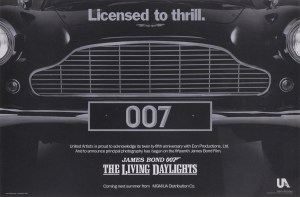
Gadgets wise, we get a nice mixture. Bond’s car, an Aston Martin V8 Vantage, may lack the classic lines of the DB5, but packs a nice amount of punch, revealed in a chase sequence which exhibits rockets, a jet booster and even skis. It’s a shame it ends up destroyed, but I guess some traditions are hard for the franchise to shake, though it would of course eventually reappear in 2021’s No Time To Die, to which we are, slowly but surely, on the road. The only other gadget of real note is the keyring with knockout gas and plastic explosive, both of which prove useful, with the thing keyed to Bond by having it activate on a wolf whistle. I suppose a case could also be made for the gadgets including the pipeline down which Koskov is evacuated in the early parts of the movie, and certainly it’s an impressive setup and balanced nicely between believable and fantastic. Other than that, the equipment Bond puts to use is reassuringly normal – a sniper rifle, explosives and of course, his trusty Walther.
 On the villain side, you have the exploding milk bottles, diamonds hidden as ‘ice’ around what’s supposedly a human heart and Necros’ headphones, whose cable doubles nicely for him as a garotte. Brad Whitaker gets to play with a machine gun that has a fibreglass ‘shield’ bolted to it – in one of the movie’s few low points Bond empties his gun at the shield instead of shooting Whitaker, well, anywhere else – and that about wraps it up. The plot being confined to diamonds, drugs and arms dealing means we don’t have any volcanic lairs, moonbases or undersea fortresses to deal with.
It all adds to the feeling that, in spite of its more fantastical elements, it’s more of a grounding of the character. Tales of dumped sequences including a magic carpet scene only lend to this impression. It isn’t deadly serious but it also isn’t anywhere near the camp heights of earlier entries in the series. Even Art Malik’s turn as Kamran Shah, a leader of the Afghan Mujahadeen, is pulled off with more sensitivity than anyone who’d followed the franchise to that point might expect. It’s not perfect, and if anything it feels like we could have more of the character, but it also doesn’t devolve into racist stereotyping – if anything it pokes fun at this with Kamran’s early performance to his Russian captors as a simple idiot quickly giving way to the sophistication of an experienced operative when it needs to.
In conclusion, The Living Daylights is perhaps one of the strongest entries in Bond screen canon. Dalton effortlessly balances the darker aspects of the character with a touch of heart and humour in ways that the previous incumbents had never quite managed. John Glen turns in perhaps his single best directorial performance, with a screenplay that feels as vital and fresh and energetic now as it did thirty-five years ago, and the visual effects stand up in a way that they just don’t in anything that came before. For me, Dalton is perhaps the strongest all round performer to don the famous tux, and this movie is one half of the reason why.




 Sci-Fi Bulletin: Exploring the Universes of SF, Fantasy, Horror and Spy-fi!