007: Feature: Shaken, not stirred – The Road to No Time to Die Part 14: Octopussy (1983)
With star Roger Moore starting to feel his age and wanting to retire from the role, and a rival studio having enticed Sean Connery back to play the role in […]



With star Roger Moore starting to feel his age and wanting to retire from the role, and a rival studio having enticed Sean Connery back to play the role in […]
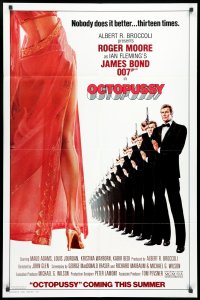 With star Roger Moore starting to feel his age and wanting to retire from the role, and a rival studio having enticed Sean Connery back to play the role in a Thunderball remake, the odds could scarcely have been stacked more against the studio for Octopussy. Having persuaded Moore to stay on, and with John Barry back on scoring duties, could they produce the goods and prove that the only real Bond was their Bond, wonders Greg D Smith?
It’s no real secret that a lot was riding on Octopussy. Kevin McClory had finally not only got his Thunderball remake Never Say Never Again (which we will cover soon) greenlit and up and running, but had managed also to tempt back original Bond actor Sean Connery to take the title role. Having struggled enough to maintain the continuity of the franchise when changing actor themselves, Eon must have been somewhat concerned to be suddenly up against the man who had originated the role for them, and who for many was Bond. So, having re-grounded the character with the excellent, gritty and focused For Your Eyes Only, they’d definitely look to build on that and make something really special that would retain the pre-eminence of their version of the character against the other effort set to come out at almost the same time, right? Right?
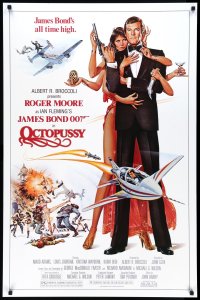 Well, no. It gives me no pleasure to say it, but by god is this movie an absolute mess, and one which I can’t help but feel, watching from the detached perspective of nearly 40 years later, wasn’t really trying all that hard at all.
And the thing is, the basic roots are there for something much better. Once again, we don’t have some weird recluse super genius with an over-elaborate plan to boil the oceans or turn the world’s population into fish or whatever – just a rogue Russian General wanting to cause a nuclear incident that will drive nuclear disarmament among the Western nations and leave them vulnerable to invasion from Mother Russia. Even the way in which he’s driving towards this goal, funding his activities via the smuggling of real art treasures and the sale of clever forgeries of the same, feels grounded in a way that the activities of other Bond villains have not.
 There’s also the setup of the title character and her network of smugglers, based on an old network and, while a little fanciful, still sounding broadly grounded. Octopussy runs a network of women, saved from lives of poverty or worse and raised to be master smugglers, thieves and even assassins. She’s very much in the mould of For Your Eyes Only’s Columbo or On Her Majesty’s Secret Service’s Draco – a character who’s into criminal enterprises but not the ‘real’ baddie – one with principles and morals (and importantly, lines they won’t cross), the sort of morally grey character with whom Bond can co-operate, because of the morally grey world which he himself inhabits. That the movie even takes the time to forge a link between the two (Bond having given Octopussy’s father the option of an ‘honourable’ suicide when sent to arrest him for treason) makes this work even better.
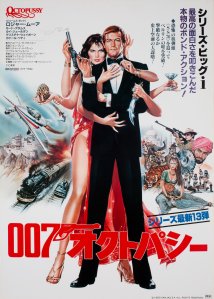 But then, there’s the other side of things.
Clown outfits, a Gorilla costume, a Tarzan yell from Bond as he swings on a rope, a bit of stunt casting for the ‘comedy’ sidekick and a crocodile disguise. These are just some of the more outlandish, silly aspects which all serve to work hard against the more gritty elements of the narrative itself.
There’s also how many knots the movie ties itself in as it can’t quite seem to settle on who exactly is the ‘main’ Bad Guy. Steven Berkoff’s General Orlov, an old school hardliner out of step with the thawing nature of the Cold War (slightly exaggerated here for fictional effect from where it actually was at the time) is ostensibly the Big Bad. It is he who has the plan to detonate a nuclear device at an American Airbase in Germany, killing thousands. It is he who wants the ability to invade the European continent unopposed at the head of a glorious Russian army. And yet, the movie spends relatively little time with him, preferring instead to focus on Khamal Khan, the exiled Afghan Prince with whom he has been working on the smuggling project.
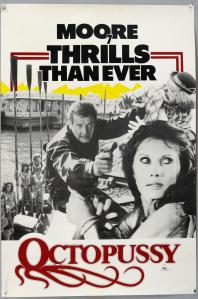 Khan, played here by Louis Jordan, is a slightly odd character by the standard of Bond villains. Somewhat of an eccentric man of wealth, he lacks the intimidating qualities of a Blofeld or Kristatos, the charisma of a Kananga or even the over the top theatricality of a Goldfinger. Instead, he feels like a rather muted, second rate robber, only really interested in money. His sidekick Gobinda, a large, powerfully built man with very little to say, reminds one of a sort of off-brand Jaws, Kabir Bedi having neither the sheer physical stature or uniqueness of appearance of Richard Kiel, nor anything really in the script to help make his character interesting.
The oddness this creates in the film’s narrative is, I suspect a lot of the issue I had with it. The ostensible ‘threat’ is the nuclear one, coupled to a potential power struggle within the Soviet government. But the smuggling, art reproduction and Khan’s own vanity are much more the focus of the movie’s run time, even towards the end when there’s a literal nuclear bomb to defuse before it causes an international incident. The focus is very much more on Khan and his ‘betrayal’ of Octopussy and her people (save the bizarre knife-throwing twins who are part of Octopussy’s circus but have apparently no loyalty toward her). Ourov ends up shot down like a stray dog by border police, apparently under the impression he’s trying to defect. Khan, by contrast, gets to be part of the big end of movie action sequence, ending up dying a fiery death in a plane crash once his minion Gobinda has been dispatched by Bond.
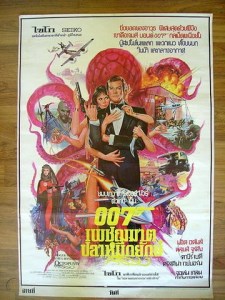 Narrative tensions aside, there’s so much more that really can’t be escaped about the film, not the least of which is the visibly older Moore. Though his charm and screen presence never diminished, even well into his eighties, it’s undeniable that the creaks are starting to show here. Several stunt shots are very clearly a stuntman rather than Moore, and when Moore is required to participate in a bit of on screen action, a fisticuffs or similar, the lag to his movements and the slight unsteadiness on the feet cannot be hidden. Possibly, these are things which showed up less on the cinema screen or VHS and televisual transmission, but on Blu Ray, the films warts are all up there very prominently and clear to see.
I’ve mentioned the stunt casting of Vijay Armitraj, but it bears repeating. The popular tennis pro, who had been cast after Cubby Broccoli met him at Wimbledon, is a charismatic enough presence, but his character is so thinly sketched (to say nothing of hugely stereotypical) that it’s difficult to take him seriously. And that’s without considering the fourth wall-breaking elements of him playing the Bond theme on his flute when Bond first meets him disguised as a snake charmer, or his use of an actual tennis racket as a weapon against some henchmen. That he meets his end offscreen just contributes to the feeling that Armitraj is a token inclusion here, a guy the producer liked and wanted a part written for, and nobody really made much effort with it.
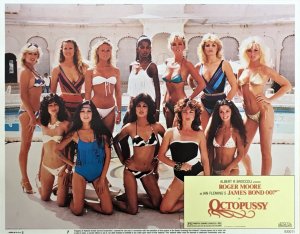 There are signs of positivity, not least in female representation – Octopussy herself, while rather being a sort of third stringer in her own movie, is a successful, powerful woman at the head of an organisation and this is never treated either by the script or the characters as anything unusual. Her lieutenant Magda, who you’d swear is going to die (because she’s a non-main Bond Girl who sleeps with Bond and that’s the formula) actually survives the length of the movie and turns out to be a much richer character than the viewer might initially expect. On the other hand, we also get introduced to Moneypenny’s new assistant, who seems to have been included mainly because Lois Maxwell was starting to also get a little older and we can’t have the secretary who flirts with Our Hero ageing now, can we? And Octopussy inevitably ends up having to be rescued by Bond in the third act because some narrative conventions are too powerful to be overcome by a mere Bond film, though at least the boat she ends up canoodling with Bond on as the credits roll is her own floating palace so…yay feminism?
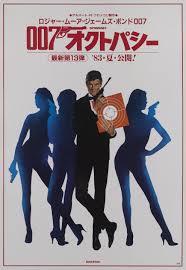 It does also – among the nonsensical plot and baffling decisions – have the odd decent set piece. The early sequence involving a small home-made jet is really rather impressive, especially the part where it gets flown through a hangar, achieved by the sort of analogue technical wizardry which would be rendered unnecessary in the modern age and looks far better than certain other sequences later in the franchise which would be rendered digitally (but we’ll get to that). The train stunt sequence, which infamously resulted in stunt co-ordinator Martin Grace fracturing his leg, is also well done and breathless to watch, though the plane sequence at the end is rather dated and again HD shows up Gobinda’s obvious parachute beneath his suit as he falls from the plane.
All told, it feels rather more like an odd halfway house between one of the better Bond movies and an Austin Powers-esque parody, flipping tones, barely paying attention to narrative consistency and having its focus wander from scene to scene. Somewhere in there, there may well be a decent Bond film, but on this viewing, I couldn’t find it.
 Doctor Who News Star Trek News
 Sci-Fi Bulletin: Exploring the Universes of SF, Fantasy, Horror and Spy-fi!