Interview: David Gilman (2022)
David Gilman’s new novel Betrayal features the return of his hero Dan Raglan, who debuted in The Englishman. Betrayal sees Raglan travelling to America and fighting in both urban and […]



David Gilman’s new novel Betrayal features the return of his hero Dan Raglan, who debuted in The Englishman. Betrayal sees Raglan travelling to America and fighting in both urban and […]
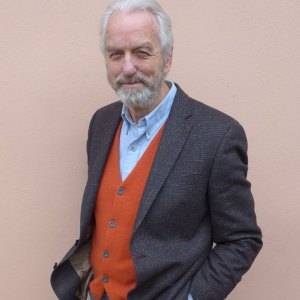
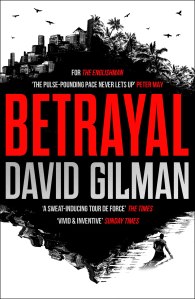 David Gilman’s new novel Betrayal features the return of his hero Dan Raglan, who debuted in The Englishman. Betrayal sees Raglan travelling to America and fighting in both urban and tropical jungles. Gilman chatted with Paul Simpson about Raglan’s latest exploits – and the true life incidents that inspired part of it.
The first two Raglan books have been set against very different backgrounds. Will the third book take him to completely new territory?
Yes, I think it will because for me, the locations are as important as the characters. I’ve actually got to get you, the reader, to be there in that location, with Raglan, my character. To me, it’s a totally immersive state.
I go to probably 98% of the locations where I can get to. If you remember in the first book, in The Englishman, he ended up in a penal colony in Russia which I think was interesting for me. I didn’t go there by the way…
(laughs) I assumed that was in the 2% you didn’t.
That was in the 2%, but I was very fortunate because a couple of years ago I came across an amazing Italian documentary that went inside and that really opened it up for me. And then, of course, my subsequent reading made a very strong core for the end of that book. Then with the second book we went to a totally different place and again, I did travel through that whole area.
Frankly, when I write a book, I have no idea what the story’s going to be about. It was only when I got this special invite, a personal invite, to go and do a tour round the Pentagon, that actually triggered quite a lot.
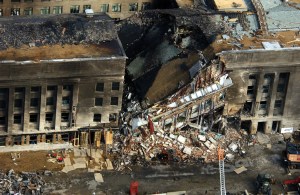 One of the facts that really shot out at me when I researched the 9/11 attacks a few years back was just how much worse that could have been.
Yes, it was really quite profound. When I got to the Pentagon, I didn’t know who my host was going to be initially and it turned out he was a retired US Marine corps lieutenant colonel. The private tour was down all the back corridors and what have you, and we reached a corridor. We stood there and he said, “This is where the tail section ended up.” He explained to me how they’d just completed all the renovations on that west wall. 125 people died in the Pentagon, it could have been thousands.
Before you went there had you got an idea what the general nature of the plot you were going to throw Raglan into? Or did things just resonate and there was a sort of domino effect from there?
 Just taking a step back… One of the premises of Dan Raglan is that he’s a former French Foreign Legionnaire. There’s about 140 nationalities serve with the Legion and very few Brits so I thought that was quite a nice idea. But also, they don’t swear allegiance to France, they swear allegiance to the Legion: that’s where their allegiance lies. That’s why they say the Legion is their family.
So it’s always a very good link, for me as an author now, that he would always respond to a call for help from a former legionnaire or someone who knows somebody.
When I got to the Pentagon I hadn’t even written the first [book in the series] but I did know with The Englishman where I was going. So I couldn’t bring the Pentagon forward [into that plot], I knew I had to wait.
So, then I said “Well, hang on, why is Raglan in the Pentagon?” He’s been called by somebody’s wife via the system of getting to Raglan – you don’t just pick up the phone – and it’s a former legionnaire working in the Pentagon.
I discovered there was always a presence of the Defence Intelligence Agency at the Pentagon. They normally have their quarters further up the Potomac, but there’s always a presence because the Defence Intelligence Agency has a subsection called the Defence Clandestine Service. I thought, “OK, this is really where my man who’s gone missing was working. Why has he gone missing? Is he the bad guy? Is he the good guy? What will Raglan find out?” And that’s what triggered that story.
And the drugs connection to it all: you can’t really be round the underbelly of any major American city without coming into contact with that.
It didn’t immediately jump out as the main plot but of course what happened, as you say being in a city like Washington DC, the links started to open up. Once we started Raglan investigating and getting the links to his guy, the picture broadened and then in its own way it narrowed down as to what this man had discovered. What was the link to the drug trade?
It’s not just about the drug trade, but it was all these elements that came together that allowed Raglan to move forward in the investigation.
What about researching the jungle part that features in the last part of the book?
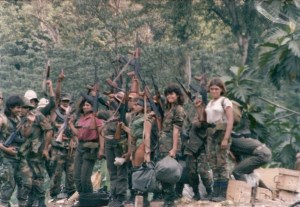 I had experience of being in the jungle and I had also visited that area. So I could feel it and smell it and taste it.
Bizarrely I discovered it was the area where they had been training the Iran-Contra guerrillas back in the Reagan era. I thought, “Oh that works quite well.” It’s a footnote in history if you like but it allowed Raglan to be in a similar environment. There were old training camps in the jungle and Raglan gravitates towards that for the denouement of the novel.
You also bring in a… I hesitate to call her a femme fatale…
I know who you mean. I wanted somebody different and I have always tried to create strong female characters even in this type of genre that we’re discussing. Even in my mediaeval series I try and have a strong female character because I have a lot of women readers and I think there has to be that link. It has to be genuine, they have to feel “Oh, that’s a good association”.
In this novel we have a slightly flawed female character who’s actually chasing her own redemption – an FBI agent – and also a second, as you say, femme fatale and she was actually based on historical fact. Such a person was trained in the country that is established in the book.
One of the things I like about Raglan in both The Englishman and Betrayal is that he will go so far and only as far as the mission requires.
 Quite right.
If he has to kill, he will kill. If he has to torture, he will torture, whereas this female character almost seems to find reasons to behave in an inhuman way.
But also, if you think about it, even the femme fatale, given her background, her motivation for coming over to the side that she did was sound, in my mind. She had her own hinterland, very much like Raglan has his own inner resources.
Every character has to have a reason for what they do, even the most evil ones. So I hope I gave her a good reason back then, to do what she was doing now, even though it was unforgivable as far as we’re concerned.
You were very consciously putting a splash of red into the shades of grey, so to speak.
Yes, and considering what she had done to those around Raglan then [her fate] had to be what it had to be, at the end of the day.
In terms of the future for Raglan, we’ve seen him in the ice, we’ve seen him in the jungle – are we going to see him in the desert which is what we most associate with the Legion?
Don’t forget the first book actually started in Mali. That’s where the Legion was fighting – and still is by the way.
It doesn’t always have to be the direct link of course, the fact that he has experience around the world. If you read anything at all about the Legion, they’ve been in some of the foulest places going, so that helps my character as well,
If you want a bit of teaser about the third book – which is a long way away from being published, don’t forget – I can tell you now it starts in London, then it goes to France, then it goes to South Sudan, then it goes to Moscow.
 The world that Raglan lives in, is that going to be a post Covid world?
Well, even when I was writing the book I was slotting him in in-between the periods when you could actually travel. I obviously didn’t make a point of that; it’s just there if anybody asked.
Frankly, I want to tell you a story. I want to engage you. Whether you, in your mind, want to think “Wouldn’t that have been the Covid period?”, that’s up to you. I just want to tell you a story and let you get on with it, and hoping that you are as immersed as a reader, as I am as an author.
Betrayal is out now from Head of Zeus. Thanks to Sophie Ransom for her help in arranging this interview, which has been edited for clarity and length.
 Doctor Who News Star Trek News
 Sci-Fi Bulletin: Exploring the Universes of SF, Fantasy, Horror and Spy-fi!