Alex Rider: Interview: Anthony Horowitz
Anthony Horowitz is the author of thirteen Alex Rider novels, as well as two stories featuring Ian Fleming’s James Bond OO7, a pair of Sherlock Holmes tales, and much more. […]



Anthony Horowitz is the author of thirteen Alex Rider novels, as well as two stories featuring Ian Fleming’s James Bond OO7, a pair of Sherlock Holmes tales, and much more. […]
 Anthony Horowitz is the author of thirteen Alex Rider novels, as well as two stories featuring Ian Fleming’s James Bond OO7, a pair of Sherlock Holmes tales, and much more. His new novel, Moonflower Murders, has just been published, and to mark the occasion, he chatted with Paul Simpson about the spy world, and stepping back to the 1950s…
Let’s start with the most current thing as we’re talking, which is the Alex Rider series. I noticed that on your website, you list the things you’ve done. They’re not in alphabetical order, or chronological order; they begin with Alex Rider. Is he the character and series you’re most proud of writing?
 First of all the choice of order on the website is not mine, someone else does it, and until this moment I hadn’t even noticed it, but if I was doing it, would I put Alex first? No, I would probably go chronological. Am I most proud of Alex? Yes, probably.
In 2000 I came up with Stormbreaker and that book literally changed my life. It made all the difference in the world to me, to my career, to my name and all the rest of it. And of all the work I’ve done, apart perhaps from Foyle’s War which consumed 16 years of my life, Alex Rider has probably taken the largest slice. I’ve written 13 books over a period of 20 years and two generations have grown up with Alex Rider – that’s how old I’ve become.
 So if I say it’s the thing I’m most proud of, I wouldn’t say they’re necessarily the best books I’ve written, but I think the impact that those books have had on a whole generation, maybe even two generations of readers, is something which I see regularly every day. That’s not a boast; I meet people who read me when they were eight and nine years old and there’s something rather wonderful about knowing that I have been inside people’s lives, in a tiny way but nonetheless, part of their lives for so long.
When I was writing kids books, it wasn’t because of a great belief in literacy and the importance of reading and the need to get young people reading, but over the years I’ve come to recognise all those things and I also recognise that inadvertently Alex Rider has had an impact on young people who might not have read but then discovered the books.
So when you ask me, am I proud of them? It’s for that reason.
With Alex, you told the story of a year over eleven books?
The books actually last approximately fifteen-sixteen months now. He goes from fourteen pretty much exactly in the first book to fifteen three months in Nightshade.
Does that present specific challenges in trying to keep his maturity the same? Obviously there’s chronological things to keep track of but actually Alex’s maturity. It’s almost like he’s having a bit of a breakdown and you’re charting that. Was that something you had to plot out across the books or that you had in mind as you went along?
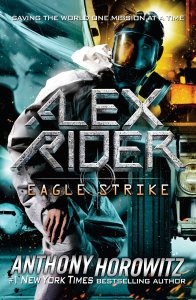 I think I was four books in, Eagle Strike, when I began to realise that this was actually going to be something of a phenomenon, it was going to continue throughout my life. Stormbreaker, Point Blanc and Skeleton Key had all done well, they had sold, each set of books sold double the ones before so it was on a roll.
In Eagle Strike I started to weave in background and thinking more about his past – his father, his uncle, his relationship with Yassen Gregorvich, all those sorts of things. I began to also get more into his psychology as a character, and actually at the end of Skeleton Key when he sees Sarov kill himself, that’s one of the very first moments when you realise this isn’t a game. He isn’t just a hero, he’s a kid and he’s being traumatised by all this. A man has shot himself in front of him. Added to which the Skeleton Key story is a pretty perturbing one: when the villain of the piece wishes to adopt the hero, you realise you’ve got something very Oedipal and strange going on.
So from the end of Skeleton Key into Eagle Strike then into Scorpia – where Alex briefly embraces the dark side as it were – I began to realise there was a sort of a dynastic feel to the books which I had to keep exploring. So, Snakehead sees Ash come in, also reveals how his parents got killed.
I didn’t plan it, I never sat down with a chart and said, “This is where he was, this is where he’s going to be”, but with each book further possibilities opened up to me and they became richer and I think better because of it.
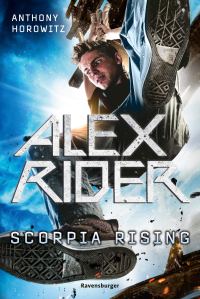 They become more serious and I was going to give up the whole series after Scorpia Rising. That and Russian Roulette were meant to be the last two in the whole series. By the end of Scorpia Rising I realised that Alex had become so damaged and so withdrawn.
It’s an interesting thing: if you read that book carefully, for the last seventy or eighty pages, you never ever get told what he’s thinking. His mind has gone completely blank, there’s no introversion at all. It’s all just “he does this”, “he does that”, he barely speaks. He is destroyed by what’s happened to him all around. And yes he goes to America and it looks as if he’s going to be adopted by another family and maybe he’ll be happy.
But the reason I came back to the books with Never Say Die five years later was because I realised I’d done Alex a disservice. I had left him in a dark place and he was too unhappy. I had to bring him back and give him back his mojo, so the next book Never Say Die is Alex cheerful again. And even bringing back dead characters to help his healing process had to be done and I’m glad I did it.
Never Say Die is a really cheerful book. I loved writing it and it really did bring Alex back to his old self again. But I’m more proud of Nightshade which is the most recent one published in April, which I think is just the best adventure of the whole lot. Certainly the action sequence at the end of Nightshade – you’ll see that this is a stunt that they should have thought up for the Bond films and never did.
 Which sort of leads neatly into asking: did writing Bond himself alter how you wrote Alex? How did they fit together?
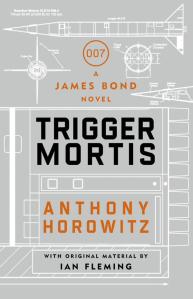
It’s a good question. I think I wrote Trigger Mortis and then I wrote Never Say Die and then I wrote Forever and a Day.
But the answer to your question is that I’m very careful to compartmentalise. When I created Alex, as I’m sure you’re very well aware, James Bond was the first and main inspiration, and at that time I worked hard to make sure that I wasn’t doing a Bond rip-off, that I wasn’t doing Fleming and my love of Bond a disservice.
I’ve made all sorts of conscious decisions to stop Alex being like Bond, and when I came to write Bond I had to completely distance myself from Alex. I realised that this is a very different world and different impetus to make those books work.
 Trigger Mortis and Forever and a Day are the two Bond continuation novels that, along with Kingsley Amis’s, I really think actually capture what Fleming was doing. Not just the plotting but the world view that he had.
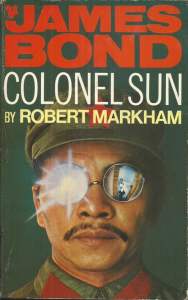
That’s very kind of you. First of all I appreciate obviously your very kind words about my books but what I particularly like is you put me up there with [Robert] Markham [the pen name that Kingsley Amis used for Colonel Sun]. I’ve read all the continuation novels and for me, the best one, by far the writer who really understood Fleming – and of course, he knew Fleming and was, they say, responsible for The Man with the Golden Gun – was Kingsley Amis. Have you read The Bond Dossier? You must have, of course.
Yes, I read that as a boy.
That’s a book I particularly like too and which I used a lot. So, anyway you’ve got good taste if you like Markham because I think he really was the best. I think there’s a torture scene at the end of Colonel Sun that lets it down a bit. Fleming wouldn’t have done that, I don’t think he’d have gone quite so harsh.
 Well, I suppose Amis was trying to go back to Casino Royale wasn’t he?
That can’t be beaten. Yes, I guess so. It’s a combination of the prostitute who comes to sexually arouse him while he’s close to death and the very bloodiest of the skewer into the ear. I re-read it recently and thought, “Yeah, I’m not sure”. And it’s interesting that of all the continuation novels that’s the only scene that the filmmakers have chosen to pull out and use.
Is there another Bond coming? I was hoping that the three year cycle might continue into 2021.
I hope so. I would like to see my contribution to the Fleming canon as a trilogy and I can see very much the area that a third book might take place in. I have as it were, a plot in my head, no title but a plot, and a plot I think Fleming would have liked, which I know people like yourself will like. But an agreement is yet to be reached and a decision has yet to be made.
 You were talking on Twitter recently about Alistair MacLean and Desmond Bagley. What books did you read growing up? They’re ones that I still love and still reread occasionally. I’ve got all MacLean and the spin offs of varying quality.
It’s funny, I’d largely forgotten Bagley and MacLean, but I can tell you when they came back into my life.
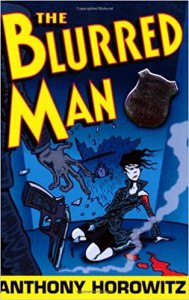
At the moment on the internet free each week, I’m posting a chapter of a Diamond Brothers book. The Diamond Brothers are my detective series, which are pastiches or take the mickey out of films that I loved. North by Northwest became South by South East; the first book is The Falcon’s Malteaser. Public Enemy Number Two is all of Jimmy Cagney, I used to adore Jimmy Cagney. The Blurred Man is based on my favourite film of all time.
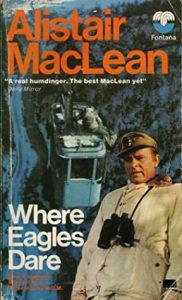 I was thinking, “Which film would I take for a new Brothers book?”, which I had to write very quickly because obviously it was for this [period of lockdown because of the COVID-19] virus and it was going to be unplanned. I was just going to write a chapter at a time and see where it went. Just into my head dropped one of my very favourite films as a young man, Where Eagles Dare and at the same moment a title came into my head, Where Seagulls Dare. That reminded me that I had loved Alistair MacLean in my teens and twenties, and Desmond Bagley too. These were two hugely important authors to me.
Unlike you I don’t have a single copy of their work in my house. I’m always nervous to go back to it. I wonder if I’ll still like it as much, all these years later, but I do remember their books and their ideas.
I think that what is missing right now in fiction generally are authors who do that job of appealing to young teens and to adults in equal measure. I can’t think of any, you might say Robert Harris.
Well, I’d put you in that category for Alex because I think the Rider books certainly do.
 Except that the Rider books are still about a fifteen year old. That’s the difference you see, because Alistair MacLean and Bagley were taking adult characters in an adult world but still somehow making them accessible for children. I mean, apart from anything else, if my memory serves there’s very little sex in those books; there’s nothing that will make the parents blush. There might be occasional scenes here and there.
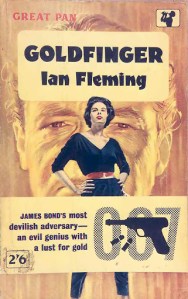
There is a tradition in British writing, which you might say begins with John Buchan which is the sort of gentleman adventurer, the schoolboy adventure, the boy scout adventurer even. Ian Fleming was very much part of that tradition and looked on the James Bond book as being very much children’s book’s dressed up as adult books. I recommend Goldfinger to young readers because, yes, there are a couple of paragraphs here and there that might make them blush but not much more than that. Bagley and MacLean and I suppose to a certain extent Nevil Shute and other writers like that, Hammond Innes, were all part of that tradition.
Would I place myself in that tradition? Yes I guess I would. I think that if you’re going to say what that tradition is about, it’s about pretty much black and white. It’s fairly simplistic in terms of its world view. Here are the good guys, here are the bad guys and you know when you get to the last chapter, who’s going to have won. They’re very fast paced but also, this is important, they’re very well written. These are good writers, they’re not writing rubbish.
There’s a storytelling power that MacLean and Bagley had.
 That’s exactly it, you put your finger on it – there are so few modern books that just have that, chapter by chapter. The cliffhanger, the surprise.
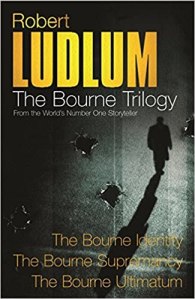
I’ll tell you another writer I used to love, again slightly after MacLean, when I was a bit older: Robert Ludlum. The original Ludlum books were ferociously complicated in a way but what I loved about them was you get to the end of chapter four and chapter five then destroys everything you believed was happening and chapter six does it again, in another direction. The good guy’s a bad guy and the bad guy’s a woman and it’s just a wonderful game. Like MacLean, his name was taken over and other writers as Robert Ludlum appeared but they were never as good.
It is difficult because the whole continuation market – Bond, Sherlock Holmes, Jeeves and Wooster, Jane Austen – is I think a curious hybrid and one which I have misgivings about even though I am guilty of four books in that world.
One of the biggest fears I have when I start doing a James Bond novel is people like yourself, because there’s something about those books that have a core audience who are more than loyal. They are knowledgeable, understand what is happening in those books and what makes them so great. I’m always so frightened that if you make a mistake, if you step out of line, if you make an assumption, if you try to be cleverer than Fleming, if you insert too much of your own persona, you are doing a terrible harm to people’s passions and dreams.
I think that’s the problem with the continuation market. I do Bond for one reason only: I love Bond, but I think people are tempted to come into these things because [the brand] has an added value because it’s going to sell lots of books etc and sometimes the result can be destructive.
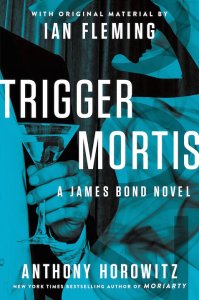 I think what works for me particularly about Trigger Mortis is that it feels like what happened off page between Goldfinger and Thunderball. As I was reading it, I was just thinking “Yes, I knew this story but I didn’t”. And that was why it worked.
Well, thank you for that. I will say this, Forever and a Day, although it is a sort of a prequel – that’s how it was advertised, as a prequel to Casino Royale – is still very much within Fleming’s timeline in the sense that nothing happens in the book that Fleming doesn’t mention himself. There isn’t, for example, a Charlie Higson-style bit about his life at Eton.
I like Charlie’s books and I think that next to Robert Markham he is probably the person who most understands Fleming’s style and viewpoint. There’s a wonderful sequence in one of the books about the human brain that Charlie wrote and when I read it I thought, this is thrilling.
It’s similar to the way that Fleming appeared to be a master at so many things – he could mention stuff casually and it felt like he knew far more than he was telling you…
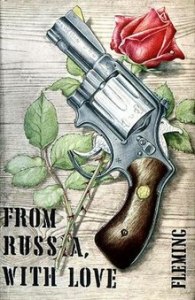 Except that it isn’t knowledge either. I’ve just recently reread From Russia, with Love and I’m actually astonished because I was researching Russia at that period and pretty much everything he wrote is untrue. Right down to the fact that SMERSH no longer existed at the time when it’s plotting to destroy British intelligence. Famously the headquarters of SMERSH which he painstakingly describes in the book, somebody went to Moscow to see it and it turns out it’s a florist.
What he’s got is an extraordinary ability to make you believe. You totally buy into it and that’s one of the hardest things for me to do because he of course had the advantage of living in that time. So he can reach out, he can see what’s on the billboard outside the office, he can actually see what’s being advertised, he can see what people are eating, what they’re traveling in. I have to sort of reach into the past and to start from scratch.
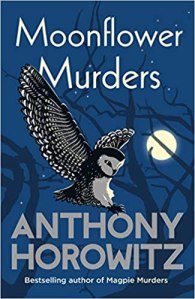 With Magpie Murders and Moonflower Murders you’re recreating the 1950s, albeit within the book within the book. Do you find it hard to put your “21st century head” down when you’re writing the period?
The short answer is no, I don’t find it a problem.
I was born in 1955 so it was to a certain extent somewhere inside my biological stream, there’s a faint awareness of what life was like. It’s not that difficult to imagine myself back and to remember the books I was reading at that time – obviously after the 50s and 60s but even so, earlier books. I don’t layer it on too thick; I don’t scour encyclopaedias or go over the internet to try and find the right brand of chocolate, and so drop in the fact that Atticus helps himself to a… what would it be? Numbers. That’s what we used to eat, the chocolate numbers.
That’s not what I do. It’s more a question of exclusion: by excluding the internet, by excluding mobile phones, by not having charter flights taking off for holiday resorts all over the world, it’s just zeroing in, and then it becomes quite easy to stick within a period. The countryside setting helps too. If the books were set in London more it would become more difficult because villages haven’t really changed.
In common with a number of authors I know you have said you like to challenge yourself with a new book. Is that the reason why you’ve only done two or more of some series?
 There are different things going on. I’ve done two Bonds because I was asked to do one which of course I wanted to do, and then the estate asked if I would do another.
I did two Holmes because having had such a big success with The House of Silk and having enjoyed writing that world so much, it seemed sensible to go back so I did Moriarty. I would like to do a third Holmes: I’m very keen on writing The Giant Rat of Sumatra.
Daniel Hawthorne: I was asked by my publisher to come up with a series because a series is sort of the holy grail now for publishing. If you get five, six, seven on the road then people will continue to come back to them and you can relax a bit, whereas if you write a single book, you have to reinvent yourself.
I’m planning to write ten of those. I’ve got the next four already in my head and then after that I have a solution to what the whole thing is about and why Hawthorne is such a terrible human being, which is interesting. I’m looking forward to writing that.
Alex continues, The Power of Five was five books and that was always conceived as a quintology,
 I have a lot of ideas and the ideas go somewhere but I don’t plan my career. Yes, with Hawthorne, it’s a bigger series and I think it’s about ten, but broadly speaking I write a book and see where it’s going to go and where it leads.
What are you currently working on?
I’m working on a TV adaptation of Magpie Murders which is hopefully going to be filmed next year and I’m thinking about the next Hawthorne, number three in the series, which will be the book I write next year.
The Moonflower Murders is out now from Century; click here to order from Amazon.co.uk
Alex Rider series 1 is available on Amazon Prime Video.
Thanks to Klara Zak and Kay Rahmani for their help in arranging this interview
 Doctor Who News Star Trek News
 Sci-Fi Bulletin: Exploring the Universes of SF, Fantasy, Horror and Spy-fi!